

October 5, 2026
What is a crypto payment gateway, and how does a business start taking payments through one?
Read article

A chargeback is when your customer's bank takes a card payment back from you: the customer complains to the bank instead of to you, and the bank pulls the money. For the merchant, that means the lost sale plus a fee, typically $20 to $100, and every case counts toward monthly limits that Visa and Mastercard watch. You can contest a chargeback with evidence, and you can get fewer of them: by taking part of your payments in crypto, which no bank can pull back, and by fixing the reasons customers go to their bank before they come to you.
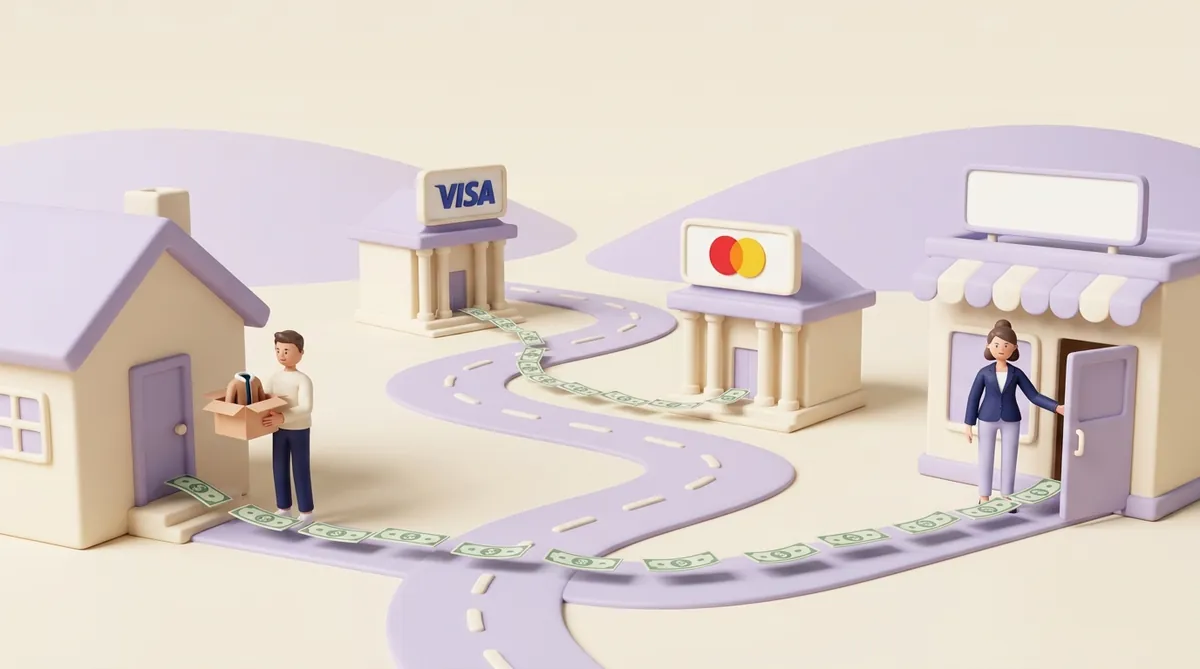
A card payment has four parties: the customer, the bank that issued the customer's card (the issuer), the bank or payment processor that accepted the payment for you (the acquirer), and you. A chargeback runs that chain backwards.
Here is what happens, step by step:
Say a customer buys a $120 jacket, it arrives, and three weeks later they tell their bank it never came. The $120 and the fee leave your balance that week, and the jacket stays with the customer while the case runs.
That is the main thing to understand about a chargeback: it is not a request. The bank acts first and asks you second.
The fee is the smallest part. A single chargeback hits you in five places:
The last one is the expensive one. Card networks measure every merchant's share of disputed payments each month. A merchant who crosses their line lands in a monitoring program, with extra fees per case and a plan to bring the numbers down.
The lines merchants hear about most, as of October 2026:
A small store rarely reaches those counts. Its processor still watches the same ratio, and the processor's own agreement decides what happens to the account long before Visa or Mastercard get involved.
A business whose ratio stays high, or whose industry is known for chargebacks, can end up needing a high-risk merchant account, with higher rates, a reserve held back from each payout and stricter review. If that is where you are heading, it is worth knowing why a business needs a high-risk merchant account and what changes once it accepts crypto.
Friendly fraud is a chargeback filed by the person who actually made the purchase. Nobody stole their card: they paid, received what they ordered, and then told their bank otherwise.
Typical starting points:
Friendly fraud is the hardest kind to fight. The customer really did pay, so your evidence has to show that they, not a thief, made the purchase and got what they paid for. With digital products this is harder still: there is no parcel to track, only login records and download logs.
Contesting a chargeback has a formal name, representment: you present the payment to the customer's bank again, this time with proof that it was valid. It goes through your processor, in this order:
Not every chargeback is worth the fight. For a $15 order, the work can cost more than the order. For a $500 order with tracking and a thank-you email from the customer, it usually is.
And if a customer writes to you before going to their bank, a refund is almost always the cheaper outcome. You lose the sale either way, but a refund carries no chargeback fee and does not count toward your ratio.
Most chargebacks have a cause you can reach before the customer calls their bank. These are the levers, starting with the one that takes the bank out of the picture:
No. A card payment is a pull: your processor takes the money from the customer's account through their bank, so the bank can pull it back. A crypto payment is a push: the customer sends coins from their own wallet, and once the blockchain confirms the transfer, nobody can reverse it. Not the customer, not a bank, not you.
Take the same jacket, paid with a 120 USDT invoice. Three weeks later the customer says it never came. There is no bank to take the money back, so they have to write to you, and you decide, with the tracking in front of you, whether to send anything back.
What disappears is the bank's lever, not the customer's complaint. A customer who did not get what they paid for still has ways to make it your problem. Crypto removes the forced reversal, not the need to deliver what you sold.
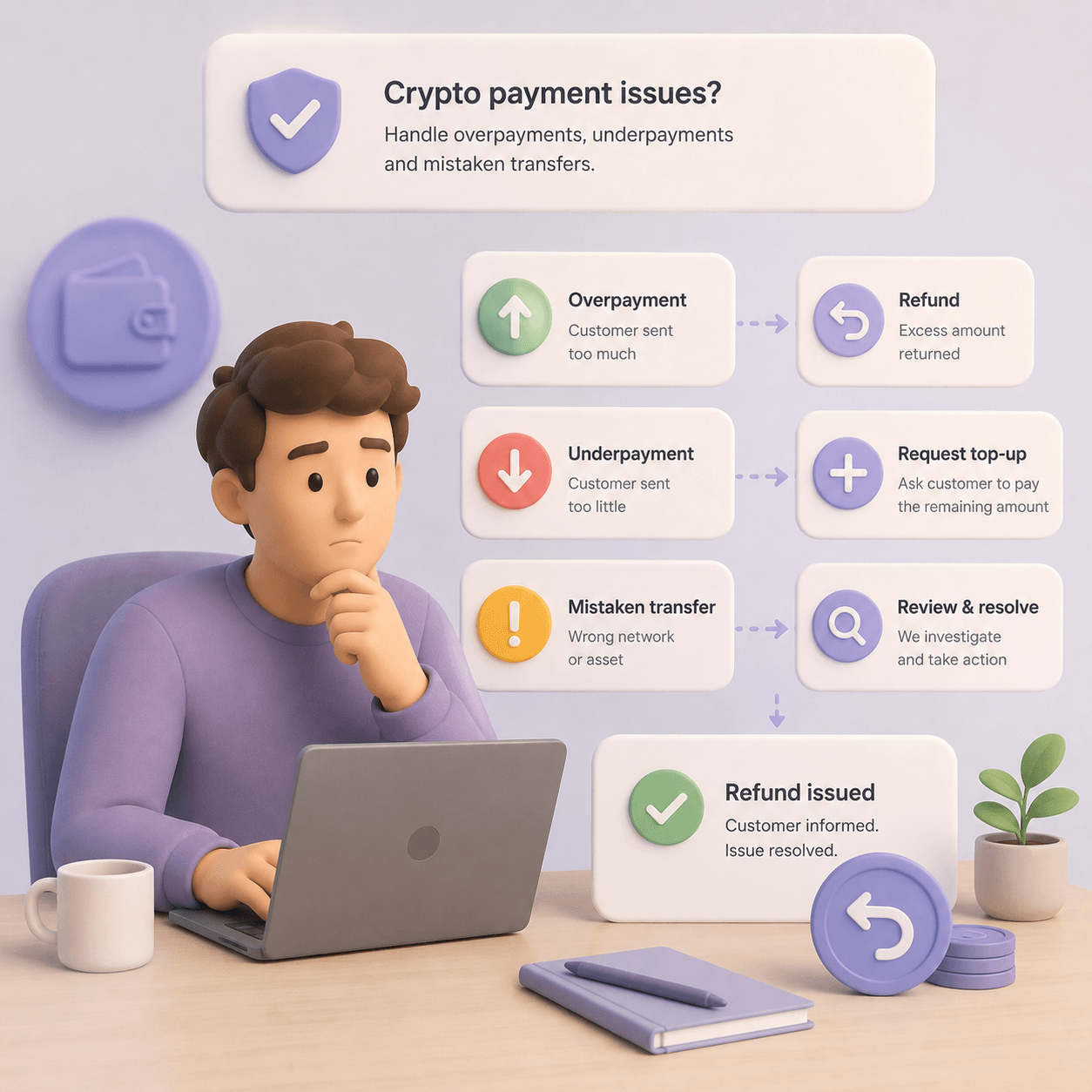
It also means every refund is now yours to make, and customers make mistakes in both directions: they pay 115 USDT instead of 120, or they pay the same invoice twice. Before you turn crypto on, decide how your business will handle crypto refunds, overpayments and mistaken transfers.

At CryptumPay, a payment that has gone through stays with the merchant. The service does not refund payments on its own: whether to give money back is the merchant's decision, and the merchant can return it with a payout from their own balance to the customer's address. The only thing the service returns itself is an overpayment, when the customer asks for it from the payment window.
Small mismatches are settled at checkout. In CryptumPay, the merchant sets a tolerance in percent, and anything within it confirms automatically. Beyond the tolerance, the payment window asks the customer to top up the payment, with up to two top-up attempts.
Many businesses that card processors file as high-risk, from travel and dating to online courses and stores with long delivery times, are among the segments CryptumPay works with. Whether a particular project is accepted is decided by the project review. The fee is 1% per successful payment, down to 0.5% at higher volumes, and the merchant receives USDT whatever coin the customer paid with. An online store can add crypto as a payment option on its own checkout page.
A chargeback is the customer's bank reversing a card payment without asking you. It costs the sale, the goods, a fee and, if it happens often, your processing account. You can win some of them back with evidence that answers the reason code, and you can prevent many more by removing the reasons customers go to their bank before they come to you. For the part of your sales paid in crypto, there is no chargeback at all: refunds are your decision.
Under Visa's dispute rules, as of October 2026, the usual window is 120 days from the date the transaction was processed. When the goods or service were due later, the 120 days run from the date the customer expected to receive them, but no further than 540 days from the transaction. That is why a pre-order or a trip booked months ahead can come back long after the sale.
A refund is your decision: you send the money back through your processor, usually after the customer asks you. A chargeback is the customer's bank taking the money back without your agreement. It adds a fee and counts toward your chargeback ratio, while a refund does neither.
You get the payment amount back, but the fee depends on your processor. Some return it when you win, and many keep it whatever the outcome. Check your processing agreement: that line tells you whether contesting small orders ever pays off.
They can dispute the card purchase with the exchange or app that sold them the crypto, under that company's card rules. The payment they then sent to you is a separate transfer on the blockchain, and a dispute with the exchange does not reverse it.
This article is not legal or financial advice.
Create an account and connect the checkout yourself, or talk to sales and we will plan the integration with you.