

.png)
May 10, 2026
How to Reduce Failed Crypto Payments: Networks, Gas Fees, Amount Errors, and Checkout UX
Read article
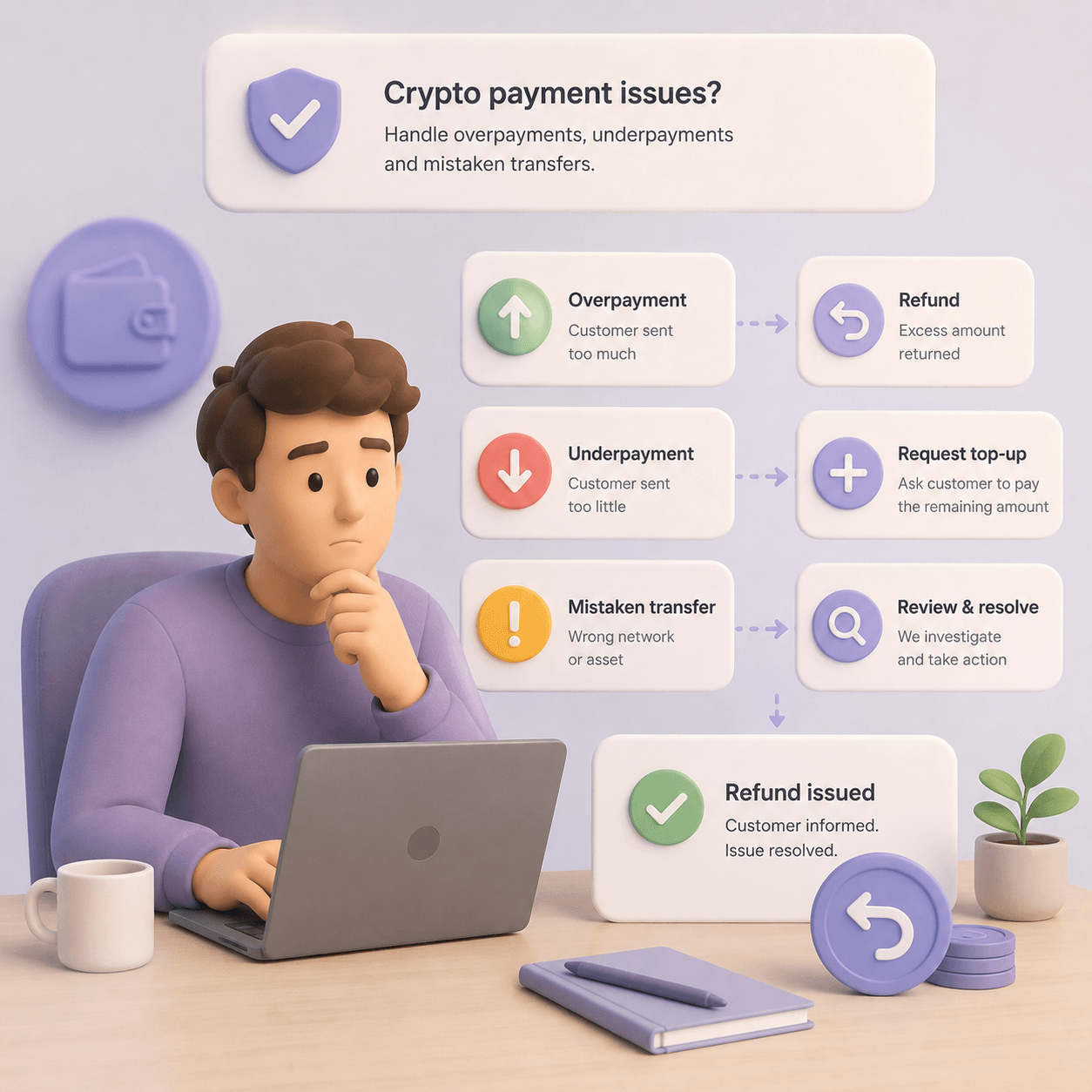
Crypto payment refunds are not just a customer support issue. They are part of payment operations.
When a customer pays by card, merchants are used to a familiar set of actions: authorize, capture, void, refund, dispute, chargeback. Crypto payments work differently. Once a blockchain transaction is confirmed, the original transaction cannot simply be rolled back. A refund usually becomes a new transaction, a customer credit, a balance adjustment, or a manual exception linked to the original order.
That difference matters for any business accepting USDT, BTC, ETH or other crypto assets on a website, in an app, through a payment link, in Telegram, or inside a digital platform. If a customer sends too little, sends too much, chooses the wrong network, pays after the invoice expires, or sends funds without the required memo, the business needs a clear process.
Without that process, crypto payments may still work — but every exception becomes a support ticket, a finance question, or a developer escalation.
This guide explains how businesses should handle crypto payment refunds, underpayments, overpayments and mistaken transfers without creating operational chaos.
A crypto refund is not the same as reversing a card payment.
In card payments, the payment system includes reversal and dispute mechanisms. In crypto, the blockchain transaction is final once confirmed. The merchant can still return value to the customer, but that return is a separate operation.
That changes the merchant’s responsibility. The business needs to know:
This is why accepting crypto through a simple wallet address is risky for a growing business. It may work for occasional manual payments, but it does not give support, finance and product teams enough structure when something goes wrong.
If your team already sees many payment errors before funds arrive, start with the broader guide to failed crypto payments. Refunds are often the next stage of the same problem: the customer has sent money, but the payment does not match the order cleanly.
Most crypto refund cases fall into a few categories. They may look similar to the customer — “I paid, where is my order?” — but they need different handling inside the business.
Common scenarios include:
Treating all of these as “refunds” is too broad. A good payment operation separates them into statuses and rules.
For example, an underpayment may require a top-up. An overpayment may require a partial refund. A wrong-network transfer may require manual investigation. A late payment may be accepted if it arrived shortly after expiry, but rejected if pricing or inventory changed. A suspicious transaction may need compliance review before any funds move out.
Before any of these rules can be applied, someone has to notice the exception. A customer who sent too much may never write, and a payment that arrived after expiry can sit unmatched for weeks. Catching them is the job of a regular check that ties every order to the money that actually reached you and lists whatever doesn't fit; that check is laid out in a routine for reconciling crypto payments against orders.
An underpayment happens when the customer sends less than the invoice requires.
Example: the invoice asks for 100 USDT, but the business receives 99.40 USDT. This can happen because the customer changed the amount manually, misunderstood network fees, paid from an exchange that deducted a fee, copied the wrong amount, or tried to round the payment.
From the customer’s perspective, the difference may look small. From the business perspective, it can affect revenue recognition, access delivery, inventory, subscriptions and support.
There are three practical ways to handle underpayments.
This is usually the right option for fixed-price purchases.
If a customer buys a one-year subscription, a digital product, a course, a license, a physical product or a B2B invoice, the business may not want to deliver the order until the full amount is received.
The payment page and support team should clearly show:
The key is to connect the second transaction to the same order. If the customer pays the remainder but your backend treats it as a separate unknown payment, support will still need to investigate manually.
This is where the crypto payment API matters. Your integration should support clear invoice IDs, statuses, webhooks, transaction hashes, order metadata and idempotent crediting logic.
Some businesses choose to accept small underpayments. This can make sense when the shortfall is tiny and the cost of manual support is higher than the missing amount.
For example, a business may decide that underpayments within 0.5% or 1% can be accepted for some products. That rule should not be emotional. It should depend on margin, payment size, product type and customer experience.
A practical threshold policy might separate cases like this:
The important distinction is fixed-price order versus balance model.
If a customer is buying a specific product, the order usually requires exact payment. If the customer is topping up an internal balance in a hosting, iGaming, ad network, API, VPN or SaaS product, the business may simply credit what arrived.
A refund may be the right option if the customer does not want to pay the remainder, the product cannot be delivered for a lower amount, or the invoice is no longer valid.
But refunding an underpayment is not free. It can involve a network fee, a minimum refund threshold, a supported network, customer address verification and internal approval.
Before refunding, check:
Small underpayments can be especially awkward. If the amount is lower than the network cost of refunding, the business needs a policy: customer credit, balance, coupon, manual settlement, or no refund below a stated threshold where legally permitted.
An overpayment happens when the customer sends more than the invoice requires.
This is easier to complete than an underpayment because the business received enough to cover the order. But the extra amount still needs a decision.
Overpayments often happen because customers pay manually, round up, pay from an exchange, copy a stale amount, or send extra funds “just in case” to cover fees. That habit creates accounting and support issues.
There are two main approaches.
For fixed-price purchases, the cleanest option is usually to complete the order and refund the overpaid portion.
This works for:
The customer should see that the order was paid successfully and that the extra amount is being refunded, waiting for claim, or being reviewed.
The refund communication should explain:
For balance-based products, refunding the excess may be unnecessary. If the customer is topping up an account, the extra amount can become additional balance.
This is often better for:
But the customer should not be left guessing. The account should clearly show that the order was completed and the excess was credited.
If your business sees frequent overpayments, review the payment UX. Customers may be changing the amount manually because the checkout does not clearly explain crypto payment fees, network costs or the difference between the invoice amount and wallet fee.
Wrong-network payments are among the most difficult crypto payment exceptions.
A customer may think “USDT is USDT,” but USDT on TRON, Ethereum, BNB Smart Chain, Polygon and Solana are different payment routes. If the invoice expects USDT on TRON and the customer sends USDT on another network, the result depends on address control, provider support, asset support and recovery rules.
The business should not promise that every wrong-network payment can be recovered. Sometimes it can be handled manually. Sometimes the funds may be technically visible but not recoverable through the payment flow. Sometimes recovery is not supported or not worth the cost.
A proper wrong-network process should collect:
Then the business can decide whether to refund, credit, recover manually, escalate, or reject the case.
The best way to reduce wrong-network tickets is to make network choice clear before payment. Do not show a long list of networks without context. Explain which network the customer selected, what asset format is expected, and what happens if they use another network.
For more detail, use the guide on choosing a USDT network.
Crypto invoices often expire. This protects the business from price changes, stale quotes, inventory changes and old payment links.
But customers do not always behave within the timer. They may open the payment page, get interrupted, return later and send the funds anyway. Or they may send the payment before the timer ends, but the transaction confirms after the invoice expires.
A late payment needs a business rule.
Possible actions include:
The right answer depends on the business model.
For a digital product with stable pricing, accepting a slightly late payment may preserve revenue and reduce support frustration. For a volatile quote, limited inventory, marketplace order or B2B invoice, late payment may require finance approval.
The payment page should not simply show “expired” and leave the customer confused. It should explain what to do if the customer has already sent funds: provide the transaction hash, wait for detection, contact support, or follow an automated resolution flow.
Some crypto payment errors are not about amount. They are about identification.
A customer may send the wrong asset to the right network. Or they may forget memo, tag, destination tag or another identifier required to match the transaction to their account.
This is common in payment flows involving assets or platforms that rely on additional identifiers. If that identifier is missing, funds may arrive but cannot be automatically assigned to the correct customer.
Support should not resolve these cases from screenshots alone. The team needs transaction-level data.
Required information should include:
If memo or tag is required, the payment page must make it obvious. Do not hide it in small text. Customers should understand that address, amount and memo/tag may all be required for the payment to be credited correctly.
A crypto refund is usually a new outbound transaction. That means network fees may apply.
There are several possible policies:
There is no universal answer. A SaaS product with high customer lifetime value may choose to absorb small refund fees. A low-margin marketplace may need to deduct them. A balance-based platform may avoid on-chain refunds by crediting the customer account.
The important point is clarity. Customers should not discover the fee policy only after something goes wrong.
A refund policy should say:
Crypto payment support should be data-driven. A screenshot from a wallet can help, but it should not be the source of truth.
Support agents need access to:
If first-line support cannot see this data, every refund case becomes an escalation to finance or engineering. That may be acceptable during a pilot, but it will not scale.
The business should also track exception categories. A high number of wrong-network tickets means the checkout needs better network guidance. Frequent underpayments may point to network fee confusion. Many expired-invoice tickets may mean the payment timer is too short or not visible enough.
The article on crypto payment metrics gives a broader framework for tracking support load, exception rate, time to credit and payment success rate.
Finance should not treat crypto refunds as informal wallet movements. Each refund should be tied to the original order and reflected in reporting.
A finance-ready crypto refund process should record:
This prevents a common reporting problem: counting an on-chain inflow as revenue even when it was underpaid, late, refunded or unmatched.
For USDT-heavy businesses, this connects directly to stablecoin payment operations for CFOs: reconciliation, settlement, conversion, withdrawals, fees and exception control.
Refunds and payment exceptions should not be bolted onto the system after launch. They should be part of the integration design.
At minimum, the backend should support clear payment states:
Product delivery should depend on business status, not merely on the existence of an on-chain transaction.
For example, a transaction may exist but still be underpaid. Another may be confirmed but linked to the wrong network. Another may be late and waiting for review. If the system grants access too early, the business creates its own loss.
Developers also need idempotency. Webhooks may arrive more than once. A payment can move from detected to confirming to completed. A refund can move from requested to processing to completed. The system must not credit the same balance twice or issue duplicate refunds.
The best refund operation is one that prevents avoidable exceptions.
A strong crypto payment page should show:
Network-fee confusion is one of the most common causes of failed or partial payments. A customer may have enough USDT but not enough TRX, ETH, BNB, SOL or another native token to pay the network fee. That creates friction before payment and can also lead to incorrect amounts.
This is why gasless USDT payments are an important UX topic, not just a technical feature. If the payment flow can reduce native-token confusion, it can reduce underpayments and support tickets.
A refund should not bypass risk controls.
If the incoming payment is suspicious, automatically sending funds out to a new address can create additional risk. This is especially important for larger amounts, high-risk industries, marketplaces, iGaming, anonymous accounts and cases where the customer asks to refund to an address different from the sending address.
AML or risk review may be needed when:
Requirements depend on jurisdiction, business model, transaction size and provider policy. This article is not legal advice. Operationally, the principle is simple: a crypto refund is also a financial transaction, so it should be tracked and controlled.
For a broader risk framework, read the guide to AML and crypto payment security.
A refund policy for crypto payments should be specific. Generic language like “refunds are processed where applicable” is not enough.
A practical policy should explain:
Do not promise universal recovery of mistaken transfers. Do not promise instant refunds on every network. Do not promise that unsupported assets can always be returned. Clear limitations are better than vague optimism.
CryptumPay is relevant when a business needs more than a wallet address. It is designed for accepting crypto payments on a website, in an app, in Telegram or in another digital platform, with a structured payment flow rather than a loose manual transfer.
For refund and exception handling, the important parts are operational: invoice context, amount, network, payment history, dashboard visibility, API integration, HTML widget options, AML controls, withdrawals and USDT settlement logic.
The QR/app flow can reduce manual entry. Network-fee handling can reduce amount errors. Support for repeated payments can make top-ups and renewals less dependent on manual wallet actions. These details do not remove the need for a refund policy, but they reduce the number of avoidable cases and give teams better data when exceptions happen.
The goal is not to make crypto refunds identical to card refunds. The goal is to make them predictable, auditable and manageable.
Before accepting real customer payments, test more than the happy path.
Run these scenarios:
For each scenario, answer three questions:
If any answer is unclear, the payment flow is not ready to scale.
A confirmed blockchain transaction cannot be reversed like a card payment. A business can still refund the customer, but the refund is usually a new outbound transaction, a customer credit, or a manual adjustment linked to the original order.
The merchant should compare the expected and received amounts, check the network and invoice status, then apply a rule: ask for the remaining amount, accept the underpayment within a threshold, credit the actual amount to balance, or refund the payment.
For fixed-price orders, the business can complete the order and refund the excess. For balance-based products, the overpaid amount can be credited to the customer’s account if the policy allows it.
Sometimes, but not always. It depends on the network, asset, address control, provider support, amount, fees and risk review. Businesses should avoid promising automatic recovery for wrong-network transfers.
That depends on the merchant’s policy. The business may absorb the fee, deduct it from the refund, credit the customer internally, or apply a minimum refund threshold. The rule should be visible before customers pay.
Create an account and connect the checkout yourself, or talk to sales and we will plan the integration with you.