


August 31, 2026
Stablecoin Payments in Europe: What You Can Accept After MiCA in 2026
Read article
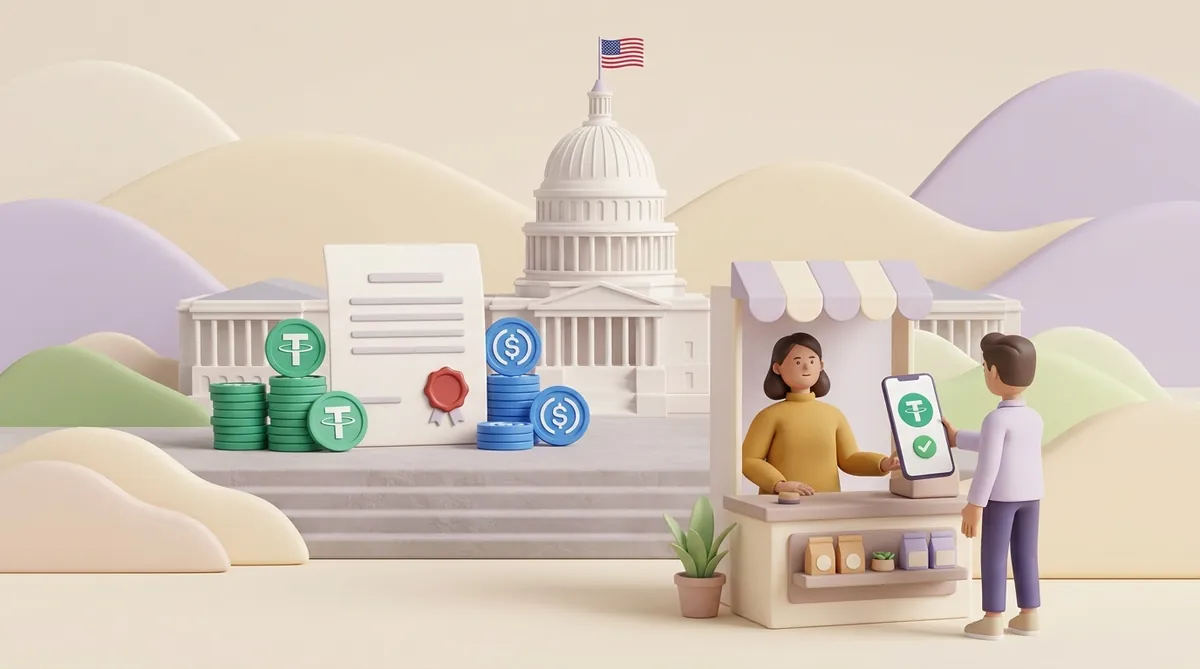
The GENIUS Act is the US federal law, signed on 18 July 2025, that decides who may issue a dollar stablecoin for people in the United States and what has to stand behind it: at least one dollar in cash or short-term US Treasuries for every coin, with the reserves disclosed every month. As of October 2026 it takes effect on 18 January 2027, and a business that takes USDT or USDC does not have to change anything before then. The date that matters more for sellers is 18 July 2028, when platforms serving people in the US may offer only stablecoins from issuers the Act approves.
The Act regulates one thing, which it calls a payment stablecoin. In the Act's own definition (Sec. 2, US federal law), that is a digital token used, or designed to be used, for paying or settling, whose issuer must buy it back for a fixed amount of money and promises to keep its value stable.
In plain words: one coin, one dollar, and a company that owes you that dollar. USDT and USDC are the stablecoins most businesses meet, and both are built this way.
The Act puts its duties on two kinds of players (US federal law, as of October 2026):
Software stays outside the second group. A self-custody wallet app, the kind where only you hold the keys to your coins, is not a service provider under the Act (US federal law, as of October 2026).
Three dates matter (US federal law, as of 3 October 2026):
The detailed rules are still being written. In 2026 the Office of the Comptroller of the Currency (OCC), the main federal regulator of national banks, and other federal regulators published proposed rules. As of 3 October 2026 none of the Act's primary federal stablecoin regulators had issued final ones.

From 18 January 2027, only a permitted payment stablecoin issuer may issue a payment stablecoin in the United States (Sec. 3(a), US federal law). Put simply, that is a company licensed under the Act. There are three ways to become one:
Foreign issuers have a separate way in (US federal law, as of October 2026). Under Sec. 18, the US Treasury can recognise a foreign country's stablecoin rules as comparable to the American ones. A US platform may offer a foreign issuer's coins only if that issuer is technically able to carry out lawful US orders, such as an order to freeze coins.
Issuing without a licence is a federal crime. Under Sec. 3(f), anyone who knowingly takes part in it faces a fine of up to $1 million per violation, up to five years in prison, or both (US federal law, from 18 January 2027).
Under the Act (US federal law, as of October 2026), an approved issuer takes on five duties:
Here is what full reserves mean in practice. An issuer with 20 billion coins in circulation must hold at least $20 billion in those assets, and anyone can see their make-up in the monthly report.
In exchange, the Act settles a long-running question: a stablecoin from an approved issuer is not a security under US federal securities law (as of October 2026). That keeps it out of the rules written for shares and investment products.

USDT, the largest stablecoin, is issued by Tether, a company based outside the United States. Under the Act (US federal law, as of October 2026), that puts USDT on the foreign route. Until 18 July 2028 US platforms can keep offering it. After that they can do so only if USDT meets the Act's terms for foreign coins.
Tether has prepared two answers:
USDC is issued by Circle, a US company, so it goes the domestic route and needs a US licence under the Act like any American issuer. As of October 2026 neither coin is banned under the Act, because the Act has not yet taken effect. For a merchant choosing between them today, the practical differences between the two coins weigh more than the law does, and they are laid out in how to choose between USDT and USDC for payments.
Yes, and the Act turns that from a policy into a duty. From 18 January 2027 (US federal law), an approved issuer must be able to freeze coins on a lawful order and must comply, and US platforms may carry a foreign coin only if its issuer can do the same.
The big issuers already freeze coins. Tether and Circle have blocked addresses at the request of law enforcement for years; the Act makes it a condition of doing business in the US.
A freeze hits an address, not a person. If coins a customer paid you with are later linked to a crime and an order freezes your address, everything on that address stays put, and you cannot move it.
Two habits lower that risk:
How often to convert and how much to keep in coins is a treasury decision with its own costs, and it is worth setting as a rule rather than deciding each week; that is what controlling USDT conversion and withdrawals as a finance team walks through.
The GENIUS Act does not create a licence or a registration for a business that takes stablecoins as payment for its own goods or services (US federal law, as of October 2026). As written, its duties fall on issuers and on service providers, the businesses that exchange, transfer or hold coins for others for a fee in the United States. A shop that sells its own product for USDT does none of these things for anyone else.
What reaches you is the change around you:
The GENIUS Act is also not the only rule that applies to a business taking crypto. Whether that is allowed where you operate, and on what terms, is answered country by country in is it legal for a business to accept crypto payments.
Sec. 3(g) of the Act (US federal law, from 18 January 2027) says a stablecoin not issued by an approved issuer is not cash or a cash equivalent for accounting purposes.
The Act only says what an unapproved coin is not. Whether an approved coin counts as a cash equivalent on your balance sheet is a question for accounting standards and your auditor.
For a US company, that makes the issuer's status a bookkeeping question too. A balance held in a coin whose issuer has no US approval cannot sit in the cash line, so it is worth checking the status of the coins you hold before each reporting date.
The GENIUS Act is US law. Its platform ban is about offering coins to people in the United States, so it does not govern what a seller in Georgia or the UAE accepts from buyers in Europe or Asia (as of October 2026).
Your US customers are a different matter. From July 2028 the coins they can buy on US platforms will be approved or recognised ones. If Americans are a noticeable share of your sales, offering a coin that will qualify keeps paying easy for them.
Other regions run their own regimes. The European Union already applies MiCA, its crypto-assets regulation, which sets its own rules for which stablecoins EU platforms can offer; the practical picture for sellers is in which stablecoins you can accept in Europe after MiCA.
Nothing in the Act forces a merchant to act today, but four steps keep you ahead of it:
The GENIUS Act regulates the companies that issue stablecoins and the platforms that sell them, not the businesses that accept them as payment. It applies from 18 January 2027, and US platforms must narrow their coin lists by 18 July 2028. For a merchant the work is modest, and none of it has a deadline before 2027.
No. Under the Act (US federal law, from 18 January 2027), neither an approved issuer nor a foreign issuer may pay holders any interest or yield, whether in cash, tokens or anything else, just for holding or using the coin. The ban is written for issuers. A stablecoin balance is a way to hold dollars, not a savings account.
No. The Act (US federal law, as of October 2026) forbids an issuer to claim that its coin is backed by the full faith and credit of the United States, guaranteed by the government or covered by federal deposit insurance. What protects holders instead is the one-to-one reserve, the monthly report and their priority over other creditors if the issuer fails.
No. The Act covers only payment stablecoins, tokens whose issuer must buy them back for a fixed amount of money. Nobody owes you a set price for bitcoin or ether, so they fall outside it (US federal law, as of October 2026).
This article explains the law in general terms and is not legal advice. For decisions about your business, consult a qualified lawyer in your jurisdiction.
Create an account and connect the checkout yourself, or talk to sales and we will plan the integration with you.