


September 1, 2026
Best stablecoin for payments: how to choose between USDT and USDC (and why BUSD is gone)
Read article

When customers pay in USDT, stablecoin treasury management lands on the finance team as five jobs:
On top of that sits one risk a bank account doesn't carry: the issuer can freeze tokens at an address. Stablecoin payments for CFOs come down to these jobs plus one conversation with the accountant about the balance sheet.
This guide starts where checkout ends: the money has landed and someone has to own it. If you don't accept stablecoin payments yet, start with how a crypto payment gateway gets connected and what it really costs.
A bank transfer comes with a payer name and a reference field. A USDT transfer has neither. On the blockchain you see a sending address (a string of letters and digits), an amount, a network, a time and a transaction hash, which is the transfer's unique receipt number. Nothing in it says "invoice 1043".
That gap is the main difference finance teams notice once they compare crypto payments with bank transfers on fees and speed. The fix is to link the payment to the order before the customer sends it, not after.
There are three common ways to do it:
Whichever method you use, record the same five fields for every payment: order number, transaction hash, network, amount received and the time it was confirmed. The network matters more than it looks. USDT exists as separate tokens on TRON, Ethereum and other chains, so a transfer on the wrong network never reaches your address. Ops staff should know which USDT formats exist and which one the business accepts.
The customer pays 100 USDT, but your balance may show less. The payment processor takes its fee, and the network charges its own fee whenever you move the money on.
Book the sale at the invoiced amount and the processor's cut as a payment expense, the same way you treat card fees. Then the revenue line matches the invoice and the bank-style reconciliation still works. The pieces that make up the difference are explained in how network fees, gas and gateway fees work.

Any processor you use should send your system a status for each payment and a final amount credited after fees. Ask two questions: at which status is the money actually yours, and which field holds the net amount?
At CryptumPay, statuses come by webhook (an automatic message from the processor to your server): created → pending → crediting → finished. The income field, which is the amount credited after all fees, is present only in the finished webhook. So the rule for your ledger is simple: post the payment when finished arrives, and take the net figure from income.
Some payments won't line up with anything. A customer sends 98 USDT instead of 100 because their exchange took a withdrawal fee. Someone pays an invoice that already expired. A client pays two invoices in one transfer. Money arrives from an address nobody recognises.
Most of these start at checkout, and the usual causes of failed and short crypto payments are worth fixing there. Some will still reach finance, so write the handling down before the first one does:
USDT tracks the US dollar, so holding it isn't a bet on crypto prices. For a business that reports in dollars, a USDT balance behaves much like a dollar balance, with three extra risks: the issuer, the peg and the place you keep it.
For a business that reports in euros or pounds, holding USDT also means holding dollars. That exposure to the exchange rate is the same one you'd have with a USD bank account.
The case for converting quickly is simple: payroll, rent and tax are paid in fiat, and fiat in a bank carries none of those three risks. The case for holding is just as practical. Some businesses pay contractors or suppliers in USDT, and converting to fiat only to buy USDT back later costs two spreads. If that's you, look at whether suppliers abroad can be paid in stablecoins before you set the policy.
Most finance teams land on a middle rule:
The stablecoin keeping its dollar value is an assumption, not a promise. Before you pick a buffer size, read what happens to a business when a stablecoin loses its peg, meaning its price slides away from one dollar.
Converting means selling USDT for dollars or euros on an exchange or through a broker, then withdrawing to the bank. You pay a trading fee or spread, a network fee to move the USDT, and sometimes a bank fee on the incoming wire. Those costs belong in the total cost of taking payments, next to what drives online payment fees and how businesses cut them.
Going straight to Tether, the company that issues USDT, is rarely an option for a merchant. Tether redeems only for verified customers, with a minimum of 100,000 USD and a fee of 0.1% or 1,000 USD, whichever is greater.
If your checkout also takes bitcoin and other coins, the first treasury question comes before any of this: how long does a volatile coin sit on your books before it becomes something stable? The shorter, the better, and the ways to protect crypto takings from market swings all come down to shrinking that window.
At CryptumPay, incoming payments are converted to USDT as soon as they arrive: "Converted as soon as it arrives, so your balance never sits in a volatile coin." For the finance team this means one asset to reconcile and one hold-or-convert policy, whatever the customer paid with.
There are four places a business can keep USDT. Each one carries a different counterparty risk, meaning the chance that whoever holds the money for you fails or blocks it:
A sensible setup for a growing business uses more than one of these. The provider balance is where payments land. A company-controlled wallet or custodian holds the working buffer. The bank holds the rest.
"Company-controlled" still leaves the main decision open: whether one person holds the key or several people must sign each transfer together. Two things settle it: how many people move money and how much sits in the wallet. Between them, they decide which crypto wallet setup suits a business of your size.
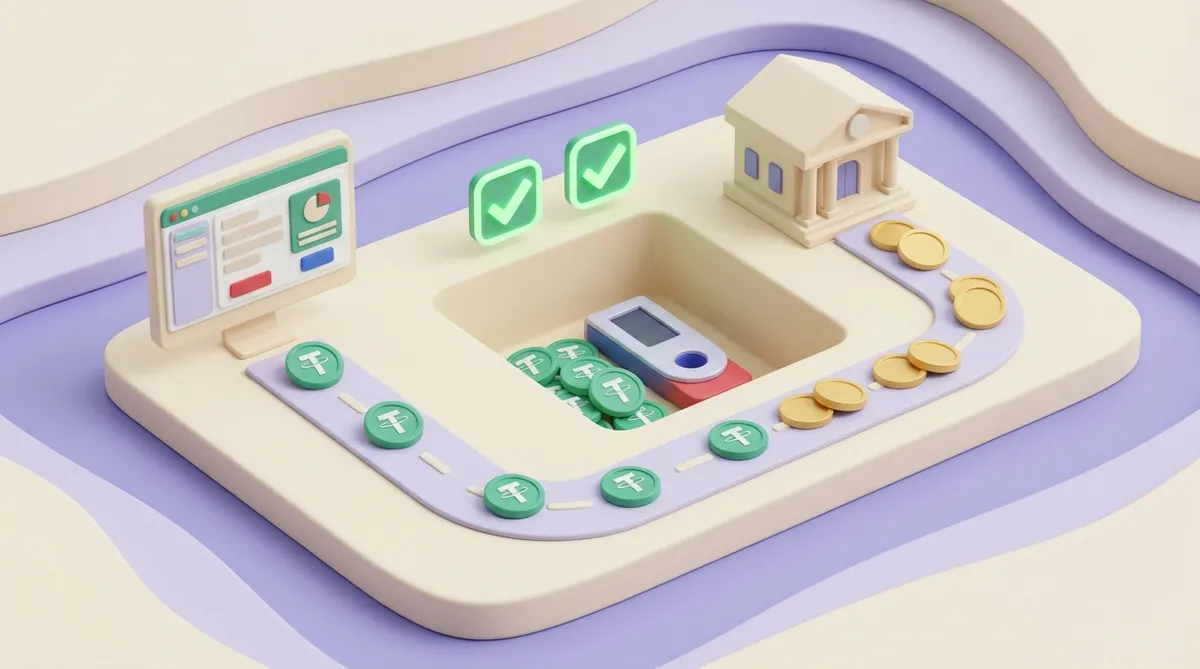
The USDT smart contract, the program that keeps track of everyone's balances, lets Tether block a specific address. Once an address is frozen, tokens at that address can't be moved at all. Nobody at your company can override this, and neither can your wallet provider.
Tether's terms of service let it freeze tokens where the law requires it and where it decides freezing is prudent. In practice freezes follow sanctions lists and law-enforcement requests about stolen or criminal money. In the US, the GENIUS Act, signed on 18 July 2025, makes this an obligation rather than a choice. Every issuer of payment stablecoins, foreign ones included, must be technically able to freeze and seize tokens and must comply with lawful orders. The act takes effect no later than 18 January 2027.
For an honest merchant the realistic risk is indirect. A freeze targets an address, not a person. If a customer pays you with stolen funds and investigators trace the money to your receiving address, your address can end up on the list, along with every legitimate payment sitting there.
A few habits keep that risk small:
The same logic applies to issuer risk in general. A business that holds all its stablecoin reserves in one token depends on one company. That's one reason to understand how USDT and USDC differ as payment stablecoins, even if you only accept one of them.
A crypto transfer can't be reversed or recalled. A bank can sometimes stop a wire sent by mistake, but a blockchain can't. So the controls that matter all sit before the money moves:
Ask any payment provider how withdrawals work and what protects them. At CryptumPay, withdrawals are available any time with no minimum amount, in manual and automatic modes. A manual withdrawal from the dashboard needs no IP allowlist. A withdrawal through the API (POST /v1/withdraw) requires an IP whitelist configured for the API key, so a stolen key alone can't send money from an unknown server.
The short answer for most businesses today: USDT is not cash on the balance sheet. Under US GAAP, the fair-value rules for crypto assets that FASB introduced in ASU 2023-08 leave out tokens that give the holder a claim on underlying assets. That's usually read as excluding fiat-backed stablecoins, so companies and auditors have to analyse each token, and practice still varies.
This is moving. On 18 August 2026, FASB, the body that writes US GAAP, proposed guidance on when certain digital assets can count as cash equivalents. A token would need a direct, on-demand right to redeem with the issuer for a known cash amount, backed by reserves held only in cash and Treasury bills of three months or less. Buying and selling on an exchange wouldn't be enough. Comments are open until 19 November 2026, and nothing is final.
Even if the proposal is adopted as written, USDT would not pass for any holder. Tether's reserves include bitcoin, gold and secured loans, not only cash and short Treasury bills. On top of that, Tether redeems only for its own verified customers, and the minimum and fee described above are the kind of restrictions the test rules out. How the rules work under IFRS is covered in the questions below.
This is general information as of September 2026, not legal, tax or accounting advice. Before year-end, settle these points with your accountant:
For the bookkeeper, most of these points turn into the same few entries made again and again. The payment goes in at its value on arrival, the fee is booked as an expense, and a later conversion is a sale with a gain or a loss. It helps to come to the year-end conversation already knowing how each crypto payment, fee and conversion is recorded in the books.
Stablecoin treasury management is ordinary finance discipline applied to a payment rail with no reference field, no recall and an issuer that can freeze. Link every payment to an order before it's sent, and give unmatched money a written procedure. Hold only the USDT you'll spend, in more than one place, behind approvals no single person can bypass. Take the balance-sheet question to your accountant early, because the standard-setters are changing the answer right now.
IFRS has no standard written for stablecoins. In 2019, the IFRS Interpretations Committee concluded that crypto holdings are not cash and are usually intangible assets under IAS 38, or inventory under IAS 2 if the business holds them for sale in its ordinary course. A stablecoin that gives the holder a contractual right to redeem for cash may instead be a financial asset under IFRS 9, but the right has to belong to the holder, so the terms of each token matter. This reflects the position in September 2026; confirm it with your auditor.
The SEC doesn't write accounting standards for companies; in the US that's FASB's job. In April 2025, SEC staff said that "covered stablecoins", meaning dollar tokens backed by low-risk liquid reserves and redeemable one-to-one, are not securities. In February 2026, staff allowed broker-dealers to apply a 2% haircut to payment stablecoins in their capital calculations. Neither statement tells an ordinary business how to classify USDT on its balance sheet.
USDT has held close to one dollar for most of its history, and Tether publishes quarterly reserve reports checked by an accounting firm. These reports are attestations, not full audits. In November 2025, S&P Global Ratings cut its assessment of USDT's ability to hold its peg to "weak", pointing to riskier reserve assets such as bitcoin and gold, and to gaps in disclosure. For a business, "safe enough" is a question of size: fine as a transit balance, riskier as the place you keep a quarter's cash.
The main risk is receiving money linked to sanctions, fraud or theft, which can bring a frozen address, a closed exchange account or questions from your bank. Anti-money-laundering (AML) duties such as customer checks and the travel rule, which requires sender and recipient details to travel with a transfer, fall mainly on crypto service providers. In the EU, the Transfer of Funds Regulation has applied the travel rule to crypto transfers since 30 December 2024. A merchant still has sanctions obligations of its own, so screening incoming payments and knowing who your larger customers are is worth the effort.
Create an account and connect the checkout yourself, or talk to sales and we will plan the integration with you.