November 6, 2026
How to accept USDT (Tether) payments from your customers
Read article

On 13 November 2026 about $286 billion worth of stablecoins were in circulation, and two coins hold most of it: USDT and USDC together make up 85.5%. The money is just as concentrated by network, with most of it sitting on Ethereum and Tron.
Below are the shares of the twelve largest coins and the twelve largest networks, and where USDT and USDC sit network by network, each with a year-ago column to show what moved.
A stablecoin is a crypto token that keeps a fixed price, almost always one US dollar. A coin's market share is its slice of all stablecoins in circulation, counted in dollars.
Data dashboards call the total "market cap". For a stablecoin that is simply the number of tokens in circulation times one dollar, so the total and the supply are the same figure. Ordinary coins move with their price and add a second figure that counts tokens not released yet, which is the difference between market cap and FDV in crypto.
Two terms in the table below describe what stands behind a coin:
In dollars, the market shrank by about $16 billion over the past thirty days, and it sits about $13 billion below its level of a year earlier. Almost everything in it is a digital dollar: all euro stablecoins together are under a third of a percent.
The table lists every stablecoin with more than $1 billion in circulation. What the columns mean:
Both leaders lost a little share over the year, and the gap between them and everyone else stayed huge. The biggest gains came from small coins: RLUSD, USDG and USDD each more than doubled their slice. USDe went the other way and lost more than a third of its share.
A stablecoin holds its dollar price only as long as the reserve behind it holds. When the price slips below a dollar and stays there, that is a depeg, and it hits anyone holding the coin at that moment, which is why a business should know what a stablecoin depeg is and what to do about it.
A chain, or blockchain, is the shared ledger where tokens are recorded. One stablecoin can be issued on many chains at once, and tokens can also be carried from one chain to another through a bridge: a program that locks them on the first chain and issues a matching copy on the second.
This table counts every stablecoin by where it sits now, whichever chain it was first issued on. What the columns mean:
Ethereum is still the largest home for stablecoins, but over the year it lost almost ten points of share, and Tron gained almost seven. Most of that shift is USDT: the part of all USDT that sits on Tron grew from about 42% to more than half, while its part on Ethereum shrank.
Further down the list, the networks look more like USDC territory. Solana, Base, Arbitrum and Polygon each hold more USDC than USDT, and on Hyperliquid, a trading platform with its own blockchain, almost every stablecoin dollar is USDC.
USDT holds 61.3% of all stablecoins and USDC holds 24.2%, so for every dollar of USDC in circulation there are about two and a half dollars of USDT. USDT is issued by Tether and USDC by Circle; both are fiat-backed and both are meant to be worth exactly one dollar.
Size is only one argument when a business decides which of the two to accept. The others, from where customers hold the coin to how each issuer handles its reserves, are weighed in which stablecoin is best for business payments, USDC or USDT.
The sharper difference between the two coins is where they live. USDT has at least $1 million on 50 networks and USDC on 68, yet each keeps most of its supply on one or two chains. The two tables below show how each coin is split.
USDT on each network in billions of dollars, and the share of all USDT that sits there, now and a year ago:
Tron now holds more than half of all USDT, while a year ago the larger part sat on Ethereum. Outside those two, only BNB Smart Chain and Solana hold more than $2 billion of it each.
The network matters in practice, not only in statistics. A USDT transfer arrives only if both sides use the same network, so USDT held on Tron cannot pay an address that expects it on Ethereum.
The share of USDT on a network does not tell a business which network to take payments on: a sender and a merchant weigh networks by different things. That choice has an answer of its own in the best USDT network for a business.
USDC on each network in billions of dollars, and the share of all USDC that sits there, now and a year ago:
USDC is spread wider than USDT. Besides Ethereum, six networks hold at least $1.5 billion of it each, against two for USDT outside its main pair. Over the year Ethereum's part of USDC fell by six points, and the slices of Hyperliquid, Base, Arbitrum, Polygon and BNB Smart Chain all grew.
For a business, these shares hint at what customers are likely to pay with: six of every ten stablecoin dollars are USDT, and the rest is split between USDC and a long tail of smaller coins on many networks. A crypto payment service can take whatever the customer sends and settle the business in one currency, so the business does not have to pick a coin or a network for its customers.
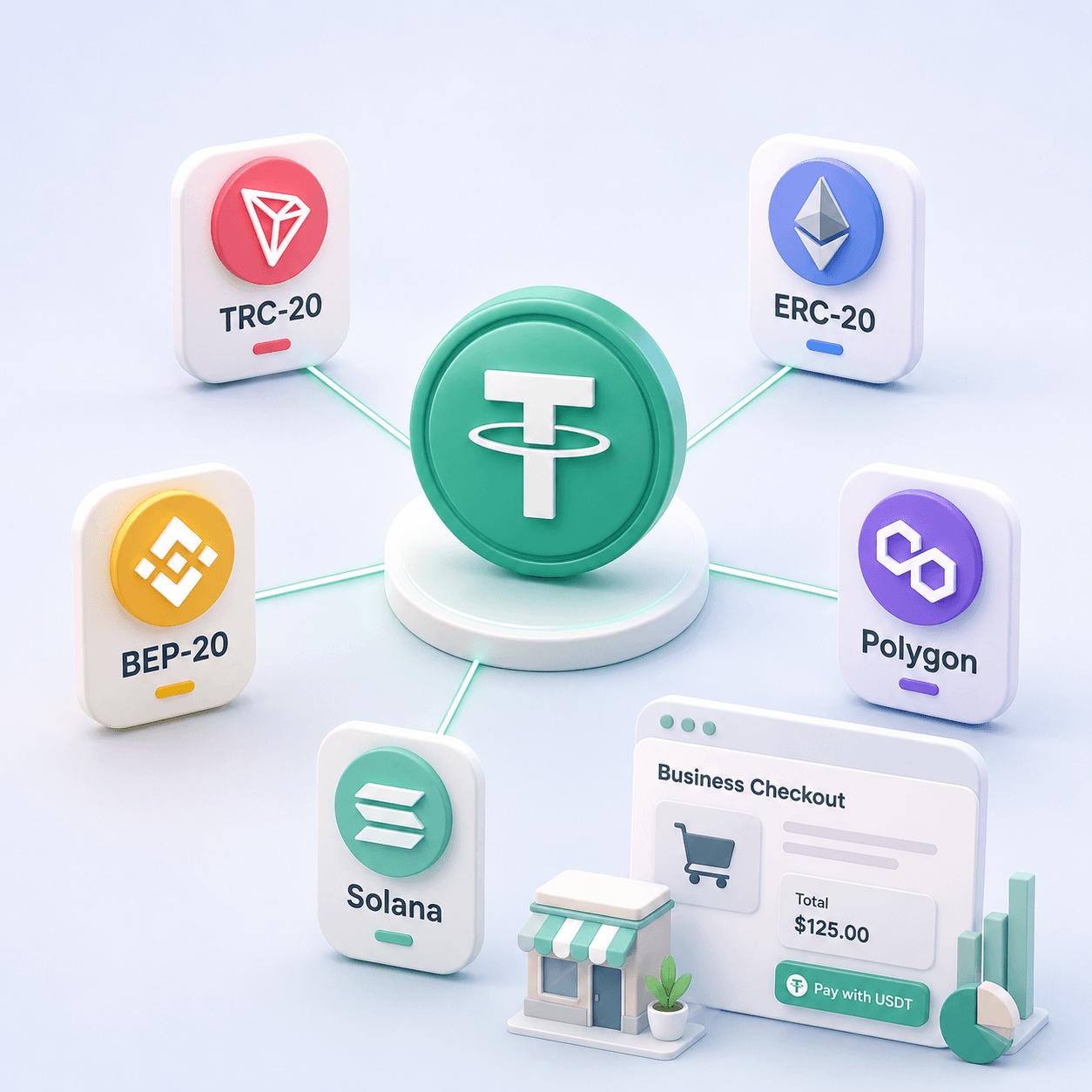
At CryptumPay it works like this:
A business that wants to accept payments this way can start with CryptumPay's crypto processing for online business.
Put this page next to another stablecoin dashboard and the figures will rarely match to the last billion. Here is where the gaps come from:

Stablecoins in November 2026 are a two-coin, two-chain market: USDT and USDC hold six of every seven dollars, and Ethereum and Tron hold four of every five. The year's changes happened inside that frame rather than against it:
It depends on where you draw the line. 183 stablecoins have at least $1 million in circulation, 38 have $100 million or more, and 12 pass $1 billion. Tokens below $1 million are not counted here.
Tether, the issuer of USDT, with $175.4 billion in circulation by its own count. Circle comes second with $69.1 billion of USDC. No other single coin comes close: the third-largest, USDS, has about $5.4 billion.
DefiLlama's stablecoins page shows a daily history of the total and of each coin's supply. This page is measured again every month with the same counting, so its tables can be compared month to month.
The figures are a snapshot taken at 23:34 UTC on 13 November 2026 from DefiLlama's stablecoin data, which counts tokens in circulation on each network; the USDT and USDC totals were checked against Tether's and Circle's transparency pages. Year-ago shares come from DefiLlama's daily series, counted the same way, and "no data" means the series has no point for that date.
Create an account and connect the checkout yourself, or talk to sales and we will plan the integration with you.