
May 22, 2026
Gasless USDT Payments: Why Customers Fail to Pay Without TRX, ETH or BNB
Read article
Two readers arrive at this question, and the answer splits at the first fork.
Somebody gave you payment details. Then there is nothing to choose. Open what they sent, find the asset and network written as one pair — "USDT, TRC-20" — and send in exactly that. A transfer on the wrong network does not bounce back: only whoever controls the destination address can return it, and often nobody can.
You control both ends — withdrawing from an exchange into your own wallet, say. Then the dropdown is a real choice. Open the destination's deposit page and see which networks it accepts. Then decide by what you will do with the money next and what the trip back out costs; the withdrawal fee comes last. A cheap withdrawal into an expensive exit is no saving.
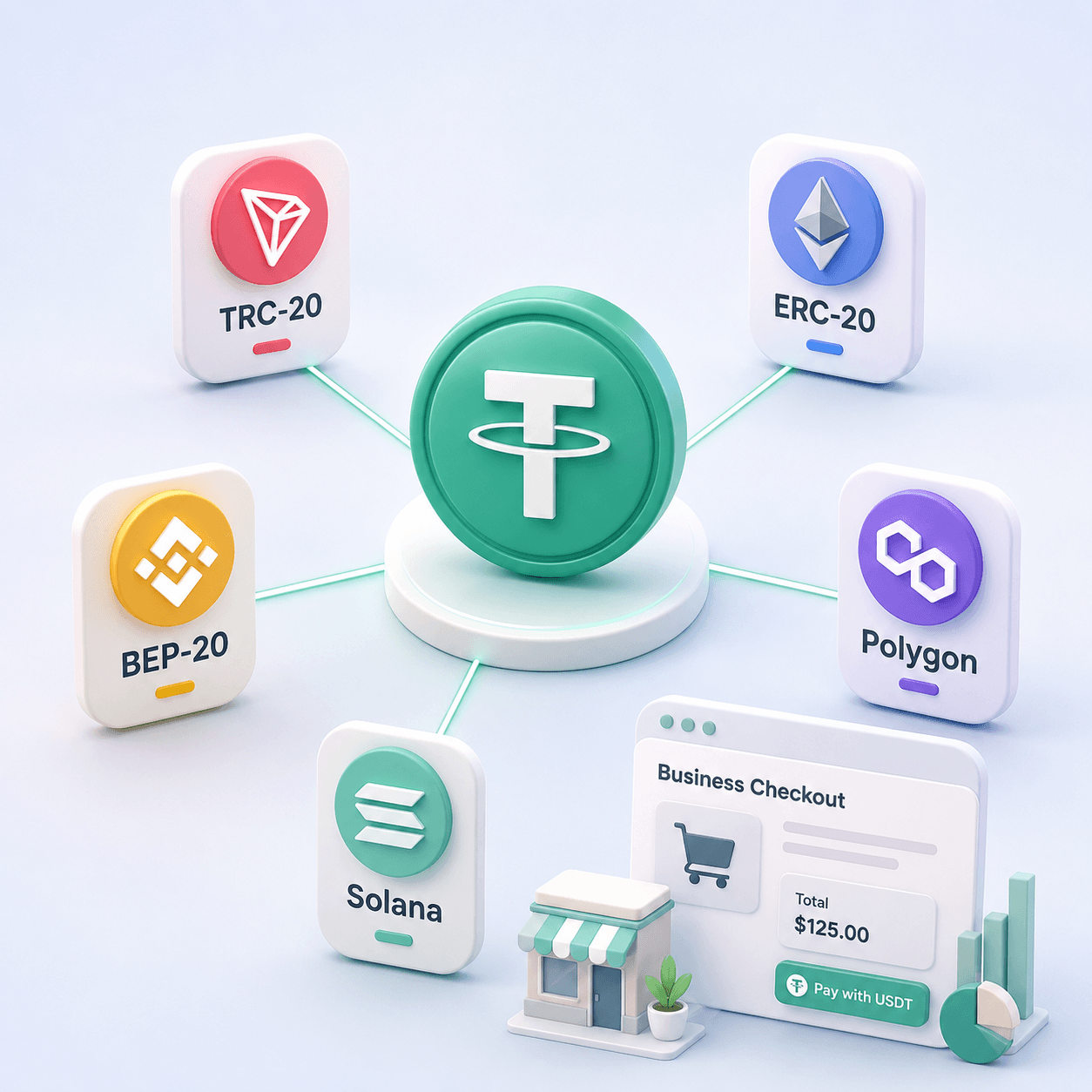
Either way, USDT alone will not move. The fee is paid in the network's own coin — TRX on TRON, ETH on Ethereum, BNB on BNB Smart Chain, SOL on Solana, POL on Polygon. A wallet holding 500 USDT and zero TRX cannot send anything.
The longer answer belongs to whoever accepts. For them, "which network is best for USDT" has an answer, and it is a rule. The best USDT network is the one your customers already hold USDT in. A cheaper chain your buyer does not use just generates support tickets.
That advice usually arrives bundled with "and that network is TRON, because TRC-20 is the cheapest." Over the past year that stopped being true. It does not change the rule — it makes it stronger.
In USDT business payments the network is set by whoever receives: an exchange's deposit page, a shop's checkout, a supplier's invoice. The sender copies it. The only exception is the one above, where you own both ends.
The prices below still concern the sender, because the sender pays them. If both your ends support several networks, that section is your comparison; if you are choosing routes to open for customers, it is your cost of doing business.

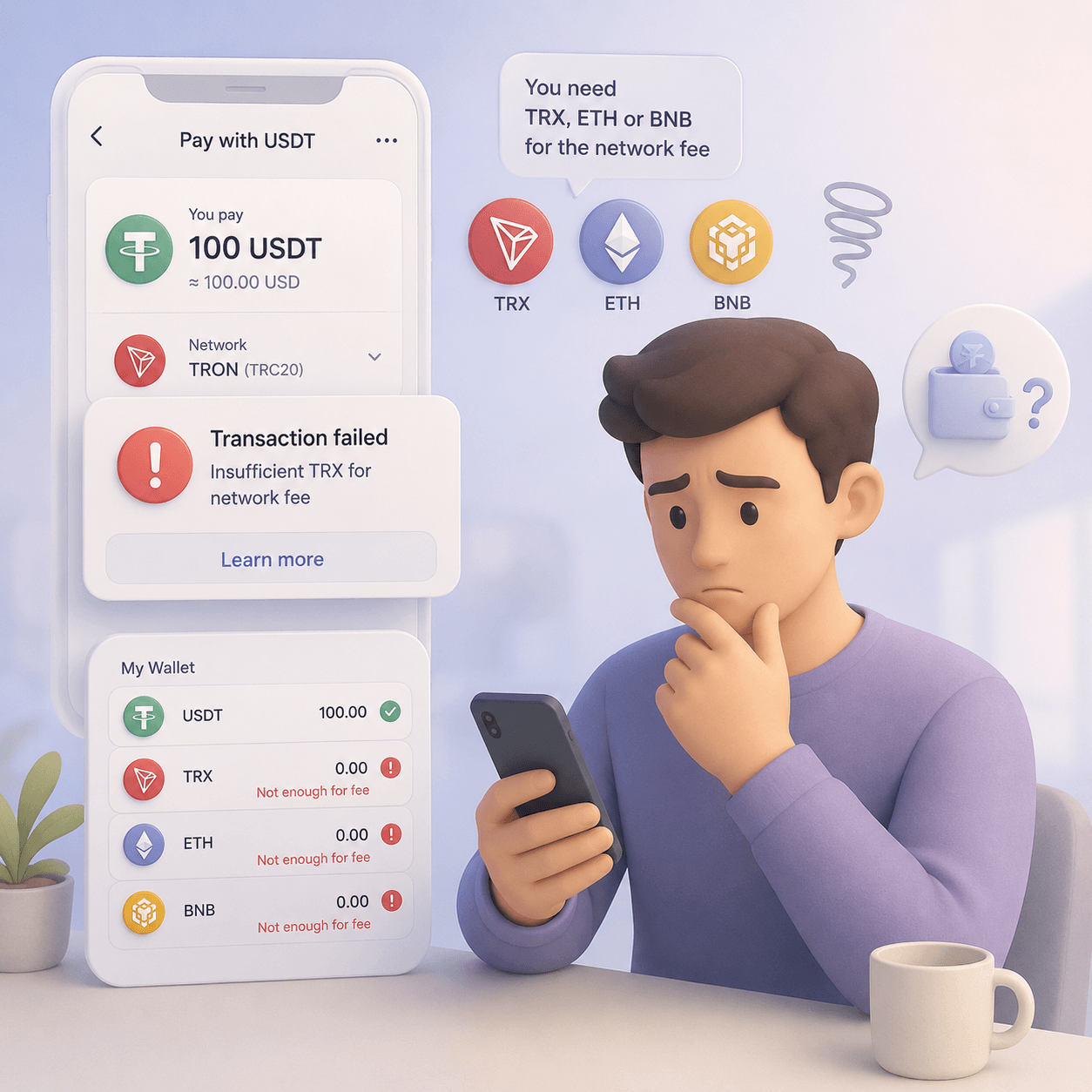
Every network charges for writing your transfer into its ledger, and it charges in its own coin. The customer sees a full USDT balance, presses send, and the wallet refuses. Before you design a checkout, read up on running out of the coin that pays the fee — the problem lands on your support queue.
A second cost sits on top, and it has nothing to do with blockchains: what a payment provider charges to accept the money. The spread across the industry is wide — a percentage, a flat amount per payment, a minimum, sometimes a charge on top of the network fee. Ask in writing before you sign. CryptumPay charges 1% per successful payment, from 0.5% at high volume, and lets the fee be passed on to the customer.
Every card carries the same four things: the coin the fee is paid in, what a transfer costs and where that figure comes from, when it stops being reversible, and who should switch it on. Dollars use CoinGecko rates for 2 September 2026.
Fees are paid in TRX. TRON prices transactions in units of energy, and the price per unit is a network parameter: 100 sun, or 0.0001 TRX, unchanged since 29 August 2025 (TRON network parameters). On-chain receipts read on 2 September 2026 show 64,285 energy for a transfer to someone who already holds USDT. That is 6.4 TRX — with TRX at $0.324263, about $2.08. Treat the usage as a measurement of that day: the network recalculates it as the contract's load moves. The price per unit stays put.
A block arrives every 3 seconds and becomes irreversible once 19 of the 27 super representatives have built on it, about a minute.
Switch it on if your customers already pay from TRON; the cost is not the reason. Guide: accepting USDT on TRON.
Fees are paid in ETH. You pay for the work the transfer takes — about 65,000 gas (ethereum.org) — at whatever the network charges for gas that minute. On 2 September 2026 Etherscan's tiers ran 0.124 to 0.136 gwei, which with ETH at $2,389.67 comes to about two cents. Run the sum again before you quote it, because the price is an auction. Ethereum.org's own worked example prices the identical transfer at 0.5 gwei, its April 2026 average, and lands at $0.076.
A block finalises in about 15 minutes.
Switch it on for large invoices and customers whose treasury already sits on Ethereum.
Fees are paid in BNB. The minimum gas price has been 0.05 gwei since 1 October 2025. The same arithmetic — 65,000 gas, BNB at $685.88 — gives about $0.002 a transfer; BNB Chain's overview puts a typical transaction at around half a cent or less, a wider estimate covering more than token transfers.
Blocks come every 0.45 seconds, from 14 January 2026. BNB Chain's published finality figure, about 1.875 seconds, comes from the earlier Maxwell release at 0.75-second blocks, so there is no finality number to promise a customer for these ones.
Switch it on for customers who keep funds around Binance-related wallets, and print the network name louder than the address: BEP-20 addresses look exactly like Ethereum ones. Background: BSC and BEP-20.
Fees are paid in POL. Polygon retired MATIC as its gas token in September 2024, and a post dated 3 September 2025 put the swap at 99% complete; customers still holding MATIC-labelled balances remain a live support case. The Polygonscan explorer prices a token transfer as a finished figure instead of in units: about $0.002 at all three tiers on 2 September 2026, with POL at $0.091069. Only Solana's base fee is lower.
Finality runs 2 to 5 seconds, since 10 July 2025.
Switch it on for EVM customers who want Ethereum habits at a fraction of the fee. One caveat first: the "Currently Supported Asset Protocols" section of Tether's supported-protocols page listed 14 chains on 2 September 2026, and Polygon was not one of them. USDT on Polygon exists, moves and is accepted. It is the issuer's own list of where it issues and redeems, with a separate deprecated section below; both change, so read the current version before parking a large balance. Setup: Polygon payments.
Fees are paid in SOL. The base fee is 5,000 lamports — 0.000005 SOL — per signature (Solana documentation), which with SOL at $99.27 is $0.0005, a twentieth of a cent. Under load the sender can attach an optional priority fee on top, so that is a floor.
Slots run roughly every 400 milliseconds, and Solana's upgrade page gave TowerBFT finality as 12.8 seconds on 2 September 2026.
Switch it on when your audience already lives there. Solana sits outside the EVM world: a different wallet habit for the customer, a separate address format for your team. Guide: Solana payments.
Line those five figures up and the familiar ranking is upside down. Solana at $0.0005. Polygon and BNB Smart Chain at about $0.002. Ethereum at about two cents. TRON at $2.08.
TRON is the most expensive of the five, by a factor of a hundred over the next one up. It is also the network the whole internet still recommends as the budget option.
Two things moved. TRON's energy price is a network parameter, so its cost does not swing hour to hour; it steps when the parameter or the usage is recalculated, and it stepped up. Ethereum's gas price is an auction, and on an ordinary day in 2026 it clears at almost nothing.
The conclusion is not "switch to ERC-20". TRON became expensive in a way you can quote in advance. Ethereum became cheap in a way you cannot: two cents today, $0.076 on ethereum.org's April average, no promise about next week. For an invoice, a figure you can state beats one that is usually lower. The real lesson sits one level up: price is not what you choose a network on at all. It moved this year and it will move again.
You probably have no payment history yet, so start with the question that gets you one. Ask your first customers which network is convenient for them to send from — their USDT comes from an exchange or a wallet, and they know which. Three matching answers tell you more than any comparison page. Switch that one on.
Then read your first fifty to a hundred invoices. Three numbers decide the second network:
Draw the line for route two at one invoice in ten. When the same other network turns up that often — as a wrong-network arrival, or as a customer asking for it — it has an audience; one or two stragglers in a hundred are noise, and every extra route costs you addresses to watch and support instructions to write.

Three mechanics change the arithmetic, each on the first transfer to a fresh address.
On TRON, a first transfer to an address that has never held USDT costs roughly twice as much. Receipts read on 2 September 2026 show 130,285 energy against 64,285 — about 13 TRX, or $4.22 that day. The reason is mechanical: writing a brand-new storage slot into the token contract costs more than updating one that exists. Price invoices for that case.
On Solana, the recipient needs a separate account to hold the token, and 0.00203928 SOL — around twenty cents — sits reserved against it. That is a refundable deposit, not a fee; close the account and it comes back. The money still has to be there before the first USDT can land.
On Polygon, gas is POL, not MATIC, and has been since September 2024. A customer working from an old guide will top up the wrong coin.
Whichever chain you use, the token is a claim on the issuer — and the issuer acts on it.
Since 1 September 2025 Tether no longer issues USDT and is no longer obliged to redeem it on five chains: Kusama, Bitcoin Cash SLP, Omni Layer, EOS and Algorand. It left those contracts unfrozen, so wallet-to-wallet transfers still function. The redemption guarantee behind them stopped.
Tether also freezes addresses: by its own published figures, more than $4.4 billion so far. None of that turned on which network the funds sat in.
Payment pages differ more than they look, and the gaps stay invisible until a customer hits one. Walk a provider's checkout as a buyer and confirm the sender gets:
What happens after the money lands differs too. Some services hold the balance in whatever coin arrived; some convert it. At CryptumPay incoming funds are converted to USDT as soon as they arrive, which removes one variable from reconciling what arrives.
The one they told you to use. The address only exists on one network; a "better" choice sends the money where nobody can reach it.
The network where you'll need the money next depends on where the next recipient is waiting and where you have the coin to pay the fee. For example, withdrawing via BEP-20 may be cheaper on an exchange, while the recipient only accepts TRC-20, so an additional transfer through an exchanger can eliminate the savings. Before converting, it is therefore worth comparing rates and terms across specialized services, for example through the Nadoswap crypto exchanger aggregator. The exchange withdrawal fee is the last consideration in this decision.
It does not bounce. The funds sit at that address on that chain, and only the holder of the private key can move them. With an exchange deposit address that means a support case with no guarantee; between self-custody wallets, importing the key into a wallet that supports the other chain.
No. On 2 September 2026 it was the most expensive of the five, at $2.08 a transfer. Moving to Ethereum is the wrong lesson to draw from that. A ranking which inverted itself inside a year is a weak basis for a decision you will live with for years.
Because the fee is charged in the network's coin, not in USDT. Top up a little TRX, ETH, BNB, SOL or POL, depending on the network, and the transfer will go.
The one its customers can pay from today. With no payment history, ask a handful of them where they hold USDT and take the answer that repeats.
Figures were measured on 2 September 2026 and converted at CoinGecko rates for that day.
Create an account and connect the checkout yourself, or talk to sales and we will plan the integration with you.