October 5, 2026
What is a crypto payment gateway, and how does a business start taking payments through one?
Read article
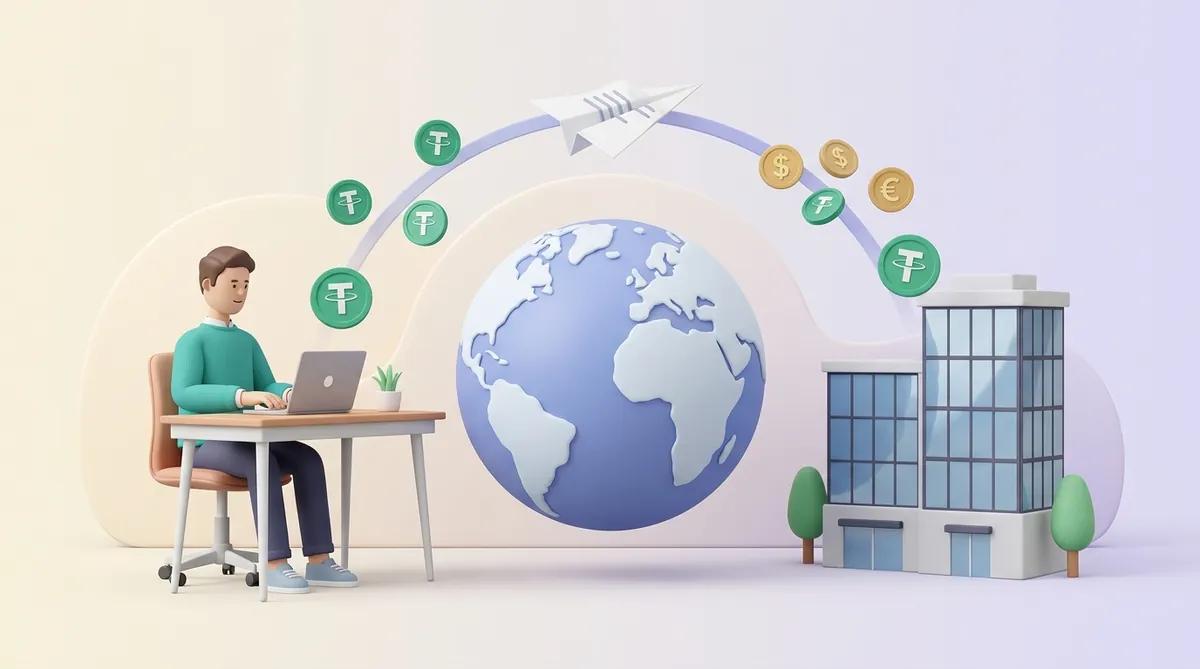
An invoice for a client in another country is your usual invoice with three additions: the currency named outright, a line saying who handles the tax, and a way to pay that works from the client's country. Settle that last part before you send anything — a crypto payment link, an international bank transfer or a card payment — because an invoice that is perfect on paper can still get stuck on the way the money travels.
Most of the invoice is the one you would send to a client next door. The difference is that nobody on the other side knows your local habits, so everything that feels obvious at home has to be written out.
Here is what goes on it:
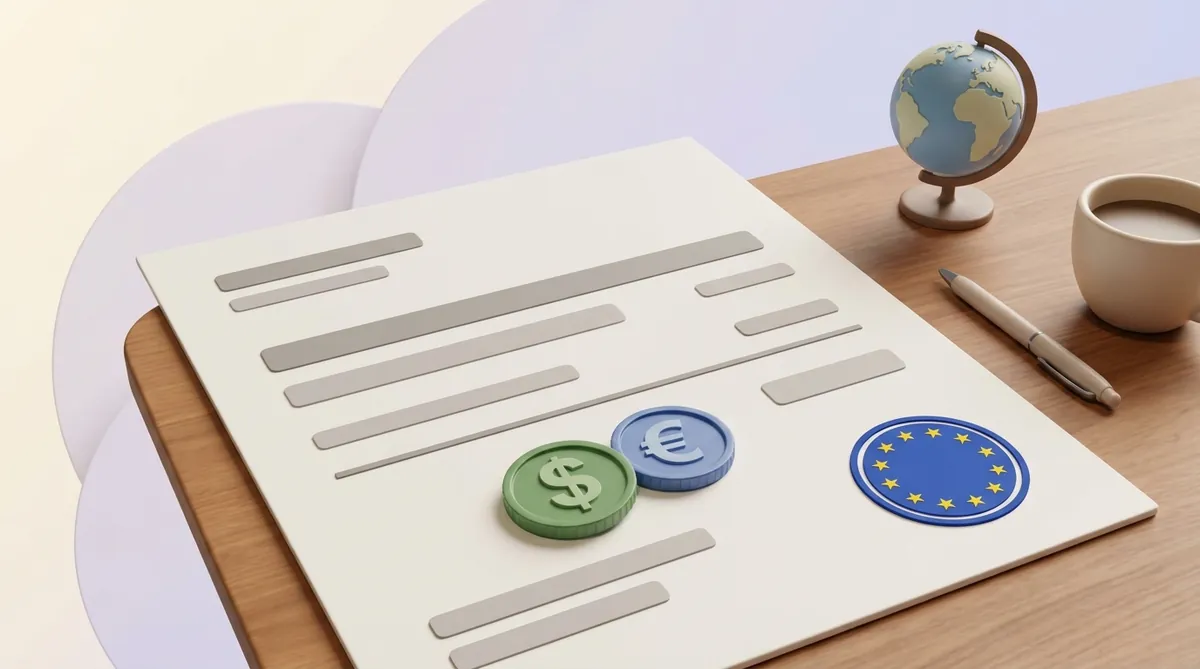
The currency decides who carries the exchange-rate risk: the chance that the rate moves between the day you send the invoice and the day the money lands. You have three options:
Here is what the risk looks like in money. Say you agree 2,000 euros with a Berlin agency, but your rent and bills are in dollars. If the euro slips 3% between the invoice and the payment, that job brings you about 60 euros' worth less, and nobody did anything wrong.
Whatever you choose, fix it in the contract or the quote before the work starts. The invoice then repeats what was agreed instead of opening a new discussion.
If you invoice in USDT, or let the client pay a dollar invoice in crypto, the invoice needs a few extra details: the network, the exact amount and how long the rate holds. Those details, and the cases where a client sends slightly more or less, are covered in our guide to what a crypto invoice must say and what to do when the amount is off.
VAT is a tax on sales. At home the seller usually adds it to the price and pays it to the state. When you sell a service to a business in another country, that duty can move to the buyer, and your invoice has to say so.
Whether you add VAT depends on where you are registered and who the client is. Three common cases for services sold to businesses:
For example, a copywriter in Lisbon invoices a Berlin agency 1,500 euros. The invoice shows 1,500 euros with no Portuguese VAT added, both VAT numbers and the words "Reverse charge". The agency declares German VAT on its own side.
Your own country's rules on income tax, sales tax or GST still apply to what you earn, wherever the client sits.
Before you send an EU client an invoice without VAT, check their VAT number in VIES, the European Commission's free VAT number checker. If the number does not come back as valid, ask the client about it first.
If you are VAT-registered in the EU and invoice a business in another member state under the reverse charge, the invoice must go out no later than the 15th day of the month after the VAT became chargeable (EU, Council Directive 2006/112/EC, Article 222, as of October 2026). For a one-off job where nothing was paid before the work was completed, the VAT becomes chargeable in the month you finish, so the deadline is the 15th of the next month. If the client paid a deposit upfront, ask your accountant which month counts for that part.
The reverse charge doesn't apply here, because a private person can't account for the VAT. In the EU, electronically supplied services sold to private individuals are taxed in the country where the buyer lives (EU, Council Directive 2006/112/EC, Article 58, as of October 2026).
Small sellers have an exception. Such sales are taxed in your own country instead when all of these hold (EU, Council Directive 2006/112/EC, as of October 2026):
Once the total goes over 10,000 euros, the buyer's country taxes these sales from that moment on. The EU's One-Stop Shop lets a seller declare that VAT in one return instead of registering in every country (EU, as of October 2026).
At home, payment terms can be two words. Across a border, spell out four things:
With a new client in another country, an upfront deposit of a third or a half limits what you lose if they never pay. The cost is that some clients will try to negotiate it down.
The payment method decides how fast the money arrives, how much of it survives the trip and whether it arrives at all. Before the first invoice, ask the client how they usually pay foreign suppliers. If you are reading this because a transfer has already bounced or a payment platform doesn't work in your country, start with what to do when payments from abroad won't come through.
The main ways to get paid:
You can put more than one method on the same invoice. A payment link next to bank details lets the client pick whatever is easier on their side.
A crypto payment link is issued by a payment service that watches the network, tells you when the client has paid and handles what arrives. Here is how it works when you get paid on invoices with CryptumPay:
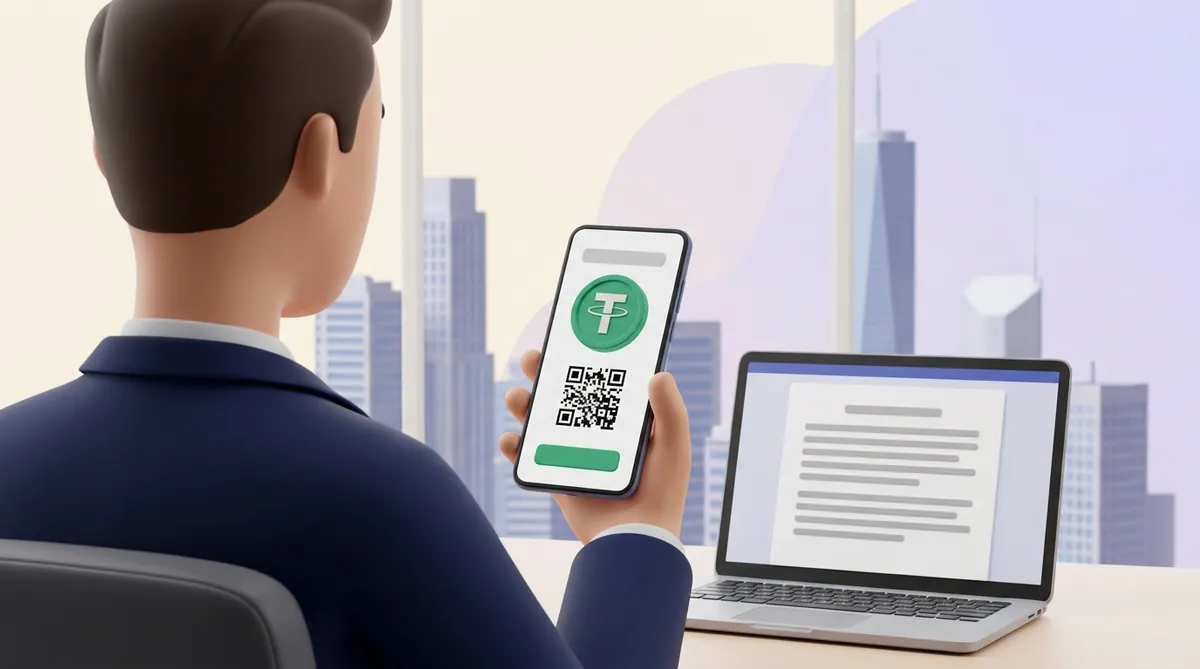
To see what the client sees, from the link in the email to the paid status, read how to accept USDT with a payment link or a QR invoice without any integration.
Agree the currency and the payment method before the work starts, then let the invoice repeat them. Write out everything a stranger in another country could misread: legal names, currency codes, calendar dates and who pays the fees. Add the tax line that fits your case, and send the invoice the day the work is accepted, so the payment clock starts early.
A company pays through an accounts team that works on its own schedule and its own rules. Before the first invoice, ask your contact whether they need a purchase order (PO) number on it, whether you have to register as a supplier, and which inbox the invoice should go to. An invoice without the PO number can sit unpaid without anyone telling you why.
Yes. Amounts on the invoice may be in any currency, as long as any VAT payable is shown in the national currency of the member state (EU, Council Directive 2006/112/EC, Article 230, as of October 2026). On a reverse charge invoice you add no VAT yourself, and the client converts the amount when it declares the VAT on its side.
When the customer is liable for the VAT, the invoice must carry the mention "Reverse charge" (EU, Council Directive 2006/112/EC, Article 226, point 11a, as of October 2026). A short explanation next to those two words helps whoever books the invoice on the client's side, for example: "Reverse charge: VAT to be accounted for by the recipient under Article 196 of Council Directive 2006/112/EC." Put the line next to the total, where the client expects to see the VAT amount.
This article is general information, not legal or tax advice.
Create an account and connect the checkout yourself, or talk to sales and we will plan the integration with you.