

June 11, 2026
What Is a Crypto Swap and How Does It Work?
Read article

Crypto is no longer a single-chain world. A user may hold USDT on Ethereum, trade on BNB Smart Chain, use a wallet on Polygon, explore a Layer 2 network, and still need the same asset to appear somewhere else — a Layer 2 here usually means Base, Arbitrum or Optimism, so how these Layer 2 networks work decides where the money lands. A crypto bridge is the tool that tries to make that movement possible.
At a basic level, a bridge lets assets or messages move between blockchains that do not naturally share the same ledger. That sounds simple, but it adds a new layer of complexity: smart contracts, liquidity pools, relayers, wrapped tokens, validators, fees, waiting times, and security assumptions.
This is why cross-chain transfers feel different from a normal wallet transfer or a crypto swap. A swap changes one asset into another, often on the same network. A bridge changes where an asset can be used.
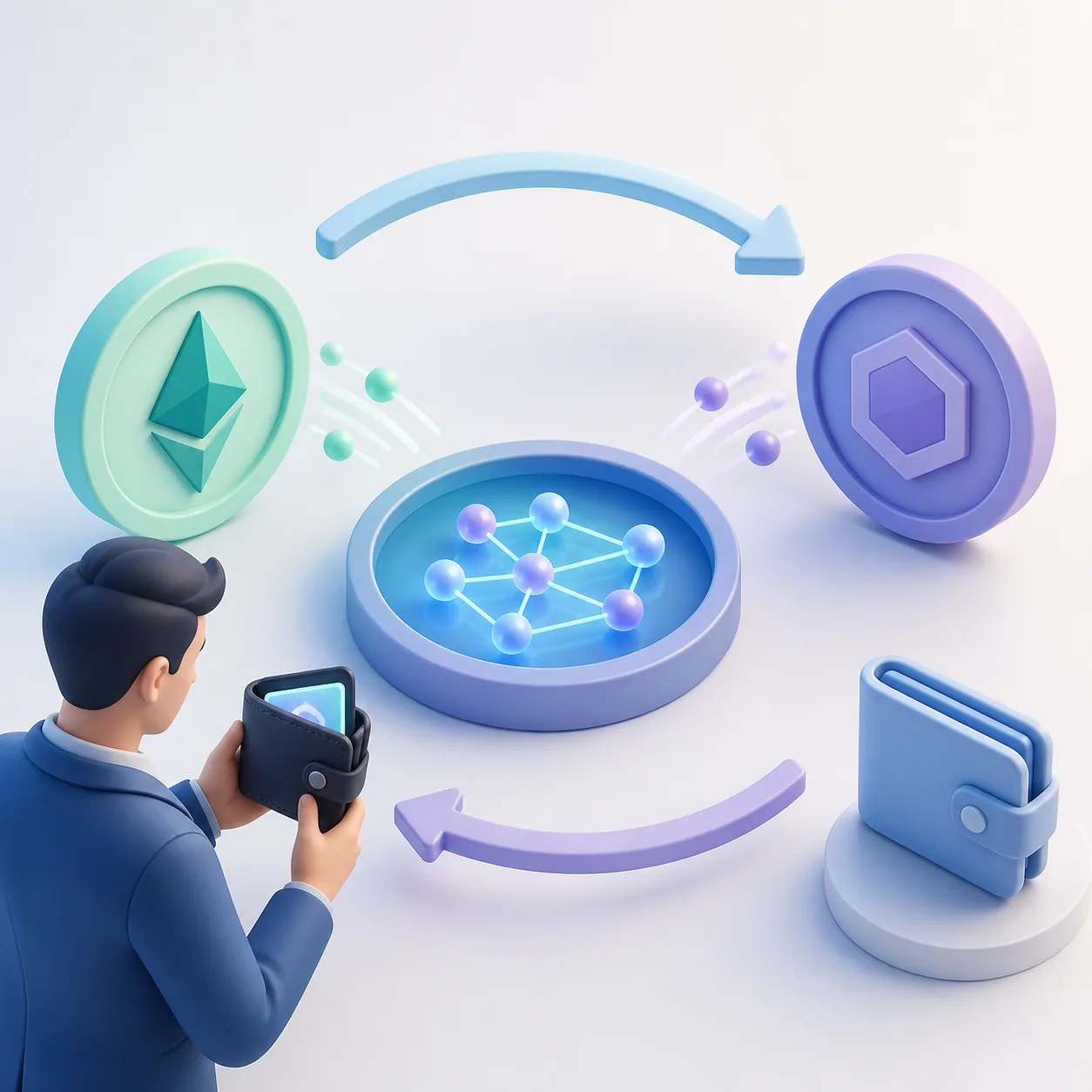
A crypto bridge is infrastructure that connects two blockchain networks. It helps a user move value from one chain to another, for example from Ethereum to BNB Smart Chain, from a Layer 2 network back to Ethereum, or from one EVM-compatible chain to another.
Most bridges do not literally pick up a token from one blockchain and place it on another. Blockchains are separate systems. Instead, a bridge usually uses one of several models:
The result can look like a simple transfer in the wallet interface, but under the hood it is closer to a coordinated workflow across two systems.
A typical bridge transfer has several steps.
First, the user chooses the source network, destination network, asset, amount, and recipient address. This is already a common place for mistakes. Sending from Ethereum to BNB Smart Chain is not the same as sending from Ethereum to Polygon, even if the address format looks familiar.
Second, the user signs a transaction on the source chain. This transaction may lock tokens in a bridge contract, burn a token, or deposit funds into a liquidity route. The user pays the source-chain network fee, so gas conditions matter. If you want a broader payment-focused explanation, see this guide to network fees in crypto payments.
Third, the bridge mechanism observes or verifies the source-chain event. Depending on the bridge design, this may involve validators, relayers, light clients, or oracle-style infrastructure.
Fourth, the destination-chain action is executed. The user receives a wrapped token, native token representation, or pooled liquidity on the destination chain. In some systems this is fast; in others, withdrawals or final settlement can take much longer.
Finally, the user should verify the result on the correct explorer and in the correct wallet network. A cross-chain transfer can appear incomplete if the wallet is still showing the old network.
One of the most important bridge concepts is the wrapped token. A wrapped token is a representation of an asset from another chain. For example, a bridged asset on one network may represent a token locked on another network.
The key point is that a wrapped asset depends on the bridge or issuer behind it. Two tokens can have similar names and tickers but different contracts, different liquidity, and different redemption assumptions.
This matters for users and businesses because not every “USDT” or “ETH-like” token is operationally the same. Networks, token standards, and contract addresses matter. The same logic appears when businesses choose between ERC-20, BEP-20, TRC-20, Polygon, and Solana routes for stablecoin payments. The practical payment side is covered in more detail in the guide on how to choose a USDT network.
Crypto bridges differ by design. The names vary across protocols, but most practical bridges fall into a few broad groups.
Native bridges are built for a specific ecosystem. A Layer 2 network, for example, may have an official bridge for deposits and withdrawals between the Layer 2 and Ethereum. These bridges often align closely with the network’s security model, but withdrawals can still have waiting periods or specific rules.
Third-party bridges connect many chains through their own contracts, validator sets, liquidity networks, or messaging systems. They can be convenient because they support many routes, but users depend on the bridge’s security and liquidity.
Liquidity bridges use pools on different chains. The user effectively deposits into one side and receives from another side. This can be faster and more convenient, but liquidity depth, fees, and routing quality become important.
Cross-chain messaging protocols are broader than simple token movement. They can send instructions between chains, allowing applications to trigger actions across networks. This is powerful, but it also increases the complexity of what must be secured.
A bridge transaction can include several costs at once. The obvious one is the network fee on the source chain. If the destination chain also requires execution, there may be a destination-side fee or a fee embedded in the bridge quote.
Liquidity-based bridges may include a service fee or spread. If liquidity is thin, the received amount can be worse than expected. Some routes also include a swap in the middle, which introduces slippage. That makes the experience closer to a combined bridge-and-swap flow rather than a simple transfer.
Users should check:
For businesses, this is not just a user education issue. If a customer pays from the wrong network or sends a bridged token the merchant does not support, support teams may need to investigate the transaction manually. A good payment flow should reduce ambiguity before money moves.
Bridges are useful because they connect fragmented liquidity. They are risky for the same reason: they sit between systems and often hold or control large amounts of value.
The main risk categories are:
A normal blockchain transfer has one main network context. A bridge transfer has at least two. That means more places where the user, wallet, protocol, or interface can make a mistake.
This is why bridges have historically been attractive targets for attackers. A bridge may hold locked assets, mint representations, or control release logic. If that mechanism fails, the damage can affect users far beyond one transaction.
There is no way to make every bridge transfer risk-free, but users can reduce avoidable mistakes.
Before bridging, check that the bridge route supports the exact asset and destination network. Do not rely only on ticker names. Open the token contract from the bridge interface or a trusted explorer, especially when receiving a wrapped token.
Start with a small test transfer if the amount is meaningful. This is slower, but it can reveal whether the wallet, route, asset, and destination network are configured correctly.
Make sure the destination wallet supports the network. For EVM-compatible networks, the address may look the same, but the wallet still needs the correct chain selected.
Avoid bridge links from ads, direct messages, and search results that look suspicious. Bookmark official bridge pages and access them through the project’s documentation when possible.
After the transaction, verify both sides. If the source transaction succeeded but the destination funds are not visible, check the destination explorer, token contract, and bridge status page before assuming the funds are lost.
For payment operations, the same discipline applies to incoming transfers. A support team should check the TXID, network, asset, amount, confirmations, and status. This process is similar to the workflow in how to check a crypto payment, but cross-chain cases require extra attention to source and destination networks.
Bridges are especially important around Ethereum and EVM-compatible networks. Ethereum is a major settlement layer, while many users move to Layer 2 networks or sidechains for lower fees and faster transactions. The trade-off is that assets often need to move through a bridge.
Ethereum Layer 2 networks are designed to process activity away from Ethereum mainnet while still using Ethereum in different ways for settlement or security. Sidechains and independent EVM chains may look similar in a wallet, but their security assumptions can differ. That is why a bridge route is not just a UX choice; it is also a trust choice.
For users who already understand how Ethereum payments work, bridges add another layer: not only “which asset and address?” but also “which chain, which representation, and which route?”
BNB Smart Chain and BEP-20 tokens are another common example of a network where users often compare fees, wallet support, and token availability. If you need the network basics first, read the guide to BSC and BEP-20 tokens.
Most businesses do not need to run their own bridge. But they do need to understand the user behavior that bridges create.
A customer may hold the right asset on the wrong network. They may bridge funds shortly before paying. They may send a wrapped token instead of the native token the business expects. They may assume that any token with the same ticker is acceptable. They may send funds from a network the merchant does not support.
This is where payment UX matters. A merchant should make supported networks explicit, show the correct address and amount, set clear expiration logic, and give support teams enough data to investigate. If a business accepts crypto through a structured payment system such as CryptumPay, the goal is not to “support every bridge.” The goal is to reduce manual ambiguity around network, asset, amount, status, and reconciliation.
For companies that receive stablecoin payments, the bridge lesson is simple: network choice is part of the payment product. The fewer assumptions customers have to make, the fewer recovery cases the operations team has to handle.
A bridge is not always the best route. If the recipient accepts the asset on the same network where you already hold it, a normal transfer is simpler. If you need to change assets on one network, a swap may be enough. If you are moving funds to an exchange, it may support deposits on multiple networks without requiring a separate bridge.
You should be cautious with a bridge when:
The best bridge transfer is not the fastest-looking one. It is the one where you understand the route, the asset, the fee, the waiting time, and the failure path.
Crypto bridges are a core part of the multi-chain ecosystem. They make it possible to move assets and messages between networks, but they also introduce new trust assumptions and operational risks.
For users, the practical rule is to slow down before signing: check the route, network, token contract, received amount, fees, and destination wallet. For businesses, the rule is to reduce ambiguity before customers pay: supported networks, correct assets, clear payment status, and a support workflow that can verify transactions without guesswork.
Bridges make crypto more connected. They also make the simple question “where are the funds?” more complicated. Understanding that trade-off is the first step to using cross-chain infrastructure responsibly.
Create an account and connect the checkout yourself, or talk to sales and we will plan the integration with you.

