


June 21, 2026
What Is a Stablecoin Depeg and What Should Businesses Do?
Read article
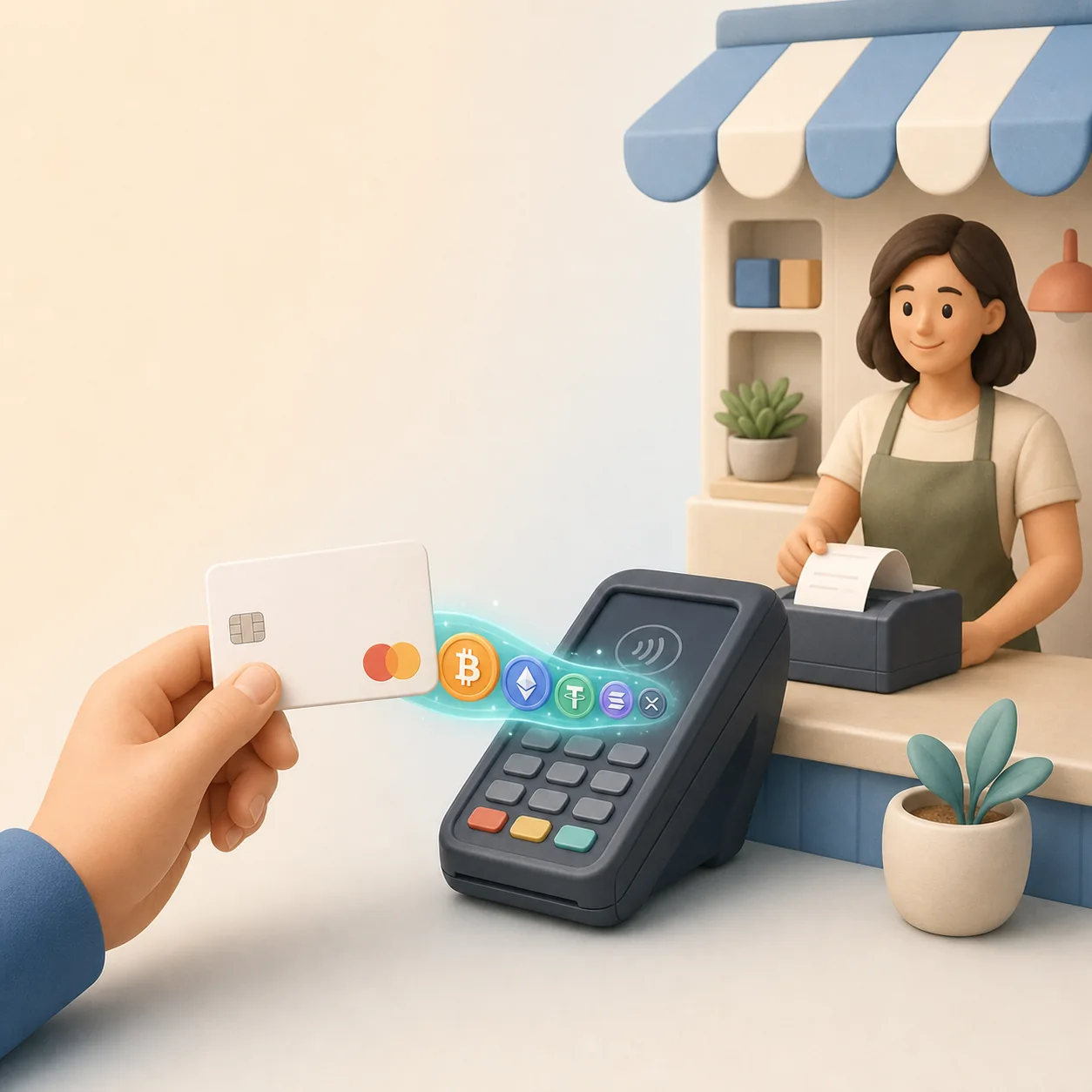
A shopper can tap a crypto card at an ordinary payment terminal without the store accepting USDT, connecting a wallet, or waiting for blockchain confirmations. The experience looks like a normal card payment because, from the merchant’s side, it usually is one.
The crypto component sits behind the card. The provider checks the user’s available balance, converts or reserves the required value, and sends the transaction through conventional card infrastructure. The merchant generally receives fiat settlement through its existing acquirer rather than stablecoins from the customer’s wallet.
That convenience can make stablecoins easier to spend, but the term “crypto card” covers several different products. Some require users to sell crypto before spending. Others convert it at the moment of purchase. Some use a custodial balance, while newer models can connect a card program to on-chain or smart-contract infrastructure.
Understanding those differences is the only reliable way to compare fees, custody, availability, and risk.
A stablecoin card is a physical or virtual payment card whose spending power is connected to a balance held in USDT, USDC, or another supported digital asset.
The card itself is normally issued under a conventional card program by a licensed issuer or its partner. It can often be used wherever the relevant card network and issuer permit transactions. The store does not need special crypto software.
The card may be marketed as:
These labels are not interchangeable legal or technical categories. One provider may require users to preload a fiat card balance by selling USDT. Another may check a crypto account and convert value during authorization. A third may use smart contracts or tokenized balances behind the scenes.
The important questions are not what the marketing calls the card, but where funds are held, when conversion happens, who performs it, and what claim the user has against the provider.
It can function like a familiar debit or prepaid card at checkout, but that does not mean the crypto provider itself is a bank.
A typical program can involve several parties:
The exact structure varies by country and product. The issuer, not the card artwork or app brand, determines many of the card’s formal rules.
Users should identify the issuer, applicable terms, safeguarding model, supported jurisdictions, dispute process, and the entity holding the crypto balance. A recognizable card-network symbol alone does not answer those questions.
There are several common models.
The user deposits stablecoins into an account controlled by the provider or its custodian. The app displays a crypto balance, but the provider controls the wallets and private keys.
This model is operationally simple. The provider can reserve funds quickly, perform conversion internally, manage card authorizations, and process refunds through its own ledger.
The trade-off is counterparty risk. The user depends on the provider’s solvency, security, withdrawal policy, compliance controls, banking partners, and service availability.
The user sells stablecoins before spending and loads a conventional fiat or prepaid balance. Once converted, the card transaction no longer depends directly on the price or liquidity of the original token.
This model makes the exchange rate visible at top-up time. It also means the user no longer holds stablecoins inside the spendable card balance.
The app continues to show a crypto balance until a purchase is authorized. The provider then calculates the required stablecoin amount, reserves or sells it, and funds the fiat card transaction.
This feels closest to “spending USDT,” but technically the merchant still receives a card payment. The user is performing a crypto-to-fiat conversion as part of the payment flow.
Some newer card architectures connect spending to smart contracts or user-controlled wallets. The design may preserve more user control until authorization, but it still needs a compliant issuer, card processing, conversion, and settlement structure.
“Self-custodial card” should not be accepted as a complete explanation. Users should check whether funds can move without their signature, whether assets are locked in a contract, who can upgrade that contract, and what happens when the card is offline or the blockchain is congested.
For a broader view of moving between crypto and conventional money, see the guide to crypto on-ramps and off-ramps.
The exact sequence depends on the provider, but a purchase commonly follows this path.
The customer taps, inserts, or enters the card. The merchant sends an authorization request containing the transaction amount, currency, merchant details, and card credentials.
The card program checks whether the card is active, whether the transaction fits its limits and risk rules, and whether enough spending value is available.
If the balance is held in stablecoins, the provider also needs a conversion price and enough liquidity to cover the authorization.
The provider may place a hold on a fiat-equivalent amount, reserve the corresponding stablecoin balance, or sell the required amount immediately.
The exchange rate used at this stage may not be the final rate if the transaction is completed later.
The authorization travels back through the card network to the terminal. To the merchant, the result resembles any other approved card payment.
The merchant later submits the finalized transaction. The issuer and acquirer complete clearing and settlement under the card program’s rules.
The provider reconciles the final fiat amount against the stablecoins sold or reserved. Tips, deposits, offline transactions, currency conversion, and adjusted final amounts can create differences between authorization and settlement.
Card payments are not always settled for the amount first shown.
Hotels, fuel stations, vehicle rentals, restaurants, and other merchants may request a temporary authorization hold. The final charge arrives later after the merchant confirms the actual amount.
If a crypto card converts stablecoins immediately at authorization, the provider needs a policy for any later difference. It may reserve extra value, convert again, release unused funds, or reject transactions with uncertain final amounts.
Users should check:
This detail matters because the user may see a balance reduction before the merchant has actually received final payment.
A card advertised as having “zero transaction fee” can still be expensive. The total cost may be spread across several components.
The provider may charge an explicit fee when selling the stablecoin for fiat.
The quoted rate may include a margin compared with the market midpoint. A small spread on every purchase can matter more than a visible monthly fee.
If the purchase currency differs from the card’s settlement currency, another conversion may occur. This is separate from converting USDT or USDC into fiat.
Moving stablecoins into the platform can require a network fee. Buying stablecoins, withdrawing unused funds, or transferring between supported networks can create additional costs.
The provider may charge for issuance, delivery, replacement, inactivity, ATM use, subscription plans, or declined transactions.
The useful comparison is the end-to-end cost: acquiring the stablecoin, moving it to the provider, spending it, and withdrawing or converting the remainder.
CryptumPay’s article on what drives online payment fees explains why headline percentages rarely capture the whole payment cost.
Linking a card to USDT or USDC does not eliminate the risks of the underlying asset.
If a stablecoin loses its peg, the provider may change its conversion rate, reduce the available spending balance, pause top-ups, or temporarily stop supporting the token. A displayed balance of 1,000 tokens does not guarantee $1,000 of executable card spending.
The user is also exposed to the provider’s liquidity. Even if issuer redemption continues at par, the card platform needs a functioning route to convert the token and fund card settlement.
The guide to stablecoin depeg risks explains why market price, redemption value, and practical liquidity can diverge.
A merchant refund travels back through the card system. It is not normally a blockchain reversal.
Depending on the product, the provider may:
This can create gain or loss relative to the original purchase if the exchange rate changed. Fees charged during the initial conversion may not be refundable.
Refunds can also take several business days because the merchant, acquirer, network, issuer, and crypto platform all participate in the process.
Users should distinguish a merchant refund from a card dispute or chargeback. The latter follows card-network and issuer rules and may require evidence. The existence of a stablecoin balance does not remove conventional card-dispute processes.
A crypto card combines regulated card issuance with digital-asset services. Providers therefore commonly require identity verification and may request information about residence, source of funds, expected use, or business activity.
Availability can depend on:
A virtual card may be available in places where physical delivery is not. Some products prohibit specific merchant categories or cross-border uses.
Requirements vary by provider and jurisdiction. A card working during travel does not mean it can legally be issued to a resident of every country.
So before you apply, check that the provider is licensed where you live: the application will ask for a photo of your ID and a selfie, and a regulated company is usually required to keep those records for years. Here is how to tell whether it's safe to send your ID to a crypto service.
A crypto card and a direct crypto payment solve different problems.
With a crypto card, the customer uses card credentials and the merchant receives a conventional card transaction. The payment inherits card acceptance, authorization rules, potential disputes, issuer controls, and card-processing costs.
With a direct crypto payment, the customer sends the asset through a blockchain network. The merchant or payment provider detects the transaction, confirms it, and records it against an invoice. There is no card authorization or chargeback mechanism built into the blockchain transfer.
A card is useful when:
A direct crypto payment can make more sense when:
The comparison is not “cards or crypto” in absolute terms. Both can exist in the same payment mix. The article on why businesses offer multiple payment methods explains the value of matching the rail to the customer and use case.
Consumer cards are designed for personal purchases and ATM access. Business cards need additional controls.
A company should look for:
The company also needs to decide whether stablecoins are treasury assets, an expense-funding rail, or merely the source used to load a fiat card account. Those treatments create different accounting and operational records.
Corporate users should not fund employee spending from one uncontrolled personal wallet. The stablecoin operations guide for CFOs managing settlement and withdrawals provides a broader control framework.
A stablecoin card primarily helps the holder spend. A crypto payment gateway primarily helps a business receive and reconcile payments. They sit on opposite sides of the flow.
An online company may accept customer payments through CryptumPay, convert incoming assets to USDT, and withdraw under its treasury policy. It may separately use a card provider for employee expenses or purchases from suppliers that only accept cards.
Keeping the roles separate improves accounting:
Trying to use a consumer crypto card as the company’s entire payment stack usually creates weak reconciliation and unclear ownership.
Before applying for or funding a card, check:
The best card is not necessarily the one with the longest list of supported coins. It is the one whose custody, conversion, fees, limits, and refund rules match the user’s actual spending pattern.
Usually no. The merchant normally receives a conventional fiat card payment through its acquirer. The stablecoin conversion happens within the card provider’s infrastructure.
Not necessarily. Some cards are linked to custodial crypto accounts, some use pre-converted fiat balances, and some connect to on-chain infrastructure. The card itself does not explain who controls the assets.
The merchant amount may be unchanged, but conversion spread, foreign exchange, ATM, subscription, top-up, or withdrawal fees can increase the total cost.
The provider may adjust the spending value, widen conversion rates, pause support, or limit transactions. The exact response depends on its liquidity and card-program rules.
A merchant can accept the card as an ordinary card payment through its card processor. That is different from directly accepting a customer’s stablecoins on-chain.
Both descriptions end with money in the merchant’s account, but it is not the same money moving. Push on that and a further question appears: what kind of digital money you are being paid in at all. Tokenized deposits versus stablecoins, and what the difference changes for payments, takes that up.
A stablecoin card does not make every shop a crypto merchant. It makes a crypto or stablecoin balance usable through familiar card infrastructure by converting or reserving value behind the scenes.
That bridge is useful, but it adds several layers: custody, conversion, issuer rules, card processing, foreign exchange, refunds, and regional restrictions.
Before choosing a card, follow the money from the wallet to the merchant. If the provider cannot clearly explain where funds sit, when conversion occurs, which rate applies, and how refunds work, the tap-to-pay convenience is hiding too much of the real transaction.
Create an account and connect the checkout yourself, or talk to sales and we will plan the integration with you.