How does a business off-ramp crypto payments to its bank account?
Published
08.06.2026
Updated
25.09.2026
Contents
A business gets crypto payments into its bank account by selling the coins for dollars or euros on a platform that can wire the money to the company, and that step is called an off-ramp. A business account at a regulated crypto exchange does this job: the company sells its USDT there and withdraws the money to its own bank. Before comparing fees, make sure the whole chain works for a company like yours, from the coin you hold to the bank that receives the dollars.
Where the off-ramp sits between your customer and your bank
A crypto payment makes four stops on its way to your bank account:
The customer pays. Someone abroad pays a 200 USDT invoice from their wallet or exchange account.
The coins land with you. The 200 USDT arrives on your balance at a payment gateway or in your own wallet.
You send the coins to the off-ramp. The off-ramp is a platform that buys crypto from companies and pays for it in regular money.
The off-ramp pays your bank. You sell the USDT for dollars or euros and withdraw them by bank transfer to the company account.
The reverse road, from dollars into crypto, is called an on-ramp. A merchant who is paid in crypto seldom needs it. The exception is buying a little of a network's own coin to pay transfer fees when you send USDT from your own wallet.
The second stop is the gateway: the service that gives the customer a payment address and tells you the money has arrived. Choosing one is a separate decision with its own price list, so it is worth knowing what a crypto payment gateway really costs and how to connect it.
Four ways a business can cash out crypto
A business gets from USDT to a bank account by one of four roads:
A business account at a crypto exchange. You open an account in the company's name and pass KYB, the business version of an identity check: the exchange checks who owns the company and where its money comes from. After that you sell USDT through a trading pair such as USDT/USD and withdraw the dollars by bank transfer.
An off-ramp provider or an OTC desk. An off-ramp provider is a payment company that takes stablecoins and pays out dollars or euros to a bank account, often through an API that your own system calls. An OTC desk (short for "over the counter") buys large amounts from you directly at a price agreed in advance, instead of through the exchange's public order book.
Redemption with the stablecoin's issuer. The company that issues a stablecoin buys it back at one dollar per coin. Tether, the issuer of USDT, takes direct redemptions from 100,000 dollars and charges the greater of 1,000 dollars or 0.1%, plus a verification fee of 150 dollars, as of September 2026. On the 100,000 minimum that fee works out to 1%, and it only falls to 0.1% from a million dollars upward. Circle, the issuer of USDC, redeems through Circle Mint, an account for exchanges, banks and other institutions that is not open to individuals.
Selling to a person, peer to peer. On P2P platforms you sell USDT to an individual who pays you by bank transfer. For a company this means payments from strangers on the bank statement and a real risk of a transfer that is later reversed or was sent from someone else's stolen account. If you still consider this road, first read how P2P crypto scams work and how to sell crypto more safely.
For most merchants the real choice is between the first two roads. An exchange account covers modest, irregular volumes. A provider or an OTC desk makes sense when volumes are large and regular, or when the off-ramp has to run from your own system without anyone clicking buttons.
What to check before you open an account
KYB takes days and a pile of company documents, so it pays to learn early whether a platform fits you. Get answers to these questions from its help pages or its sales team:
Does it take your coin on your network? USDT exists on several networks, such as TRON and Ethereum, and a platform may accept it on only some of them. USDT sent on a network the platform does not support can be lost or stuck for weeks of support tickets.
Does it serve companies from your country? Platforms publish the countries where they onboard businesses, and some exclude certain lines of business. Check both before you start KYB, not after.
Which currency and which bank rail does it pay out in? Dollars go by wire, euros by SEPA, the EU's bank transfer system. If the payout currency differs from your account's currency, your bank converts it at its own rate.
What are the limits for a new account? Daily and monthly caps can be low at first and rise as the account builds a history. Make sure they fit at least a month of your takings.
How does it check incoming crypto? Regulated platforms screen deposits against lists of risky wallets, and a payment that once passed through a flagged address can be frozen while they ask questions. Screening payments on your side as they come in makes this less likely; here is how AML checks and wallet screening protect crypto payments.
What an off-ramp costs, layer by layer
An off-ramp has no single fee. Between the USDT on your balance and the dollars in your bank, money comes off in several places:
The network fee. Moving USDT to the platform is a blockchain transfer, and every such transfer pays a fee to the network that carries it.
The trading fee or the spread. Some platforms charge a visible trading fee; others earn on the spread, the gap between the rate you get and the market rate. If you get 0.998 dollars per USDT while the market pays 1.000, you have paid 0.2% without seeing a fee line.
The platform's withdrawal fee. Sending dollars or euros from the platform to your bank often costs a flat fee per transfer.
Your bank's side. Your bank may charge for an incoming international wire, and it converts the money at its own rate if it arrives in another currency.
Percentages are easier to judge in money. On 10,000 USDT, every tenth of a percent is 10 dollars. A flat withdrawal fee works the other way: it is the same on 500 dollars and on 50,000, so small, frequent cash-outs pay more for it than rare, large ones.
That is why the one number worth asking any platform for is the total: if I send 10,000 USDT, how many dollars land in my account? A platform that answers with a single figure is easier to compare than one that answers with a fee table.
The first cash-out takes the longest, because the account has to be opened and checked. After that, each cash-out is the last two steps.
What KYB will ask for
Platforms word their lists differently, but a business account usually needs these documents:
Company registration documents. The certificate of incorporation and the articles of association, or their local equivalent.
Owners and directors. A list of the people who own or run the company, with their IDs.
Proof of the company's address. A recent document that shows the registered address.
The steps
Open a business account and pass KYB. Apply in the company's name, not your own, and upload the documents from the list above in one go so the review does not stall on a missing file.
Warn your bank before the first transfer arrives. A wire from a crypto platform can trigger a compliance review at the bank. Tell your bank contact in advance what the money is and keep the KYB documents ready to show.
Copy the platform's deposit address and check the network. The deposit screen shows an address for one specific network. Send your USDT on exactly that network.
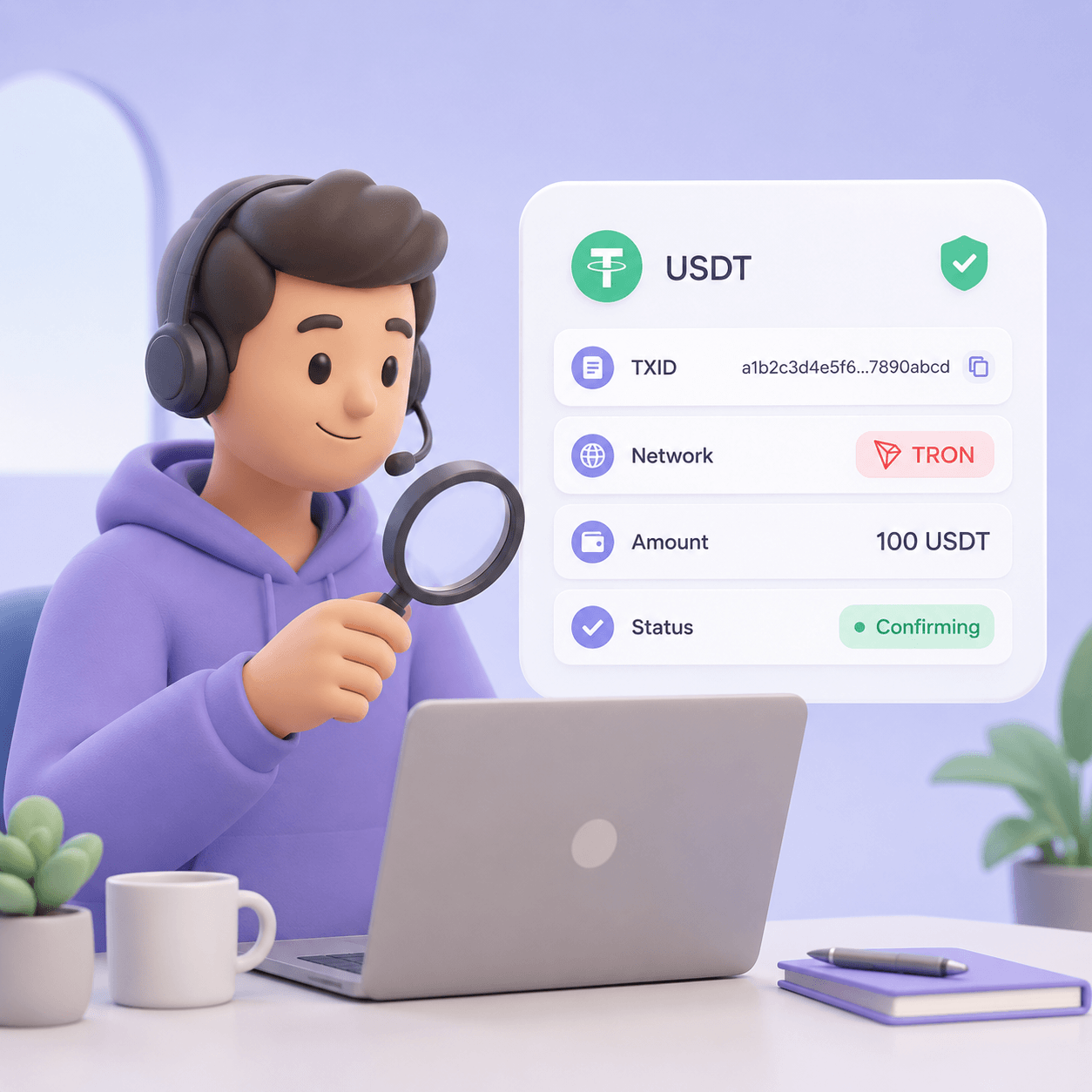
Send a small test amount first. Send, say, 20 USDT and wait until it shows on the platform balance before you send the rest. If it does not appear, the transaction ID shows where it is; here is how to check a crypto payment by TXID, network, amount and status.
Sell the USDT and withdraw the money. Sell at the market price or set a limit order at the rate you want, then withdraw to the verified bank account in the company's name.
Keep the chain of records. Your accountant has to trace each bank credit back through the sale to the customer payments behind it. Download the platform's statement of deposits and sales every time you cash out.
What your payment gateway has already done by the time you cash out
If customers pay through a gateway, part of the road to the off-ramp is already built. What it costs and how the balance is kept both shape what you bring to the exchange.
The gateway's own fee comes before any off-ramp fee. CryptumPay charges 1% per successful payment, down to 0.5% at higher volumes, plus a transfer fee: a fixed fee for servicing a one-time deposit address in the selected network. The merchant decides whether to pass these fees on to the customer; if they do, the payment window shows the fee as a separate line before payment. Added to the off-ramp layers above, this gives the full cost from customer to bank, and it helps to see how network fees, gas and gateway fees add up in a crypto payment.
Customers pay in whatever coin they hold, and a balance spread across five coins means five separate sales at the off-ramp. At CryptumPay every payment is converted to USDT as soon as it is credited, whatever coin the customer paid with, and the rate is locked while the customer pays. You arrive at the off-ramp with one coin and one trading pair.
Withdrawals from CryptumPay work in two modes:
Manually from the dashboard. A withdrawal can be made at any time, with no minimum amount and no IP whitelist.
Through the API. Withdrawals go only from IP addresses on the whitelist tied to the API key.
The merchant sets the recipient address, and it can be any address, not necessarily their own. For example, the deposit address of the company's exchange account.
How much to keep in USDT and how often to cash out the rest
Not every dollar of the balance has to reach the bank. Two parts of it are worth leaving in USDT:
Money you will pay out in USDT anyway. If some contractors or suppliers take USDT, paying them from the balance skips a round trip: selling USDT for dollars now and buying it back later to pay them.
A reserve is not free of risk either. Every USDT depends on its issuer holding the reserves behind it, and that is a risk separate from exchange rates. So the reserve should have a purpose and a size, not grow on its own.
The rest goes to the bank, and the question is how often. Every cash-out pays the flat fees again, so a stream of small withdrawals costs more than a few large ones. Waiting too long has its own price: the money sits outside the bank, where it cannot pay rent or salaries. A simple middle is a rule, such as cashing out every Monday or whenever the balance passes an amount you set, whichever comes first.
The rules depend on where the company is registered. Two large markets show what to look for:
United States, as of September 2026. The IRS treats digital assets as property, not currency. Crypto a business receives for goods or services is ordinary income at its dollar value when received. Every later sale or exchange has to be reported, even when it produces no gain. Selling USDT booked at about a dollar for about a dollar leaves almost no gain, but the sale still goes in the records.
European Union, as of September 2026. Under MiCA, the EU's crypto-asset regulation, platforms licensed in the EU may not offer trading or exchange for money in stablecoins whose issuer is not authorised under MiCA. ESMA, the EU markets regulator, set the end of the first quarter of 2025 as the deadline and allowed a "sell only" window until then. USDT is one of those coins; holding and transferring it remain allowed. An EU company paid in USDT should ask a platform up front whether it will take USDT at all, or whether the coins must first become a stablecoin authorised in the EU, such as USDC.
Whatever the country, one customer payment turns into several entries in the books by the time it reaches the bank as dollars. Before the first cash-out, agree with your accountant how to account for the crypto your business gets paid in.
In short
An off-ramp is where crypto becomes money in the company's bank account. Choose the platform by fit before price, using the questions above, and only then compare how many dollars land in the bank per 10,000 USDT sent. After that, the work is routine: cash out by a written rule and keep in USDT only what has a job to do there.
Questions merchants ask about cashing out crypto
Do I need a corporate account at the exchange, or will my personal one do?
We recommend the corporate one. With a personal account the money lands in your personal bank account, not the company's, and you will have to show both your bank and your accountant why business income went through you. A corporate account takes longer to open, but it keeps the company's money in the company's name from the customer to the bank.
Can I convert USDT straight into US dollars?
Yes, on a platform that lists a USDT–dollar trading pair it is a single sale. USDT is pegged to the dollar one to one, so 10,000 USDT sells for close to 10,000 dollars before fees. Where a platform has no such pair, the sale goes through another coin first, for example USDC, and you pay the spread twice.
Is USDC easier to cash out than USDT?
In the EU, as of September 2026, yes: Circle issues USDC under a French e-money licence in line with MiCA, so EU-licensed platforms can trade it, while USDT is not authorised there. Outside the EU both are sold for dollars on large exchanges, so the choice depends on what your customers hold and what your platform takes. Before changing what you accept, weigh what stablecoins give a business and what risks come with them.
Is there an off-ramp API, so cash-outs run without anyone clicking buttons?
Yes, if the platform has an API for it. Off-ramp providers and some exchanges let your system request a rate, send the stablecoins and order the bank payout through API calls, with the same KYB behind the account. Automation means your server can move money, so limit what it can do, starting with a fixed list of addresses it is allowed to withdraw to.
This article is general information, not legal or tax advice.
Start accepting crypto payments
Create an account and connect the checkout yourself, or talk to sales and we will plan the integration with you.