

April 18, 2025
TRC20, ERC20, BEP20 and other USDT formats: which is best for business and what are the differences
Read article
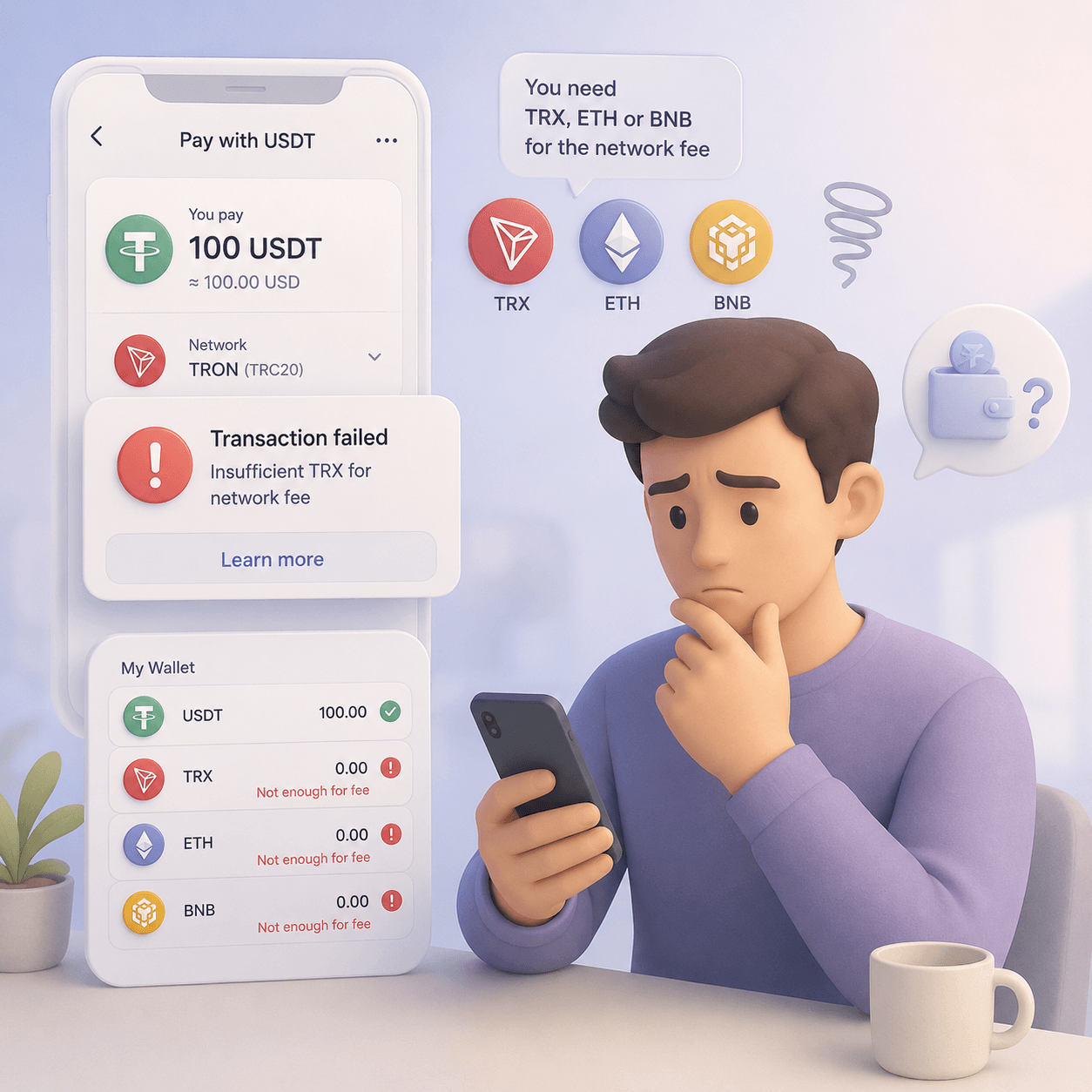
A customer chooses USDT at checkout. They open their wallet. The USDT balance is there. The purchase intent is real. Then the payment fails.
From the customer’s side, it feels confusing: “I have enough USDT. Why can’t I pay?” From the business side, it becomes an abandoned checkout, a failed deposit, an expired invoice, a support ticket, or a lost renewal.
One of the most common reasons is not the USDT balance itself. It is the network fee. To send a token, the customer often needs the native token of the selected blockchain: TRX on TRON, ETH on Ethereum, BNB on BNB Smart Chain, SOL on Solana, and so on. Without that token, the wallet may not let the transaction start.
This is why “gasless USDT payments” has become a useful search term, but it needs careful wording. The network fee does not disappear. The real goal is to make the checkout feel gasless for the customer: no manual gas calculation, no last-minute search for TRX, and fewer failed payment attempts.
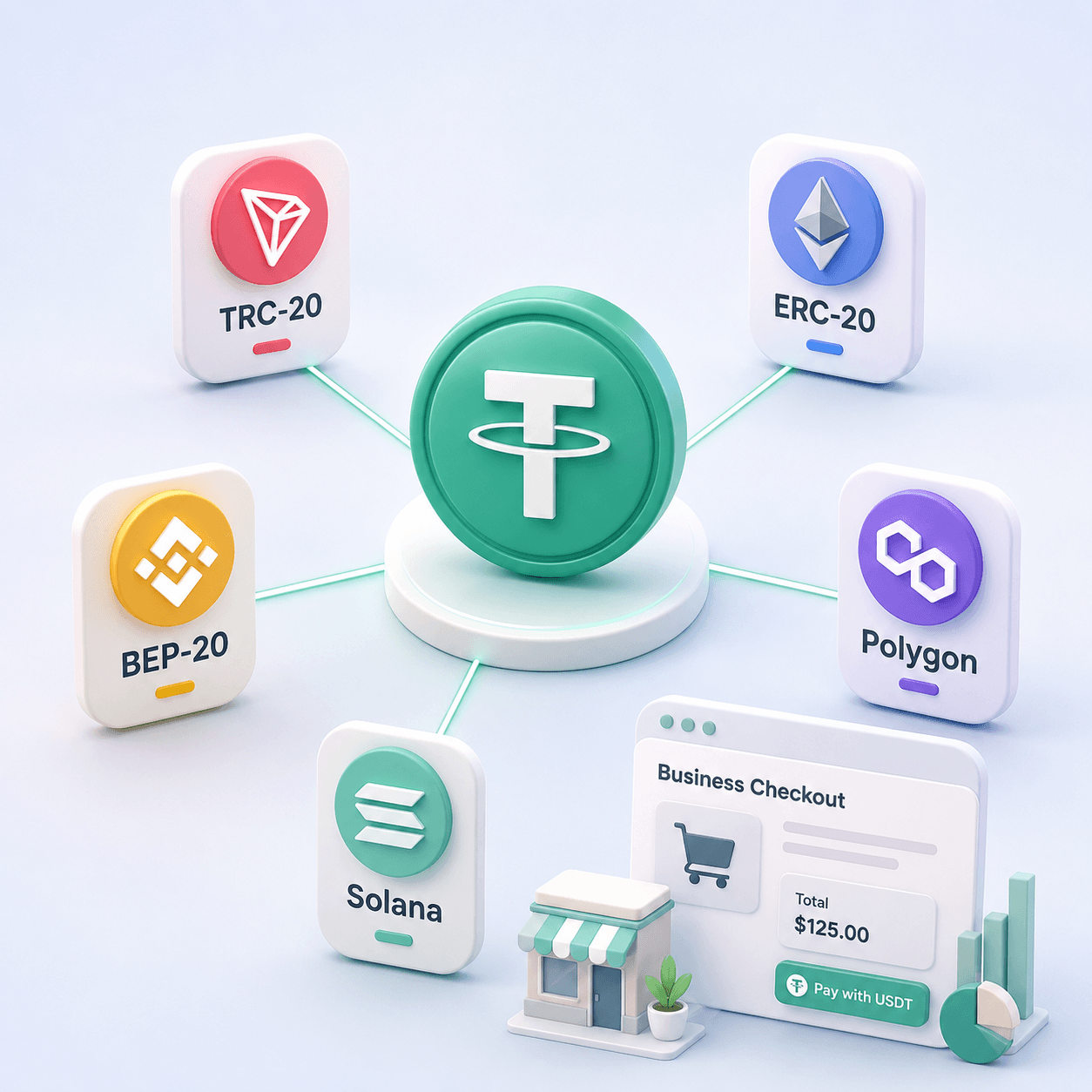
USDT can move across multiple blockchains. Tether lists USDT support across protocols such as Ethereum, BNB Smart Chain, TRON, Solana, and others. That means “pay with USDT” is not a complete payment instruction by itself. The customer also needs to know which network to use.
USDT TRC20, USDT ERC20, and USDT BEP20 may look similar to a customer because the asset name is the same. For a payment system, they are different routes. They use different networks, different fee assets, different address contexts, and different operational rules.
For more background on this distinction, CryptumPay’s guide to USDT token standards explains how TRC20, ERC20, BEP20, and other formats differ for business payments.
The customer sees one balance: USDT. The checkout has to handle a more specific question: USDT on which network?
If the customer chooses USDT TRC20, they may need TRX. If they choose USDT ERC20, they may need ETH. If they choose USDT BEP20, they may need BNB.
A simple example: a customer wants to pay 100 USDT on TRON. Their wallet holds exactly 100 USDT and 0 TRX. The balance looks sufficient, but the wallet cannot send the payment because the transaction still needs network resources. The customer leaves checkout to find TRX somewhere else. Many do not come back.
Most blockchains have a native token that pays for activity on that network. The customer may be paying with a token such as USDT, but the network still requires its own asset to process the transaction.
On Ethereum, this cost is called gas. Ethereum.org explains that gas fees are the total cost of actions in a transaction, and users pay these fees to process transactions or run smart contracts.
On TRON, the model is based on resources such as Bandwidth and Energy. TRON’s developer documentation explains that Energy is generated through TRX staking or delegated by others; TRON’s economic model also states that users without resources pay through a burning fee.
On BNB Chain, BNB is the native token used to power transactions and pay fees. On Solana, every transaction requires a fee paid in SOL.
This creates a mismatch between customer expectation and blockchain mechanics.
The customer thinks: “I am paying with USDT.”
The network checks: “Do you also have the native token required to process this transaction?”
If the answer is no, the payment may not start. If the balance is too low, the wallet may show an insufficient balance warning, disable confirmation, or display an error the customer does not understand.
This problem appears at the worst possible moment: after the customer has already decided to pay.
They may have chosen a product, subscription, deposit amount, top-up, digital service, VPN plan, SaaS credit pack, or in-app purchase. The business is close to receiving the payment. Then the wallet asks for TRX, ETH, BNB, or SOL.
For the business, this creates several losses.
Checkout conversion drops. Some customers will not buy a small amount of TRX or BNB just to complete one payment. This is especially true for low-ticket purchases, first deposits, urgent access, and mobile-first flows.
Support volume increases. The customer says, “I have USDT, but the payment does not work.” Support has to check the selected network, invoice status, wallet error, payment amount, and whether a transaction was ever sent.
Underpayments become more likely. When users calculate fees manually, some send less than the invoice amount. The funds may arrive, but the order, deposit, or subscription is not credited automatically.
Repeat payments suffer. If every top-up or renewal forces the user to think about TRX, ETH, or BNB again, the second and third payments become less reliable than they should be.
For a broader breakdown of payment failure reasons, the article on failed crypto payments covers wrong networks, gas fees, amount errors, expired invoices, and checkout UX. This article focuses on one of the most painful cases: the customer has USDT, but not the token needed to move it.
Customers rarely use technical language. They usually describe the problem in a way that sounds like a wallet issue or a merchant issue:
For a support team, these are not separate mysteries. They are symptoms of the same checkout problem: the payment flow exposed too much blockchain complexity to the user.
Three customer scenarios are especially common.
The customer received USDT from someone else. They may have USDT TRC20 in their wallet, but no TRX. The balance exists, but it cannot move.
The customer is used to exchange withdrawals. On an exchange, the fee is usually shown during withdrawal. In a self-custody wallet, the user often needs the native token separately.
The customer chose a network they do not normally use. They may understand USDT on TRON but have no ETH for Ethereum, or they may use BNB Smart Chain but select TRON by mistake.
A checkout message such as “You need TRX for the network fee” is useful, but it does not solve the payment problem by itself.
If the customer has no TRX, they need to leave checkout, open an exchange or swap service, buy TRX, withdraw it to the right wallet, wait for it to arrive, return to checkout, and try again. If the invoice has expired, they may need to create a new one.
For an experienced crypto user, that is annoying. For a mainstream customer, it is often enough to abandon the payment.
So the goal is not only to explain gas. The goal is to design the payment flow so that gas does not become a separate task for the customer.
A strong USDT checkout should not say only “Pay with USDT.” It should make the payment route clear before the customer opens a wallet.
At minimum, the customer should understand three things:
“Pay with USDT” is too vague.
“Pay 100 USDT on TRON. Network fee may require TRX” is clearer.
“Pay 100 USDT on TRON. Do not edit the amount manually; the invoice must match exactly” is better when the flow depends on exact amount matching.
The checkout should also clarify who handles the network fee. Does the customer pay it separately? Is it included in the invoice logic? Could the customer underpay if they change the amount manually? The answers must be visible before the customer sees a wallet error.
For deeper context on fee mechanics, CryptumPay’s article on crypto network fees explains how fees work across networks such as Bitcoin, Ethereum, and TRON.
The network should not be hidden in fine print. In crypto payments, the network is part of the payment method.
Weak wording:
“Pay with USDT.”
Better wording:
“Pay with USDT TRC20.”
Stronger wording:
“Pay with USDT on TRON. You may need TRX for the network fee.”
Best wording depends on the actual payment flow. If the invoice already accounts for the fee logic, the instruction should say that clearly and prevent manual amount changes.
This is not only a UX detail. It reduces wrong-network payments, underpayments, expired invoices, and support questions.
The lowest-fee network is not always the best default. A network can be cheap and still create friction if users do not hold the required native token or do not understand the wallet flow.
Network choice should reflect real customer behavior:
For many USDT payment scenarios, TRON is popular because users often associate it with USDT transfers. But even there, the customer may still need TRX or network resources. CryptumPay’s guide to TRON crypto payments is a useful supporting article for TRON-based USDT flows.
Manual transfer is where many crypto payment errors happen. The customer copies an address, switches to a wallet, chooses a network, enters an amount, checks the fee, sends the transaction, then returns to the merchant page.
Every manual step is an opportunity for error.
A QR or app-based flow can reduce that risk by pre-filling critical payment details. The customer should not have to manually move the address and amount between screens if the product can avoid it.
CryptumPay supports a QR/app flow where customers can pay after scanning a QR code without manually entering payment details. It can also include the network fee in the invoice logic, reducing the risk of incorrect payment amounts.
The most painful scenario is simple: the customer has USDT but no native token for gas. They are ready to pay, but the checkout forces them to solve a separate wallet funding problem.
In selected scenarios, CryptumPay can help with the native token required for the network fee. For example, in a USDT payment on TRON, the service can provide the TRX needed for the transaction if the user does not have it, with the corresponding value reflected in the USDT invoice amount.
This should not be described as “no fees.” The network fee still exists. The difference is that the customer does not have to leave checkout to buy a small amount of TRX, ETH, BNB, or another native token just to complete the payment.
Gas friction is not only a first-payment problem. It can hurt repeat payments even more.
For SaaS, gaming, iGaming, VPN, Telegram commerce, mobile apps, and digital products, repeat payments often matter more than the first payment. A customer may need to renew a subscription, add credits, make another deposit, unlock a feature, or top up a balance.
If every repeat payment starts from scratch, the user faces the same friction again:
That flow is too fragile for businesses that rely on recurring revenue or repeat deposits.
After the first successful payment, the repeat flow should become shorter: fewer manual fields, clearer payment history, saved context where appropriate, faster confirmation, and less wallet confusion.
For subscription and top-up products, the guide to recurring crypto payments for SaaS explains how renewals, top-ups, saved flows, and failed payment recovery work. For app-based products, the article on crypto payments in mobile apps is a better fit.
Even a good checkout will not remove every edge case. The difference is whether support has enough context to solve the issue quickly.
Support should not depend on screenshots alone. The dashboard should show a clear payment record in three layers.
Invoice data. Support needs to see the asset, network, expected amount, invoice ID, invoice creation time, expiry time, and whether the network fee logic was included in the amount shown to the customer.
Transaction data. Support needs to know whether a transaction was detected, which network it used, which amount arrived, whether there is a transaction hash, whether confirmations are still pending, and whether the received amount matches the invoice.
Resolution path. The system should make it clear whether the team should wait for confirmation, ask the customer to retry, send the case to manual review, credit the balance, request the missing amount, or escalate to finance or risk review.
This structure saves time for both sides. The customer does not need to send five screenshots. Support does not need to guess whether the issue is no gas, wrong network, underpayment, expiry, or missing confirmation.
For finance teams, this connects to stablecoin payment operations for CFOs: USDT payments need payment records, fee logic, transaction hashes, reconciliation, conversion, withdrawal tracking, and exception handling.
To know whether gas-related failures are improving, do not look only at total crypto payment volume. Volume can grow while checkout problems remain hidden.
Start with the core payment funnel:
Then track the failure points that matter for USDT payments:
For repeat-payment businesses, add repeat behavior:
These metrics turn a vague problem — “customers struggle with crypto payments” — into a concrete product and operations backlog.
Gas-related USDT failures can affect any online business, but they are most damaging in fast, repeat, or balance-based payment models.
In iGaming and betting, a failed deposit can mean the user leaves before playing.
In SaaS and AI tools, a failed top-up can interrupt product usage.
In VPN and digital services, customers often want immediate access.
In Telegram commerce, users may close the bot and never return.
In mobile apps, customers expect a short flow that feels closer to Apple Pay or a banking app than a manual blockchain transfer.
The rule is simple: the more urgent the payment, the less patience the customer has for buying TRX or BNB somewhere else.
This is also why gasless USDT payments should be treated as a checkout design problem, not only a blockchain education problem.
A crypto checkout should not become a blockchain tutorial. The customer needs enough information to pay correctly, not a full explanation of every network.
For TRON:
“Pay 100 USDT on TRON. TRON transactions may require TRX. Do not edit the amount manually; it must match the invoice.”
For Ethereum:
“Pay 100 USDT on Ethereum. Ethereum network fees are paid in ETH and may vary depending on network activity.”
For BNB Smart Chain:
“Pay 100 USDT on BNB Smart Chain. You may need BNB for the network fee.”
For a flow where the fee is handled in the invoice:
“Pay the exact invoice amount. The payment flow accounts for the network fee; changing the amount may delay crediting.”
The message should appear before the customer opens the wallet. If the explanation appears only after the wallet rejects the transaction, part of the audience is already gone.
For businesses, the goal is not to teach every customer how TRON, Ethereum, BNB Chain, and Solana work. The goal is to let customers pay with fewer manual steps and fewer avoidable errors.
CryptumPay is designed for businesses that need to accept crypto payments on a website or in an app. It supports QR-based payment flow, popular assets such as BTC, ETH, TRX, BNB, SOL, XRP, and USDT, a merchant account, operation history, manual and automatic withdrawals, automatic conversion into USDT, API, HTML widget, White Label options, AML checks, and two-factor protection.
For gas-related USDT payments, three product points matter most.
First, the network fee can be included in the invoice logic, reducing the chance that the customer sends the wrong amount.
Second, in selected scenarios, the service can help with the native token required for the fee, such as TRX for USDT on TRON.
Third, after the first payment, repeat payments can become faster and require fewer manual transfers. CryptumPay documentation describes one-button repeat deposits after the first payment and biometric confirmation in the app.
This does not remove blockchain fees. It removes part of the checkout friction that makes customers abandon payments.
Before launching or optimizing USDT payments, review the flow in three areas.
Checkout clarity. The payment page should show the asset and network together, such as USDT TRC20 or USDT ERC20. It should explain which native token may be required for the fee and whether the customer should edit the amount manually.
Error handling. The business needs a clear path for customers who have USDT but no TRX, ETH, BNB, or SOL. It also needs rules for underpayment, expired invoices, wrong-network transfers, duplicate payments, and late transactions.
Operations and reporting. Support should see invoice details, network, expected amount, received amount, transaction hash, status, and reason for manual review. Finance should be able to track fees, settlement, withdrawals, conversion, and exceptions.
If these areas are unclear, the issue is not only the blockchain fee. The issue is that the payment flow leaves too much technical work to the customer.
Gasless USDT payments are not about pretending that network fees do not exist. They are about removing the need for customers to manage gas manually at the worst possible point in the payment journey.
A customer may have enough USDT and still fail to pay because they do not hold TRX, ETH, BNB, SOL, or another native token required by the selected network. For the user, this looks like a wallet error. For the business, it becomes lost revenue, support load, underpayment, or a failed repeat transaction.
The solution is a better payment flow: show the network clearly, explain the fee before the wallet opens, reduce manual copy-paste, track gas-related errors, define support rules, and use payment infrastructure that can handle network fee logic.
The customer does not want to learn why USDT needs TRX or ETH. They want to pay, receive access, and move on. The closer crypto checkout gets to that expectation, the fewer payments businesses lose at the final step.
Create an account and connect the checkout yourself, or talk to sales and we will plan the integration with you.