September 1, 2026
How Hosting Providers Accept Crypto Payments: Costs, Statuses, and Refund Rules
Read article

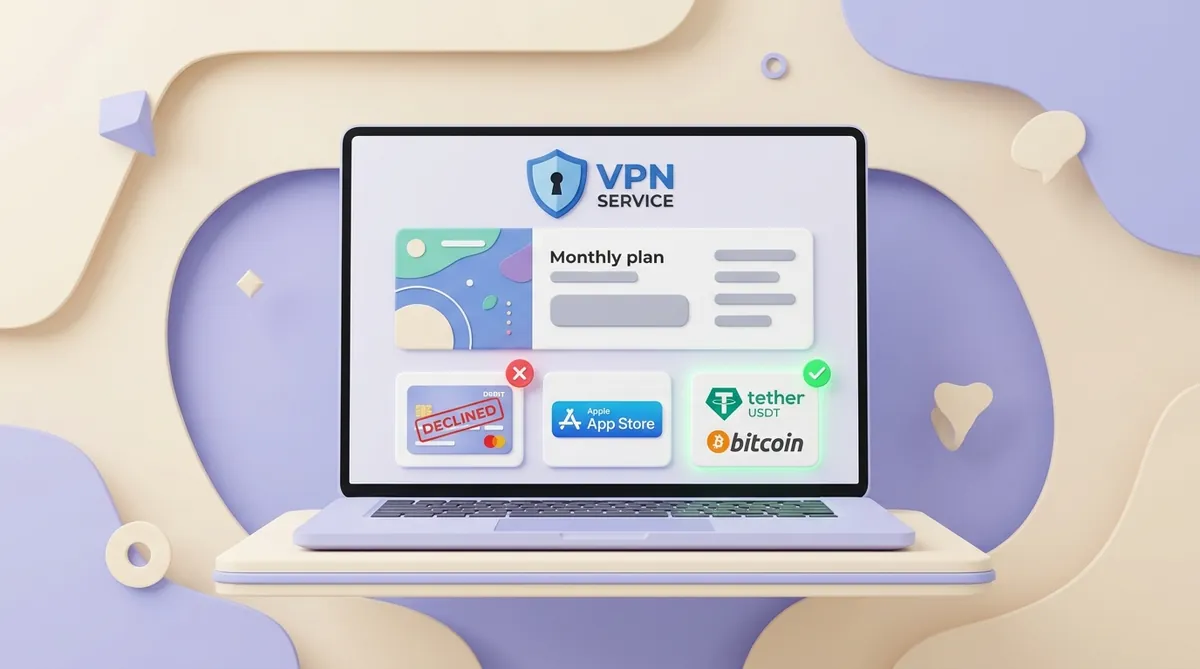
A bank saying no doesn't leave a VPN business with nothing. There are still five payment methods to choose from:
Most VPN services use two or three of these at once. Cards bring in the most customers. Crypto keeps money coming in on the day a card account gets frozen. Below we cover why banks turn a VPN down, what each route costs and where it breaks, and how to take crypto for a subscription that renews every month.
A payment processor is the company that takes a card payment on your site and passes the money on to you. Behind it stands an acquiring bank that opens your merchant account, which is what lets a business accept cards at all. When they call a business "high risk", they mean they expect to lose money on it more often than on a typical online shop.
A VPN business sets off several alarms at once:
Card networks count each merchant's share of disputed payments. A merchant who goes over their limit pays fines and can lose the right to accept cards. So a processor that expects a lot of chargebacks from a VPN would rather refuse it at the start.
A refusal isn't the worst outcome, though. The worst is getting approved and then closed down. A few months after launch the processor reviews your live payments, sees disputes growing, closes the account and holds your balance for a while to cover disputes that may still come in. Every subscription tied to that account stops renewing the same day.
None of this is peculiar to VPNs. The same underwriting file is opened on a travel agency, a ticketing site or an online school, and the common thread is the shape of the money — taken before delivery, renewing by itself, arriving from everywhere — rather than the industry name on the door. If you want the mechanics behind the label, including the four-digit category code that classifies a business before anyone reads its application, they are set out in why processors put a legal business on a high-risk merchant account.
The routes differ in who carries the risk, how much of each payment you keep and how easily they can be switched off:
A VPN merchant account is an ordinary merchant account from an acquirer willing to work with high-risk businesses. Nobody sells a special product under that name. What changes is the checking before approval and the terms after it.
Here is how to get through the application:
A crypto payment is a transfer recorded on a blockchain, a public ledger that many computers keep at the same time. Once a transfer is recorded, only the person who received the money can send it back. If you have never handled crypto, start with what cryptocurrency is and how a blockchain records a payment.
A VPN service can take crypto in two ways:
Which one makes sense usually depends on volume. Matching ten payments a month by hand is fine. Matching a thousand is a full-time job. The trade-offs, with real costs, are covered in accepting bitcoin and other crypto on a website.
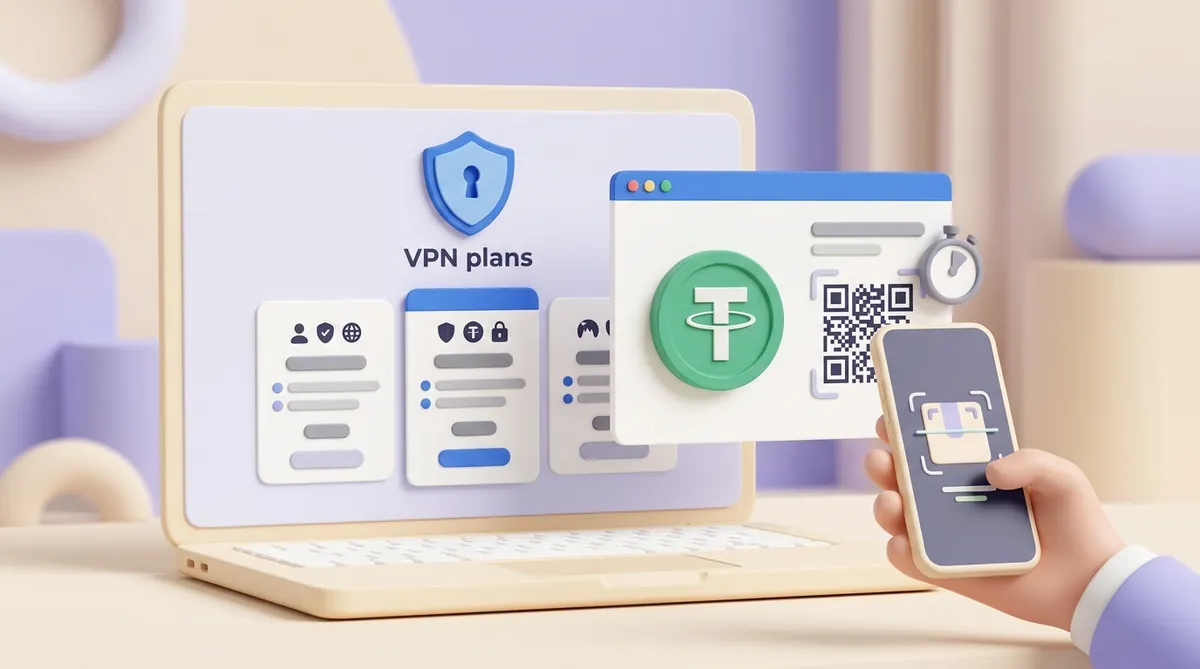
A crypto payment gateway usually gives a VPN three ways to take a payment:
At CryptumPay, the three work like this:
CryptumPay works with VPN services as subscription (SaaS) businesses. Onboarding at CryptumPay is identity verification plus a project review, usually within one business day, and the subscriptions offer is laid out in accepting crypto for plans, renewals and usage.
For a subscription priced in dollars, choosing a coin mostly comes down to whether the price still holds when you spend the money. Two coins cover most VPN customers:
A VPN that takes bitcoin doesn't have to carry that swing. The usual defence is to turn the coins into a stablecoin soon after they arrive, and the other options are in how to protect received crypto from price swings.
With USDT, one more choice remains: the network. USDT runs on several blockchains, and a customer can only pay on a network your checkout accepts. Most people sending USDT use TRON, so it's the network to support first. A transfer there isn't cheap, though: at September 2026 prices it costs the sender roughly $2–4 in TRX unless they hold energy, the TRON resource that pays for token transfers. Where that fee comes from and how it changes is covered in what USDT TRC-20 and TRX payments really cost a business.
Every extra coin brings a few more customers, but it also adds settings to maintain and support questions to answer. If you are weighing a longer list, look at which coins are worth accepting and how to set them up.
A crypto payment carries two separate charges:
There is no chargeback fee in crypto, because no bank can reverse the payment. For a business used to high-risk card terms, that changes the maths, and you can see how in what crypto acquiring costs a business in 2026.
Crypto still has a risk of its own: dirty money. A subscriber can pay from a wallet linked to theft or to sanctioned addresses, and that payment can be held for checks later. Payment gateways screen incoming transfers for this, and the checks involved are covered in AML, KYC and wallet screening for crypto payments.
For most VPN services, the safest setup combines the routes so that no single refusal cuts off income:
How you show these methods matters as much as which ones you pick. A customer who has to hunt for their method or re-enter details often leaves without paying, and the fixes for that are in how to get more of the people who reach checkout to pay.
Crypto's share grows when the pricing page treats it as a normal option, with the crypto price right beside the dollar price. Further steps are in how to bring in crypto customers and get more crypto payments.
The rules sit in different places, and a processor will ask about each of them:
A bank's refusal closes one door for a VPN business, not all of them. Every route that is left has a weak spot, so the safest setup runs two routes side by side.
One of those two should be crypto priced in USDT, because no card network can switch it off. The other is whichever card route will have you, backed by subscription rules clear enough for an underwriter to approve.
A business account is a bank account opened in the company's name rather than yours. Every route except crypto pays out only to such an account, so any VPN that takes cards needs one. Banks run their own risk checks and can turn a VPN down just as processors do. Crypto payments arrive without a bank, but a company's own bills are usually paid in regular money, so sooner or later the coins go through an exchange into a business account.
In practice that means two accounts in the company's name on the crypto side: an exchange account where the coins are sold, and a bank account that will take money from that exchange. Each one checks the company before opening and asks for its own papers, so it helps to know up front which crypto business account a company needs and what opening one takes.
When a chargeback arrives, the money is taken back from the merchant, and the acquirer usually adds a fee. The merchant can contest it with evidence, and the customer's bank decides. A VPN that keeps no activity logs has little usage data to show, so its evidence comes down to what the customer agreed to and was reminded of before the charge. That's why VPN providers refund quickly when asked: a refund costs only the payment, while a chargeback adds a fee and counts against the account.
For a subscription, the evidence that holds up is much the same in any industry: the terms the customer accepted and when, the reminder sent before the renewal, and any message where they asked about their account. The reply also has to answer the reason code the bank sent, and the processor's deadline is short. Before the next wave of renewals, it is worth learning which evidence wins a chargeback dispute for each reason code.
It depends on where your company is and where your customers are, and both the VPN itself and the crypto payment have to be allowed. In the US, FinCEN guidance FIN-2019-G001 (9 May 2019) treats a company that collects crypto for other merchants as a money transmitter that must register. Money a business accepts only as part of selling its own service falls under an exemption in the same rules. In the EU, the MiCA regulation (Regulation (EU) 2023/1114) requires crypto-asset service providers to be authorised, and the transition period for firms that had operated under national rules ended no later than 1 July 2026. If your company is in the EU, check that your payment gateway holds that authorisation.
The crypto half of that question has the same answer for a VPN as for any other seller. In the United States, the United Kingdom and the European Union, taking crypto for your own service needs no licence of its own. Türkiye, on the other hand, has banned paying for goods and services with crypto since 30 April 2021, and in China a September 2021 notice declared crypto business activity illegal. So the first thing to check for your company is which countries let a business accept crypto payments and which ban them.
Often, yes, at least at the start. Stripe's published list of prohibited and restricted businesses doesn't name VPN services, so an application can be approved. Both companies keep reviewing live accounts, though, and a rising dispute rate or a wave of complaints can lead to a paused account with money held inside it. Set up a second route before your first big wave of renewals, not after a freeze.
Nobody can charge a crypto wallet without its owner's approval, so every renewal is a new payment the customer approves. The usual approach is to send a payment link a few days before the paid period ends, so the customer has time to pay before access runs out. Longer prepaid plans mean fewer renewals to chase. At CryptumPay, a regular wallet payment requires customer confirmation: there is no automatic charge, and the customer confirms each renewal.
This article is general information, not legal or tax advice.
Create an account and connect the checkout yourself, or talk to sales and we will plan the integration with you.