en

What is a crypto airdrop and how does it work?

Published
26.10.2026
Updated
26.10.2026
Coins with the Ethereum logo float down on colorful parachutes over pastel hills, while a woman in a coral jacket and a man in a teal sweater raise their phones to catch them; one coin lands on the woman's phone with a green glow
Contents

    A crypto airdrop is a project sending free tokens to many wallets at once, usually to people who used its app early, held a certain coin or did a few small tasks for it. The tokens may be worth a few dollars, occasionally a few thousand, and sometimes close to nothing once trading starts. Scammers use the word "airdrop" as bait too, so it pays to know what a real one looks like before you try to claim it.

    Why would a project give tokens away?

    A token is a coin that a project issues on top of an existing blockchain such as Ethereum or Solana. Owning it may give you a vote on how the project is run, or it may simply be something you can sell. A token lives as an entry in the blockchain's shared record of who owns what, and if that record is new to you, it helps to read first how cryptocurrency and blockchain work.

    Giving tokens away looks generous, but it does a job for the project:

    • It spreads ownership. A token held by a hundred thousand people looks like a community, not a founders' club, and it spreads votes on the project's future beyond a handful of wallets.
    • It rewards early users. People who used the product before it had a token get a thank-you, and the project hopes they stay.
    • It buys attention. An airdrop gets talked about, and tasks like "follow our account" or "invite a friend" turn recipients into marketing.

    A well-known example is Uniswap, an exchange that runs on Ethereum. In September 2020 it gave 400 UNI tokens to every address that had used it before 1 September, more than 250,000 addresses in total. On launch day those 400 tokens were worth more than $1,000.

    How crypto airdrops work, from snapshot to claim

    Most airdrops follow the same path. The details change from project to project, but the steps stay:

    1. The project sets the rules. It decides who qualifies: for example, anyone who held a certain coin, or anyone who used the app at least five times. A project may keep these rules quiet until after the snapshot, so nobody can game them.
    2. The project takes a snapshot. A snapshot is a record of every wallet's balance and activity at a chosen moment on the blockchain. Only what happened before that moment counts: if you bought the coin an hour after the snapshot, you get nothing.
    3. The project filters the list. It may strike out wallets that look like one person splitting activity across hundreds of addresses to collect more tokens. This is called Sybil filtering.
    4. The tokens go out. Either they land in qualifying wallets on their own, or the project opens a claim page where each person collects their share.

    The tokens go out at or after the TGE, the token generation event: the day the token is created and, in many cases, starts trading. Before the TGE, an airdrop is only a promise.

    When an airdrop needs a claim, the claim page is only a front. Behind it sits a program that holds the tokens, checks whether your address is on the list and sends your share when you ask. Nobody at the project approves your claim by hand: the whole job is done by a smart contract, a program that runs on the blockchain itself.

    A man in a violet hoodie walks along a winding path with his phone: Ethereum coins lie behind him, a camera on a tripod fires a flash in the middle, and ahead a token with the Ethereum logo floats down on a parachute next to a green checkmark

    What kinds of airdrops are there?

    The word covers several different deals. The main ones:

    • Holder airdrops. You hold coin X at the moment of the snapshot and receive token Y in proportion to your balance, without doing anything else.
    • Retroactive airdrops. The project rewards people for using its app in the past, before anyone knew a token was coming. Uniswap's UNI was one of these.
    • Task airdrops. You follow an account, post about the project or invite friends. In exchange you hand over your social handles and sometimes an email.
    • Hard fork airdrops. A blockchain splits into two, and everyone who held the old coin receives the same amount of the new one. When Bitcoin Cash split from Bitcoin in August 2017, everyone who held bitcoin at the moment of the split ended up with the same amount of BCH.
    • Points programs. The project counts your activity as points and promises to turn them into tokens later. The project alone sets the conversion rate, sometimes only at the very end.

    Can you actually make money from airdrops?

    Sometimes, and nobody can know how much in advance. Receiving an airdrop is free. What the tokens are worth depends on the market once trading starts, and that market is full of people who got the same tokens for nothing. When many of them sell on the first day, the price can drop sharply.

    Many people chase airdrops on purpose. This is called airdrop farming: using new apps, moving coins between networks and making many small transactions in the hope of qualifying for a future token. Farming is not free, and its costs come in three kinds:

    • Fees. Every transaction on a blockchain costs a network fee, and farming means hundreds of them.
    • Risk to the money you use. Coins locked in a young app can be lost to a bug or a hack.
    • Time with no guarantee. A project may hide its rules, filter out farmers or never launch a token at all.

    A simple example: someone spends $200 in network fees over six months and receives tokens worth $50. Or nothing, if the snapshot rules counted something they never did.

    How to claim an airdrop safely

    A real claim takes a few minutes. These steps keep you away from the fake ones:

    1. Find the claim link at the source. Open the project's official website or its verified account and follow the link from there. A claim link that came in a direct message, a reply under a post or a search ad is not a source.
    2. Check eligibility with the official checker. A checker only needs your public address to tell you whether you qualify. Looking costs nothing and needs no signature; a page that asks you to sign something just to "see your allocation" is not a checker.
    3. Keep little in the wallet you claim with. If a claim page turns out to be fake, it can only take what the connected wallet holds. When the qualifying address also holds your savings, moving most of them to another address you control before claiming costs one network fee and limits the damage.
    4. Keep some of the network's own coin for the fee. A claim is a transaction, and the network charges for it in its own coin, such as ETH on Ethereum or SOL on Solana. If you are unsure what that charge covers and why it rises and falls, see how network fees and gas work.
    5. Read what your wallet asks you to sign. A claim transaction should look like a claim. A request to "approve" spending of tokens you already own, or to give access to all your collectibles, has nothing to do with collecting a gift.
    6. Watch the deadline and the unlock schedule. Some claim pages close after a few weeks. Some tokens arrive locked and unlock in parts over months, which is called vesting.

    Once the claim goes through, the tokens may not show in your wallet straight away. Some wallets display a new token only after you add it by its contract address, which you copy from the project's official site, not from a search result.

    How airdrop scams work

    Scammers copy every step of a real airdrop and add a trap to one of them. The common traps:

    • Fake claim pages. The site looks exactly like the project's, but the address differs by a letter or a word. Connecting your wallet alone does no harm. The harm comes when you sign: the request turns out to be an approval that lets the scammer's contract move your tokens, and a script called a drainer empties the wallet within seconds. A signature like that stays valid until you cancel it, so it helps to know how token approvals work and how to check and revoke them.
    • Tokens that turn up uninvited. One day an unknown token sits in your wallet, its name written like a website: "visit this site to claim your reward". Some show a large balance to look convincing. The token is bait, and the trap is the website it points to. Leave it alone; many wallets have a button to hide it.
    • "Pay to unlock". A page or a message says your tokens are waiting and asks you to send coins to an address first, to cover "release" or "verification". A real claim does not ask you to send coins anywhere first: you pay the network fee as part of the claim transaction itself. The coins you send to such an address never come back, and the tokens never existed.

    The last trap goes for the keys themselves. A message from "support" or a form on a claim page asks for your seed phrase, usually 12 or 24 words that restore your wallet on any device. No airdrop, project or wallet ever needs those words, and anyone who has them owns your coins, which is why it is worth knowing how to keep your seed phrase and private key safe.
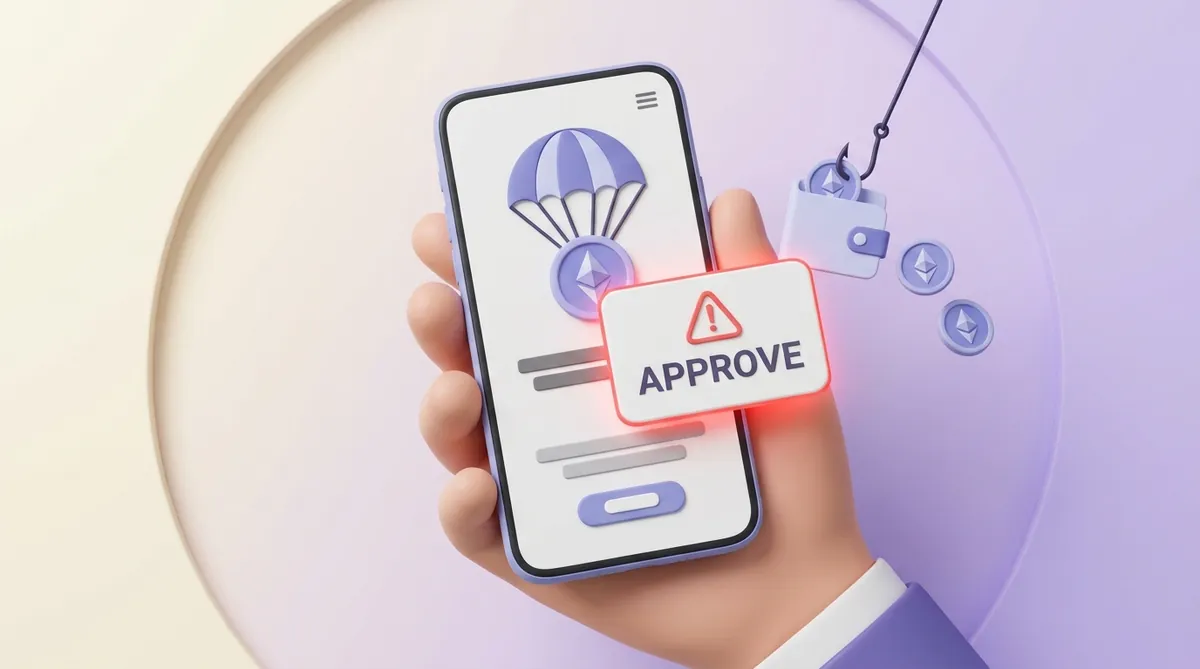
    A hand holds a phone showing a token claim page with a parachuting Ethereum coin; a red-glowing wallet pop-up with a warning sign reads APPROVE, while a hook pulls Ethereum coins out of a wallet beside the phone

    If you already signed something on a page you now doubt, speed matters more than anything else: a drainer works fast, but it may not have taken everything yet. Do three things, in this order:

    1. Revoke the approval. An approval checker, found in some wallets and on block explorers, lists every contract allowed to spend your tokens, and one transaction cancels each permission. Each cancellation costs a small network fee.
    2. Move what is left. Send the remaining coins to a new wallet with a new seed phrase, because you cannot be sure what else the page got hold of.
    3. Ignore "recovery" offers. Strangers who answer your complaint and promise to get the coins back for a fee are running the next scam. Nobody can reverse a transfer once the blockchain has recorded it.

    A fake claim page is only one of the ways a wallet gets emptied, and the rest are worth knowing before they happen: how crypto wallets get hacked and how to protect yours.

    Are crypto airdrops taxable?

    Often yes, but when and how depends on the country. Two large jurisdictions show how differently the rules can work.

    United States. The IRS addressed airdrops in Revenue Ruling 2019-24, published in October 2019, and in its FAQs on virtual currency. Under that guidance, coins received in an airdrop after a hard fork are ordinary income, equal to their fair market value at the moment you can sell or move them. That value becomes your cost basis, so when you sell later, you pay tax on the difference.

    An example under those US rules: tokens worth $300 land in your wallet, and you report $300 of income. A year later you sell them for $500, and the $200 difference is a capital gain. The ruling itself speaks about airdrops after a hard fork, so for task or points airdrops it is worth asking a tax professional how they apply to you.

    United Kingdom. HMRC's Cryptoassets Manual (page CRYPTO21250, updated 28 November 2025) says Income Tax will not always apply to airdropped tokens. Under that guidance, what you owe depends on what you did to get them:

    • Nothing in return. If you received the tokens without doing anything for them, and not as part of a trade, there may be no Income Tax on receipt.
    • A service, or the expectation of one. If you got the tokens in return for a service, or in expectation of one, they are taxed as income.
    • Selling later. In either case, selling or swapping the tokens later may trigger Capital Gains Tax.

    Elsewhere the rules differ, and your local tax authority's guidance is the place to check. Whatever the country, keep a record for every airdrop you receive:

    • The date the tokens arrived.
    • The token and the amount you received.
    • The price of the token at the moment it arrived.
    • The transaction ID, the unique code of the transfer on the blockchain.

    The time and amount of each transfer can be read off a blockchain explorer, which shows when and what you received.

    In short

    An airdrop is a project handing out free tokens to build a community and draw attention. A real one comes from the project's own channels, and claiming it is a transaction you pay a network fee for. Anything that asks for your seed phrase or a payment to unlock is a scam. Treat the tokens as a possible bonus rather than income you can count on, and keep a record for tax.

    Questions people ask next

    Which airdrop is the best one to go for?

    We don't rank live airdrops, and nobody can tell in advance what a token will be worth. What you can judge is the cost: an airdrop for an app you would use anyway costs you little, while farming a project you don't care about costs fees and time with no promised return. If a project asks for money or your seed phrase, it is not an airdrop.

    Can I get an airdrop if my coins are on an exchange?

    Sometimes. In a hard fork or a holder airdrop, the coins at the snapshot sit in the exchange's wallets, not yours, so it is up to the exchange whether to pass the new tokens on. An exchange that supports an airdrop says so in its own announcements; if yours says nothing, don't count on receiving anything.

    What happens if I miss the claim deadline?

    If the airdrop has a claim window, the contract stops accepting claims once it closes, and your share can no longer be collected. The project decides what happens to the unclaimed tokens, under the terms it published for the airdrop. That is why the deadline is worth noting on the day you learn you qualify.

    Where do people find out about new airdrops?

    From the projects themselves: their websites and official accounts. A retroactive airdrop is announced only after the snapshot, so nobody can plan for it in advance. Sites and chats that collect "upcoming airdrops" mix real announcements with guesses and fake claim links, so treat any link there as unverified until you find it on the project's own channel.

    This article is general information, not legal or tax advice.

    Start accepting crypto payments

    Create an account and connect the checkout yourself, or talk to sales and we will plan the integration with you.