en

What Is DeFi in Crypto, and How Does It Work?

Published
16.11.2026
Updated
16.11.2026
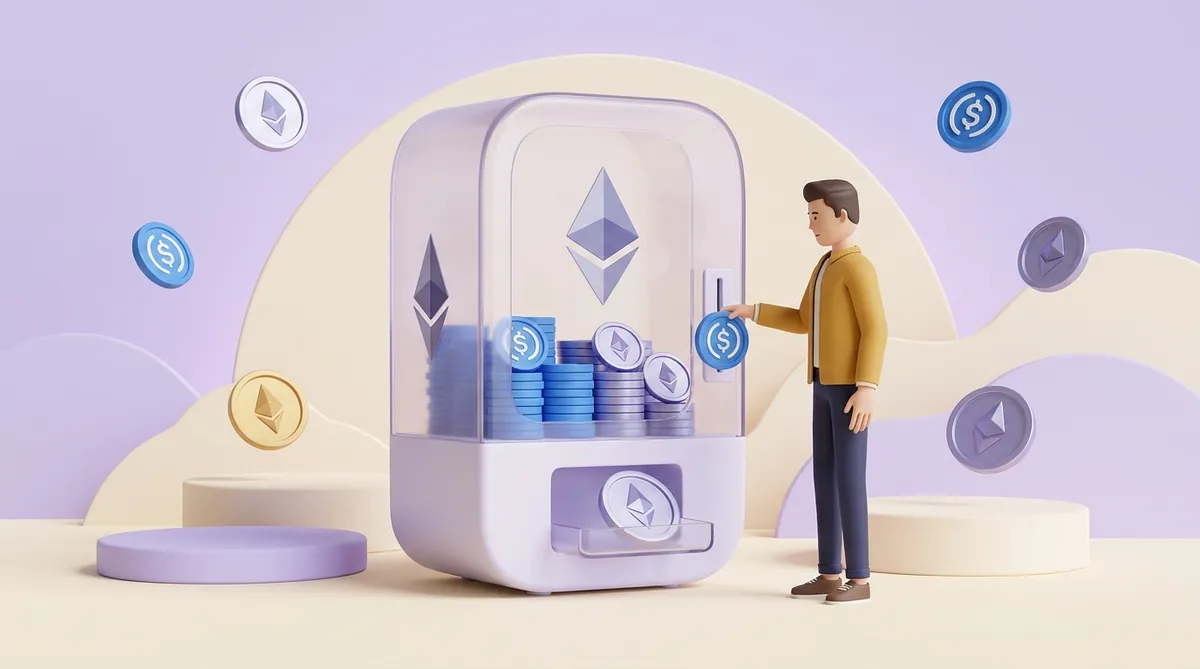
A man in a mustard jacket drops a blue USDC coin into a transparent vending machine marked with the Ethereum logo, while an Ether coin slides out into its tray
Contents

    DeFi, short for decentralized finance, is the crypto world's name for apps that do the jobs of a bank or an exchange (swapping coins, lending, borrowing, paying interest) through programs on a blockchain instead of through a company. You connect your own wallet, the program holds the pooled money and applies the same rules to everyone, and nobody in the middle opens an account for you, holds your coins or can undo a mistake.

    What DeFi means in crypto: a bank's jobs, done by code

    A bank does three jobs for you, and DeFi hands each of them to software:

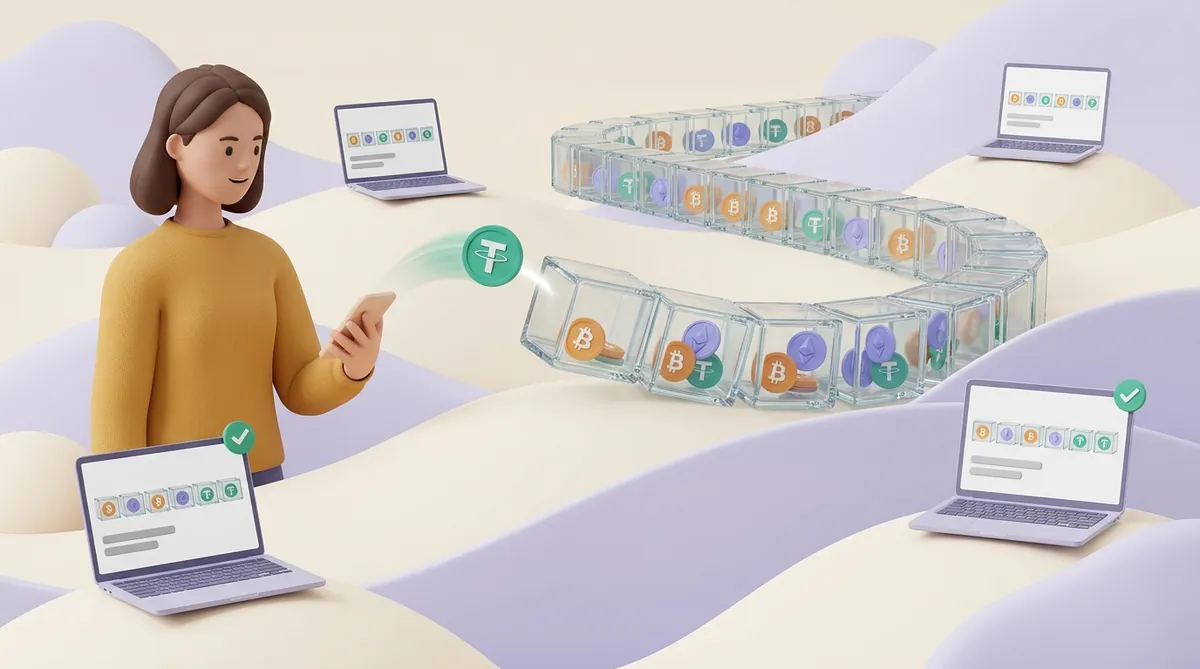
    • Keeping the record of who owns what. In DeFi a public blockchain does this. It is a ledger copied across thousands of computers that no single company can edit, and it is the foundation of how cryptocurrency and blockchain work.
    • Holding the money. Deposits sit in smart contracts: programs stored on the blockchain that run exactly as written whenever someone sends them a transaction.
    • Setting the terms. The same contracts decide who can borrow, against what and at what rate, by a formula written into the code.

    A lending app, for example, is a contract that takes deposits, lends them out against collateral and charges interest by formula. No loan officer reads your application, because there is no application.

    Three things follow from that design:

    • Anyone with a wallet can use it. There is no account to open. The app sees only your wallet address and what it holds.
    • The rules are public. The contract's code and every balance inside it can be read by anyone on the blockchain.
    • Mistakes are final. Once the network confirms a transaction, it cannot be cancelled, and there is no support desk with the power to reverse it.

    DeFi started on Ethereum, the first network built around smart contracts, and now runs on dozens of other networks as well. By DefiLlama's count, crypto worth about $71 billion was locked in DeFi apps across all networks in mid-November 2026.

    What people do with DeFi: the main kinds of apps

    Most DeFi activity falls into a handful of app types. The names below are well-known examples to make the picture concrete, not recommendations:

    • Swapping coins. Decentralized exchanges such as Uniswap and Curve let you trade one token for another straight from your wallet, with no company matching buyers and sellers. Every trade there is a crypto swap made against a pool of tokens.
    • Lending and borrowing. Apps such as Aave and Compound pool deposits from some users and lend them to others, who pledge crypto as collateral. Depositors earn the interest that borrowers pay.
    • Providing liquidity. You deposit a pair of tokens into an exchange's pool so others can trade against it, and you earn a share of the trading fees.
    • Stablecoins made by code. DAI is a dollar-pegged token created by a DeFi app against collateral that users deposit, rather than issued by a company holding dollars in a bank.
    • Staking. Apps such as Lido take coins that people lock up to help secure a network and pass the rewards back to them. Staking has its own trade-offs and deserves a separate look.
    Start accepting crypto payments with CryptumPay
    Create your first invoice right after sign-up
    Create account

    How does DeFi work when you actually use it?

    Take a simple case: someone swaps 100 USDC for ether on a decentralized exchange running on Ethereum. Four things happen:
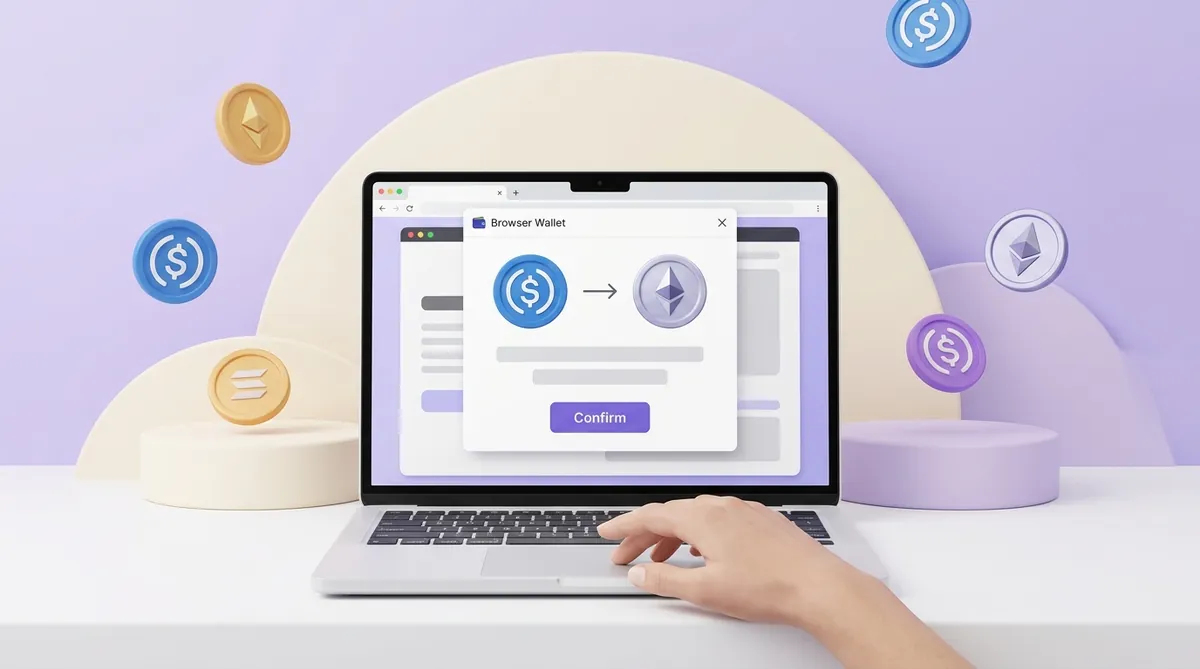
    1. Open the app's website and connect a wallet. The website is only a window; the exchange itself is a contract on the blockchain. Connecting shows the website your address and balances, never your keys.
    2. Approve the token. The first time an app works with a token, the wallet asks you to sign a permission that lets the contract move your USDC. Without that permission, the contract cannot take anything from your wallet.
    3. Sign the swap and pay the network fee. The wallet shows what goes out and roughly what comes in. On top of the exchange's own fee, the network charges for processing the transaction in its own coin, ether on Ethereum. Unless the app or the wallet offers swaps with that fee built in, the wallet needs a little ether besides the USDC. Some do: MetaMask's own swap feature, for example, can take the network fee out of the token being swapped on Ethereum, and such a swap carries a MetaMask fee of its own.
    4. Let the contract do the rest. In a single transaction it takes the USDC into its pool and sends ether from the pool to your address. Either both parts happen or neither does, and no person approves or can stop it: that all-or-nothing execution is what lets smart contracts work without a middleman.
    A hand rests on a laptop trackpad while a browser wallet pop-up on the screen shows a blue USDC coin, an arrow and an Ether coin above a purple Confirm button

    Every DeFi app works this way, whatever it does: the website is the window, your wallet is your signature, and a contract carries out the deal. What differs is the contract's logic, and two kinds of logic come up again and again: pools for trading and pools for lending.

    How DeFi liquidity pools set prices and pay depositors

    A liquidity pool is a contract holding two tokens, say ether and USDC, deposited by users called liquidity providers. A trader puts one token in and takes the other out, and the contract shifts the price by formula: the more ether leaves the pool, the more each next ether costs.

    Every swap pays a fee of a fraction of a percent of the trade. The pool shares it among the providers in proportion to what each of them deposited.

    The catch for providers is called impermanent loss. When one token's price moves sharply, traders rebalance the pool, so if ether doubles, the pool has sold part of each provider's ether along the way. The provider ends up with less than if they had simply held both tokens, and the fees may or may not cover the gap.
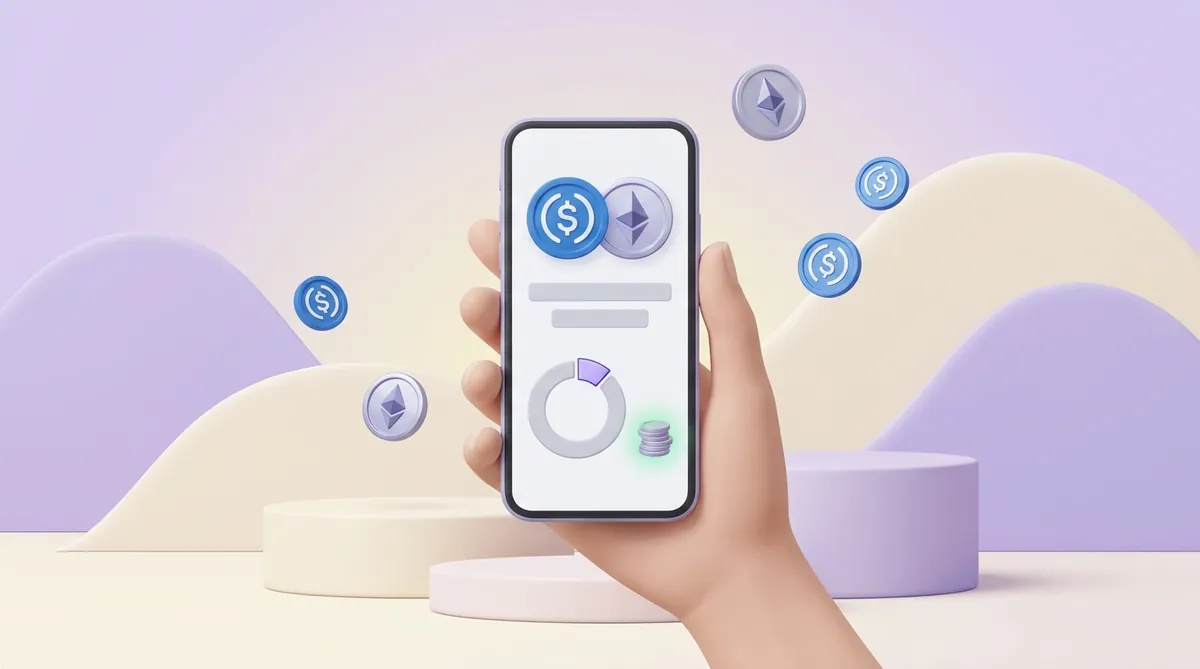
    A hand holds a phone showing a liquidity position: USDC and Ether logos side by side, a ring chart with a small highlighted share and a small stack of coins for the fees earned

    How DeFi lending works

    A lending app pools what depositors put in and lends it to borrowers. Every borrower first deposits collateral worth more than the loan, because the contract cannot chase anyone for repayment: the extra value is its only guarantee.

    The interest rate is set by formula, not by a person. The bigger the share of the pool already lent out, the higher the rate for borrowers and depositors alike. The depositors' interest is simply what borrowers pay, minus whatever share the app keeps for itself.

    Here is how a loan plays out, with round numbers for illustration; each app sets its own limits for each coin. Maria deposits ether worth $1,000 and borrows $600 in USDC, and her app allows a loan of up to 80% of the collateral's value. If ether falls 25%, her collateral is worth $750, and $600 is exactly 80% of it.

    At that line the contract allows liquidation: anyone can repay part of Maria's loan and take part of her ether at a discount. She keeps the USDC she borrowed, but she loses ether worth more than the debt that was repaid. The way to avoid it is to keep the loan well below the limit, so a price drop has room to happen before it reaches the line.

    Why borrow when you must put up more than you get? The point is to get stablecoins to spend or use elsewhere without selling coins you want to keep.

    What a DeFi wallet is, and why you can't skip it

    A DeFi wallet is a self-custodial wallet: an app that keeps the keys to your crypto on your own device, so only you can sign transactions. DeFi apps have no accounts, only addresses, so a wallet like this is the only way in.

    The coins themselves never sit inside the app. They live on the blockchain, and the wallet holds the key that can move them. On Ethereum and networks like it, the best-known example is MetaMask, and the routine any such wallet asks of you is easiest to see in how MetaMask handles fees, funding and cashing out.

    A wallet also has to work with the network the app runs on. Ethereum and the networks built on the same technology share one address format, so a single address works across all of them. Solana uses a different format, so an app there needs a wallet with Solana support, such as Phantom. And a token sent over a different network from the one your wallet is showing will not appear in the balance you expect.

    Some exchanges build a self-custody wallet into their app, sometimes with "DeFi" or "Web3" in its name. The label matters less than one question: can the company move or freeze the coins without your signature? If it cannot, the wallet is self-custodial; if it can, your coins are in the company's custody, whatever the screen says.

    That freedom has a price. A classic self-custodial wallet has no company behind it that can restore your access: it comes back only from a recovery phrase of 12 or 24 words, and whoever has those words controls the wallet. That is why learning how to protect your seed phrase and private key comes before any DeFi app.

    DeFi vs CeFi: the difference is who holds your coins

    CeFi, short for centralized finance, is the crypto industry's name for companies such as centralized exchanges that do the same jobs DeFi apps do while holding customers' coins themselves. In practice the two differ on five points:

    • Who holds the coins. In CeFi the company does, and your balance is an entry in its database. In DeFi the coins sit in your wallet or in a contract whose rules you can read.
    • How you get in. A CeFi service opens an account for you and checks your identity first. A DeFi app has no sign-up and sees only a wallet address, although some app websites block certain countries or flagged addresses.
    • Who can stop you. A CeFi company can freeze an account, pause withdrawals or go bust with clients' money inside, as FTX did in November 2022. A contract cannot single you out, but it can be hacked, or paused by its team if the code gives the team that power.
    • Who helps when you slip. A CeFi support desk can fix some errors on its own side. A deposit sent to an exchange without the memo or tag it asked for, for instance, is credited to no one, and some exchanges recover it on request for supported coins, for a fee. In DeFi there is nobody to write to, and a confirmed transaction stays as it is.
    • How you reach bank money. CeFi exchanges connect to bank cards and transfers. DeFi lives entirely on the blockchain, so turning tokens into dollars in a bank account still goes through an exchange or another off-ramp.
    On the left, a woman in a teal coat hands coins to a bank clerk through a counter window; on the right, the same woman sends coins from her phone straight into a glowing box with the Ethereum logo standing on a chain of blocks

    The two are not either-or. You can buy coins on a centralized exchange, move them to your own wallet and use DeFi apps from there. The same choice comes back every time you buy, swap or store crypto, and it has its own trade-offs between a centralized and a decentralized exchange.

    Is DeFi safe? The risks you take on instead of the bank's

    DeFi takes away one risk, a company misusing or losing your money, and brings several of its own. These are the ones that cost people money:

    • Bugs in the code. A contract does exactly what its code says, mistakes included, and attackers search for those mistakes. An independent audit lowers the odds of a flaw but does not rule it out, and a new contract carries more risk than one that has held large sums for years.
    • Control kept by the team. Some apps let their developers change the code or move the funds in it. When an anonymous team empties the pool and disappears, the scheme is called a rug pull, and the code on the blockchain gives depositors no way to get the money back.
    • Fake websites and leftover permissions. Copies of popular apps' websites ask you to sign an approval that hands your tokens to a thief. Genuine approvals also stay active after you finish, so it pays to know how to check and revoke token approvals in your wallet.
    • Prices that move against a loan. A sharp drop can trigger liquidation within minutes, as in Maria's example above. Nobody calls to warn you first, so the only protection is the margin you leave yourself.
    • Stablecoins that lose their peg. A token meant to be worth $1 is only as good as what stands behind it. TerraUSD, a stablecoin kept at $1 mainly by an algorithm rather than by cash reserves, collapsed in May 2022, and deposits held in it lost almost all their value. Stablecoins backed by reserves work differently, but they still depend on the issuer keeping those reserves in place.
    • Bridges between networks. Moving tokens from one network to another goes through a bridge. In the common design it is a contract that locks your tokens on one network and releases matching ones on the other. Because a bridge holds large sums for everyone crossing at once, it has been hit by some of the largest hacks in crypto, so before using one it helps to know how cross-chain bridges work and why they are risky.

    None of this puts DeFi off-limits, but a few habits cut the odds of a bad day:

    • Open apps from a saved bookmark. Links in ads and messages are the usual route to fake sites, and a bookmark skips them.
    • Try a small amount first. A test transaction costs one extra network fee and shows you picked the right network and token.
    • Approve only what the trade needs. Revoke permissions you no longer use; each revocation is a transaction with its own network fee.
    • Keep savings in a separate wallet. A wallet that never connects to apps cannot be drained through one, though moving funds between the two costs a transaction each time.

    The short version

    DeFi is crypto finance without a company in the middle: contracts on a blockchain do the trading and lending, and your wallet stands in for an account. The trade-off is simple: no company holds your coins, and no company can rescue them either. A sensible start is a small amount in a self-custodial wallet you already know how to back up.

    FAQ

    Can you actually make money with DeFi?

    DeFi apps do pay for putting crypto to work, and the money comes from other users: borrowers paying interest and traders paying fees. None of it is guaranteed. Rates float with demand, impermanent loss or a hack can eat both the earnings and the deposit, and a yield far above the rest of the market is a sign of extra risk or of rewards paid in a new token whose price can fall.

    Is Binance a DeFi platform?

    No. Binance the exchange is CeFi: it holds customers' coins, verifies their identity and can freeze accounts. Its closest link to DeFi is BNB Chain, the network Binance launched, where DeFi apps such as PancakeSwap run. The Binance app also includes a separate self-custody wallet, Binance Wallet, for reaching those apps.

    Is it safe to deposit money into a DeFi lending app?

    A depositor faces risks a bank customer does not. If borrowers have taken almost everything from the pool, you may have to wait to withdraw until loans are repaid or the rising rate draws in new deposits. If prices crash faster than liquidations keep up, the pool can be left with loans its collateral no longer covers, and depending on the app, depositors may bear that loss.

    Where does TradFi fit next to DeFi and CeFi?

    TradFi, short for traditional finance, means banks, brokers and card networks working with ordinary money under financial regulation. CeFi borrows its model, a company that holds your funds and runs your account, and applies it to crypto. DeFi is the only one of the three where no company holds your money at all.

    This article is general information and is not financial, investment, legal or tax advice.

    Start accepting crypto payments

    Create an account and connect the checkout yourself, or talk to sales and we will plan the integration with you.