
.png)
May 10, 2026
How to Reduce Failed Crypto Payments: Networks, Gas Fees, Amount Errors, and Checkout UX
Read article

A crypto payment flow can look complete long before it is safe to fulfil an order. A customer sees a success screen, an invoice changes status, or a transaction appears in a wallet. Your application still has to decide whether that event is authentic, whether it has already been handled, and whether the business should deliver access, goods, or account credit.
That decision is where crypto payment webhooks matter. A webhook is an HTTP notification sent from a payment provider to your server when something changes. It can reduce polling and let orders move promptly, but it is not a blank cheque to mark every incoming request as paid.
The practical goal is simple: accept events quickly, verify them carefully, keep a durable record, and change business state only once.
In a normal integration, an application creates an invoice or payment request, gives the customer instructions, and waits for a payment-related status. The provider may then send a webhook to a URL chosen by the merchant. That makes webhooks useful for moving an order out of “waiting for payment” without repeatedly asking the provider for an update.
However, one delivery can describe several different moments. It might mean that a payment request was created, that an incoming transaction was seen, that the provider considers it confirmed, or that a later status changed. Exact names and meanings depend on the provider. A transaction that is visible on a blockchain is not automatically the same thing as a payment that your own business should treat as settled.
Keep these layers separate:
This separation avoids a common failure mode: a customer-facing screen and an internal order are both marked paid because the application assumed a notification was an irreversible final result.
An integration is more reliable when its state model is explicit. Start with your own order states rather than trying to mirror every provider label. For example, an order can remain “awaiting payment” until the provider recognizes the transfer, become “payment under review” while your policy waits for the necessary confirmation or validation, and move to “ready to fulfil” only when the business rule is met.
That rule should be risk-based. A low-value digital action may use a different policy from a high-value delivery or a withdrawal. Networks have different confirmation and finality characteristics, and providers may add their own detection and risk checks. There is no safe universal number to paste into every payment flow.
The same distinction makes checking a crypto payment less confusing for support teams. A TXID can help explain what happened on-chain, while the order system still needs a documented decision about whether to fulfil, wait, or investigate.
Write the transitions down before building. A minimal model might include:
The labels can change. The principle should not: only one controlled transition should grant the valuable outcome.
An endpoint that accepts any JSON request from the internet is not a payment integration. If a provider supports signed webhooks, validate the signature exactly as its current documentation requires. The signing input may include the raw request body, a timestamp, a signature header and an endpoint secret. Do not substitute a convenient parsed payload for the specified raw-body check, and do not invent a verification algorithm because another provider uses one.
Authentication should answer, “Did this delivery come from the configured provider and was it changed in transit?” It does not answer every payment question. A valid delivery can still be a duplicate, an earlier state, an event for the wrong environment, or a notification your system is not ready to act on.
Build the endpoint around a few non-negotiable controls:
Do not rely on an IP range alone as proof of origin. Some providers document network controls; others rely on signatures, and both the configuration and the threat model can change. Follow the current provider documentation for the integration you are running.
Payment providers commonly treat a timeout or a non-success HTTP response as a failed delivery. A slow handler can therefore lead to a retry even if the payment itself has not changed. The endpoint should verify the request, store enough information to identify it, enqueue work, and return a success response promptly. Time-consuming tasks—calling another API, writing several business records, sending email, invoking fulfilment, or waiting for an internal service—belong in controlled background processing.
Fast acknowledgement is not a shortcut around validation. It is a way to separate transport reliability from business processing. If verification fails, reject the delivery. If verification succeeds but the downstream job cannot run, retain an observable pending state and let the worker retry according to your own policy.
For teams that are still choosing the integration surface, the crypto payment API checklist is a useful place to decide who owns invoice creation, status lookup, credentials, logs and failure handling. An API integration is not complete merely because it can create a payment request.
Networks fail. A provider may resend an event because it did not receive your response, a queue may retry a job, or a teammate may replay a delivery while investigating an incident. If each attempt creates a new credit, license, shipment or payout, the problem is not a blockchain problem. It is an application-state problem.
Idempotency means that processing the same event more than once produces the same business outcome as processing it once. In practice, retain the provider’s stable event identifier when one is supplied. Bind it to the payment and the intended order, mark it as processed within a transaction or equivalent atomic operation, and make the fulfilment action conditional on the order not already having reached the final state.
Do not deduplicate only by amount or wallet address. Two legitimate customers can pay the same amount, and one customer can make more than one legitimate payment. The safest key is the provider’s documented event or payment identifier combined with your own invoice/order identity and environment.
This discipline also improves payment metrics. A dashboard should distinguish a unique payment from delivery attempts, failed verification, duplicate events, manual replays and actual fulfilment. Otherwise a retry storm can look like revenue growth or a conversion surge.
A webhook stream is not a ledger ordered for your convenience. A later event can arrive before an earlier one, and a retry can appear after the application has already moved an order forward. Treat an event as a prompt to load the current payment context, not as an instruction to blindly overwrite your local state.
When an event arrives, compare it with the state your system has stored. If it is stale, record it but do not roll an order backward. If a required earlier event is absent, retrieve the current payment details through the provider’s documented API or leave the order pending for review. If the status appears contradictory, preserve the evidence and escalate it rather than guessing.
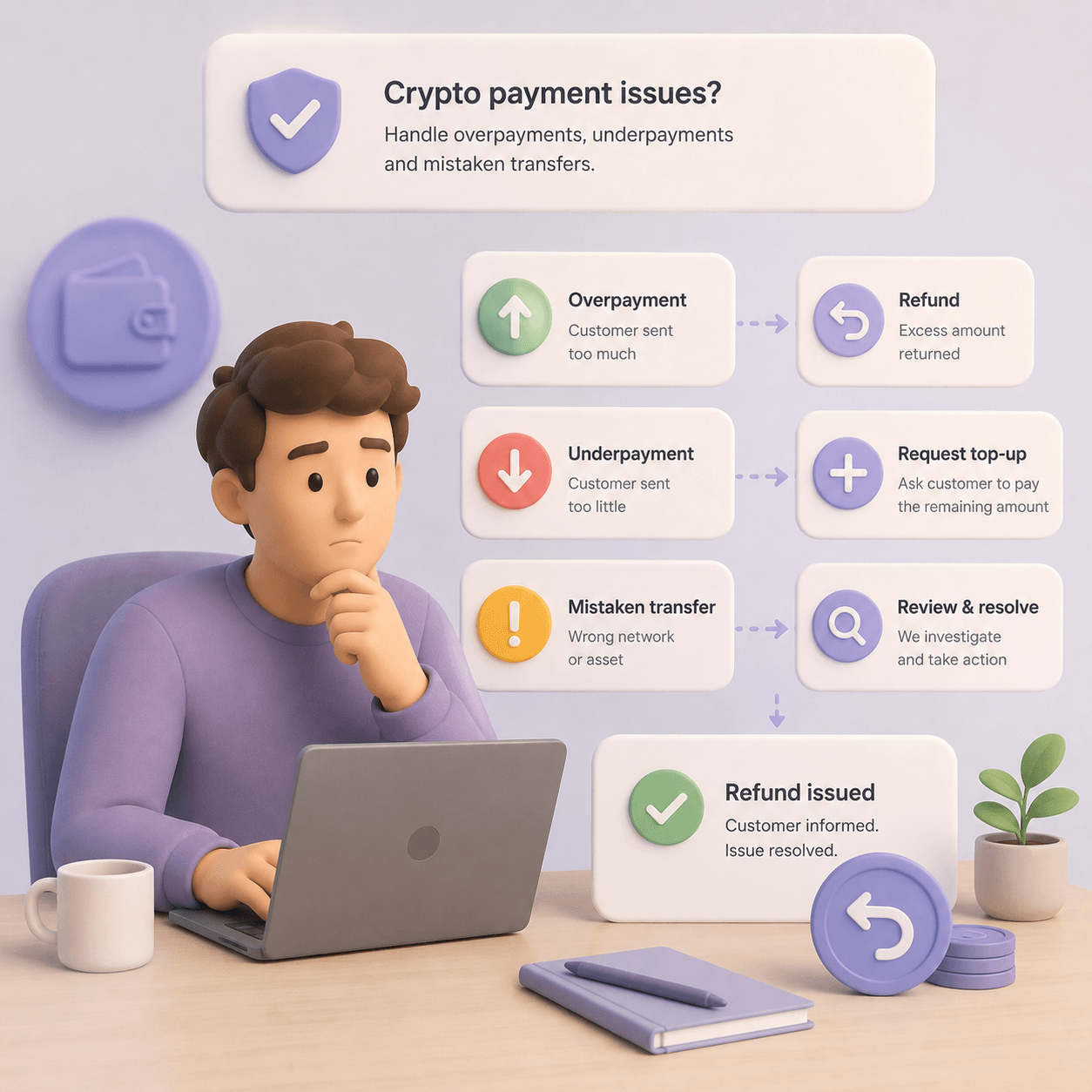
This is especially important around exceptions. A customer can send the wrong amount, use an unsupported network, pay after the invoice expires, or make a transfer that matches only part of the payment instructions. A notification should open a controlled exception path, not force your team to improvise. The operational patterns for reducing failed crypto payments help prevent many of these cases before the webhook reaches your server.
Before delivery or account credit, make a final business check that the event belongs to the intended payment. The exact data comes from your provider, but the decision usually needs to connect the provider payment ID, your invoice or order ID, expected asset and network, expected amount, current provider status, and the action already taken by your system.
For some flows, a provider status is the authoritative operational trigger. For others, your policy may also require on-chain information or a provider lookup before a higher-risk action. The point is not to make every payment slow; it is to document what evidence releases value in each scenario.
When the amount or network does not match, do not “fix” the order by guessing. Preserve the original instruction, show support the payment and order identifiers, and use a defined resolution path. That makes crypto payment refunds and corrections more consistent than a manual wallet transfer made under pressure.
The happiest path proves very little. A reliable implementation is one that has been tested when a delivery is duplicated, delayed, malformed, unverified, or received after the order was already changed by another process.
Use a non-production environment and run a compact scenario set:
Record what the customer sees, what support sees, which identifiers are searchable, and whether a replay produces exactly the same final order state. If a quick launch matters more than custom backend control, an HTML payment widget can reduce the integration surface, but it does not remove the need to understand the status and fulfilment rules you rely on.
CryptumPay offers API and HTML-widget integration paths for accepting crypto payments. A team evaluating an API flow should confirm the current documented event, status and callback capabilities for its own account before treating any generic webhook pattern as a product promise. The important questions are practical: which payment states are exposed, how a delivery is authenticated, whether it can be retried, and how an order should be reconciled when a payment changes state.
The same questions apply whether you build around CryptumPay or another provider. A sound integration combines the provider’s current documentation with your own state model, internal controls and customer-support process.
Not by itself. Verify that the delivery is authentic, identify the payment and order it belongs to, and apply the confirmation or provider-status rule your business has documented before fulfilment.
The provider may retry after a timeout or a response it treated as unsuccessful, or a delivery may be replayed during recovery. Store a stable event or payment identifier and make the resulting order action idempotent.
Only if that check is part of your documented flow. A provider’s payment record, its status semantics and on-chain data serve different purposes. Choose the evidence appropriate to the network, value and risk of the action.
No. Confirmation and finality characteristics differ by network, and the right release rule also depends on what is being delivered and the risk your business can accept.
Keep the event and payment identifiers, move the order into a controlled exception state, and resolve it through a documented support and refund process. Do not automatically fulfil a different order or assume that a similar amount belongs to the same customer.
Create an account and connect the checkout yourself, or talk to sales and we will plan the integration with you.