


August 21, 2026
USDT for Ad Networks and CPA Platforms: What Affiliate Payouts Really Cost
Read article
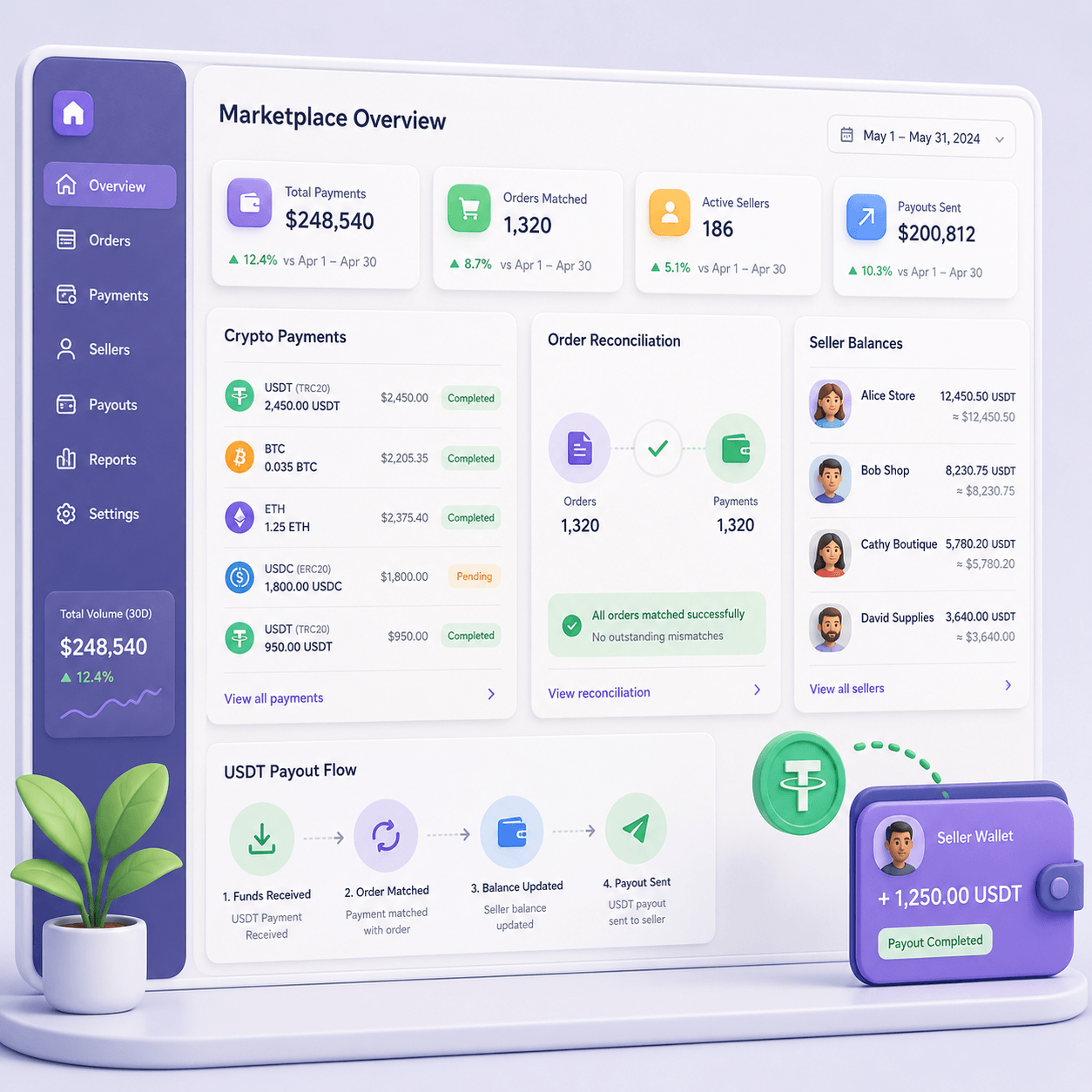
The buyer's crypto lands at an address your platform controls. You keep your fee by sending out less than you took in. Each seller gets a payout from their own balance, on whatever schedule you set.
That is the whole shape of it. Nobody has to build a bank inside the marketplace: the split is arithmetic, and the payouts are ordinary blockchain payments.
The part that takes thought is not the technology. It is who holds the money between the moment the buyer pays and the moment the seller is paid — because that one decision drives your costs, your support load and, in the EU and the US, your legal position.
Below: the three moves the money makes, the two ways to route it, how per-seller payout rules and mass payouts actually work, what the whole thing costs, how long it takes, and where a marketplace gets into trouble.

Strip out the software and a crypto payment on a marketplace is three steps, in this order:
Between steps two and three the money sits somewhere. Everything interesting about marketplace crypto payments is about that "somewhere".
Your fee is never a separate transfer. You do not collect 500 USDT and then send yourself 40 — you keep 40 and send 460 onward. The fee is what stays behind.
So on a 500 USDT order with an 8% commission, the seller's balance goes up by 460 and your own balance goes up by 40. One incoming payment, one outgoing payout, and the difference is your revenue. Nothing about crypto changes that arithmetic; it is the same netting a card-based marketplace does.
Two things do change, and they are worth setting straight before you design anything:
There are exactly two honest answers to "where does the money sit", and the choice is yours to make deliberately.
Most platforms end up pooled and should go in with their eyes open, because pooling is what turns a marketplace from a shop into something that holds other people's money. That has a legal weight, covered further down.

A payout run is a list: seller, address, network, amount. Building that list is your system's job; sending it is the processor's.
In practice a marketplace sets rules per seller rather than paying everyone the same way. The rules that earn their keep are these:
When the run fires, you are sending one instruction covering many recipients rather than clicking through them one at a time — and the reconciliation afterwards, matching each transaction hash back to the seller and the period it covered, is the part that decides whether your finance team trusts the system at all. That whole discipline — recipient lists, batching, checking the run landed — has its own mechanics worth reading before you build yours: how crypto mass payouts work when a business pays a hundred people at once.
Mass payouts are also where sellers in multiple countries stop being a problem. A blockchain payment does not care that the recipient is in Argentina, Nigeria or Vietnam; the transfer costs the same and takes the same time. What changes country by country is what the seller can do with the stablecoins once they arrive.
Not by the blockchain, no. A payout in USDT arrives as USDT. Turning it into pesos or naira in a bank account is a separate step, and there are three ways it happens.
Worth running the comparison honestly on one real seller before you decide. A small weekly payout to a seller two borders away by bank wire arrives in days, loses a chunk to correspondent fees and an exchange-rate spread, and sometimes bounces back for a missing reference; the same amount in stablecoins arrives in minutes for a fee that does not scale with the amount. The trade-off is real in both directions, and it is laid out here: crypto payments against bank transfers — fees, speed and which suits a business.
USDT is not one thing. The same stablecoin exists on several blockchains, and an address on one of them is meaningless on another. This is the single most common source of lost money on a marketplace, on both the buyer side and the seller side.
The chains differ in ways that hit a marketplace directly rather than abstractly. Transfer cost is the obvious one, and at your payout volumes it compounds. Support is the other: a seller's local exchange may accept deposits on one chain only, and if that is not a chain you pay out on, the seller has to make an extra hop and pay for it.
Pick a short list and publish it. Two networks is usually right: a cheap, fast one for everyday amounts and a widely supported one for sellers whose exchange only takes that. Every extra network you support is another address type in your checkout, another balance to watch and another way for someone to send funds into a void. The differences between the formats — which chain suits which kind of business — are worth knowing in detail: TRC20, ERC20, BEP20 and other USDT standards compared.
There is a second trap on the seller side, and new sellers hit it constantly. Stablecoins do not pay their own transfer fee: moving USDT requires a small amount of the chain's native coin in the same wallet, and the payout you sent contains no such coin.
A seller receives 460 USDT, tries to move it to an exchange, and the wallet refuses, because there is no TRX or ETH sitting next to it. From your support desk this looks like "the payout didn't arrive", and it takes a round of questions to establish that it did arrive and the seller simply cannot spend it. Some rails now let a stablecoin transfer pay its own way, which removes the problem for the seller entirely: gasless USDT payments and why people get stuck without TRX, ETH or BNB.
If you take USDT and pay out USDT, there is almost nothing to carry: a stablecoin tracks the dollar, and the amount you received is the amount you owe. That is why marketplaces settle in stablecoins rather than in bitcoin, even if they let a buyer pay in bitcoin at checkout.
The exposure shows up when the units change somewhere in the chain. A buyer pays in a volatile coin and the gateway converts at the rate of that minute; you owe the seller a number in dollars but hold a coin that moved 4% overnight; your hold period is fourteen days and your seller's local currency reprices every week. Each of those is a policy decision, not an accident, and the honest ones are written into the seller agreement: the payout is fixed in the settlement asset at the moment of sale, not at the moment of payout. The tools for keeping that exposure near zero are the same ones any business accepting crypto uses: how to protect crypto funds from market swings when you accept payments.
There is no single number, but the stack is short and every crypto payment processor charges out of the same four places:
For a marketplace the second line matters more than for a normal shop, because you send far more transfers than you receive. A thousand sellers paid weekly is 52,000 outgoing payments a year, and a fee difference of one dollar between chains is 52,000 dollars. The full breakdown of how the pieces fit together is here: how crypto payment fees work — network fees, gas, gateway charges.
Minutes, on both sides, and the variation is mostly your own settings.
An incoming payment is visible to your gateway within seconds of the buyer hitting send. What takes the rest of the time is confirmations — the number of blocks the processor waits before it calls the payment final. On a fast chain that is under a minute; on a busy one it can be several. A payout is the same transfer in reverse and clears just as quickly once the run fires.
So the honest answer to a seller asking "when do I get my money" is almost never about the blockchain. It is your hold period, your payout schedule and your review queue. Those are hours or days; the transfer itself is minutes.
Somewhere in all this there is a ledger — how much each seller has earned, how much is on hold, how much has been paid and against which transaction hash. Get it wrong and you find out at the worst possible moment, when a seller's number and yours disagree.
You have two shapes to choose between. Either your own database is the source of truth and the processor is just a pipe that moves value, or the processor keeps the money genuinely separated per seller and your system reads those balances back. The first gives you total freedom and total responsibility. The second means fewer places where your arithmetic can drift away from the actual funds.
Ask any provider the same question: can balances be kept apart per seller inside my account, and does a payout leave that specific balance rather than one pooled pot? The answer tells you how much reconciliation work lands on your side — and reconciliation, conversion and withdrawal control are exactly what a finance lead will ask about on day one: stablecoin payment operations from a CFO's point of view.
CryptumPay is one example of the second shape. Inside one account you can create projects, and each project has its own balance; a payout leaves the balance of a specific project, not a shared account balance. Projects are created by API as well, not only by hand in the console, so a seller signing up can be given one without anybody clicking.
The seller never logs in to CryptumPay — only the account owner sees the projects. The platform reads the data by API and shows it to the seller inside its own dashboard: payment history and balance, for example, in the marketplace's own interface and under its own brand.
Mass payouts are a separate capability there, alongside the per-project balances: a single call takes a list of wallet addresses and amounts. API payouts only run from whitelisted IPs, so the call has to come from a server the platform has declared in advance.
On price, CryptumPay charges 1% per successful payment, down to 0.5% at higher volumes, and settlement is always in USDT. Funds can be withdrawn at any time, with no minimum withdrawal amount. Getting started includes a review of the project, usually within one business day, so plan for that step rather than assuming same-hour activation.
This is the question where the pooled-versus-split decision comes back and bites. In both of the jurisdictions below, the law draws its line in the same place: taking crypto for your own goods is one thing, holding and moving other people's money is another.
MiCA — Regulation (EU) 2023/1114 — has applied in full since 30 December 2024, with the stablecoin titles in force since 30 June 2024. Among the crypto-asset services it defines are custody and administration of crypto-assets on behalf of clients and transfer services for crypto-assets on behalf of clients; providing them in the EU as a business requires authorisation as a crypto-asset service provider.
A marketplace that holds seller balances and sends them out on the seller's behalf is doing something that resembles both of those. Whether it counts in your particular setup depends on your contracts and who legally owns the funds while they sit — that is a question for a lawyer in your member state, not for a blog. The transitional window for firms that were already operating before MiCA applied has closed: it ran to 1 July 2026 at the latest, and shorter in some member states.
At federal level, FinCEN's guidance on convertible virtual currencies (FIN-2019-G001, issued 9 May 2019) is the reference point. Accepting crypto in payment for your own goods or services makes you a user of virtual currency, not a money transmitter. Accepting it and transmitting it on behalf of another person makes you a money transmitter unless a limitation or exemption applies.
The payment processor exemption is narrower than its name suggests: it requires, among other conditions, a clearance and settlement system that intermediates solely between institutions regulated under the Bank Secrecy Act, which is not how a public blockchain works. Assume it does not cover you until your counsel says otherwise.
State law sits on top of that and varies. New York has licensed virtual currency business activity since June 2015 under 23 NYCRR Part 200: receiving virtual currency for transmission and holding custody of it on behalf of others are licensed activities there, while merchants and consumers using virtual currency solely to buy or sell goods or services are exempt. Other states handle the same activity under general money transmitter statutes, with different definitions and different thresholds, so the question has to be answered state by state for the states you actually serve.
The failure modes are well known, and none of them is exotic. In rough order of how often a marketplace meets them:
The fourth one deserves more than a bullet. Once you pool funds you are running something that looks like financial infrastructure, and the controls that go with it — verifying sellers, screening wallet addresses, keeping records — stop being optional: how to secure crypto payments with AML, KYC and wallet screening.

For a platform that already has orders and sellers, the work is a few weeks, not a quarter. The order that saves the most rework:
A growing share of small marketplaces are not websites at all: they are Telegram Mini Apps with sellers, orders and payouts. The money works exactly as described above — invoices in, fee withheld, payout runs out — and the payout side is if anything simpler, because the sellers are already reachable in the same app.
What is not the same is the checkout. The app platform has its own rules about what a mini app may charge for and in which units, and whether your goods fall inside or outside them is the first thing to establish. Settle that before you design a checkout that may not be allowed to exist: whether a Telegram Mini App can take USDT or is limited to Stars.
A marketplace takes crypto the same way it takes cards: money in, fee withheld, payout out. The mechanics are simpler than card rails — no chargebacks, no acquirer, no correspondent banks — and the hard parts move elsewhere.
Three decisions carry the rest. Whether you pool the funds or split them at source, because that sets your legal exposure. What your per-seller payout rules are, because that sets your support load. And which networks you support, because that sets your fees and most of your failure modes.
Get those three written down before you integrate anything, and the integration itself is a few days of work against an API.
Accepting crypto for your own sales is treated far more simply than holding funds on behalf of sellers. In the EU, MiCA (Regulation (EU) 2023/1114, in full application since 30 December 2024) makes custody of crypto-assets for clients and transfer services on their behalf authorised activities. In the US, FinCEN's 2019 guidance treats accepting and transmitting crypto for another person as money transmission unless an exemption applies, and states license it separately — New York under 23 NYCRR Part 200 since June 2015. Check your own jurisdiction with counsel before you pool funds.
The blockchain part is minutes: seconds to see the payment, then a handful of block confirmations before your processor calls it final. Payouts clear equally fast once the run fires. What sellers experience as "slow" is nearly always your hold period and payout schedule, which are your settings, not the network's.
Not directly from the blockchain — a USDT payout arrives as USDT. Either the seller converts it locally themselves, which many already do, or you use a provider that offers local-currency settlement and delivers fiat over local rails in that country. In the second case, check which legal entity holds the licences for each corridor you need before you promise sellers anything.
The frequent problems are buyer-side: wrong network, a short amount after an exchange withdrawal fee, an expired invoice. The expensive ones are payout-side: transfers are irreversible, so a wrong address or a payout released before the return window closes is money you do not get back. Above those sit seller verification and key access, which are what turn an operational mistake into a serious one.
Judge them on four things rather than on a list of names: whether balances can be held separately per seller, whether payouts run from an API that takes a list of recipients in one call, which networks they support for payouts, and what they actually do about local-currency settlement in your sellers' countries. A provider that handles single-merchant checkout well can still be a poor fit for mass payouts, so ask about the payout side first.
This article explains how marketplace crypto payments work in general and is not legal or tax advice; the rules described are those in force in the named jurisdictions as of September 2026, and your own obligations depend on where your company and your sellers are based.
Create an account and connect the checkout yourself, or talk to sales and we will plan the integration with you.