September 8, 2026
Can your Telegram Mini App take USDT, or is it Stars only?
Read article

Telegram does not process crypto payments itself: the money goes through a crypto payment gateway, and Telegram is simply where you send the bill or run the bot that sends it. With no code at all, you send the customer a payment link in the chat; to sell automatically, you connect a gateway to your Telegram bot. One rule shapes the rest: under Telegram's terms, digital goods sold inside a bot or a Mini App must be paid in Telegram Stars, Telegram's in-app currency, not in crypto.
Telegram is a messenger, not a payment processor. Its payments interface for bots plugs into outside providers, and Telegram's own documentation says it collects no payment details and takes no commission.
Crypto works the same way. The customer pays on a gateway's payment page or straight into a wallet address, and Telegram only carries the message with the request.
So the real decision is how that request reaches your customer. There are four ways to set it up:
Which of these you are allowed to use depends less on the tool than on what you sell.
Telegram's terms for bot developers split everything a bot or Mini App sells into two kinds (as of October 2026):
The terms also say what happens after a breach. Telegram can send a notice, and then make the bot unavailable in the versions of Telegram installed from the App Store and Google Play, or close it altogether. For a bot that has built an audience, that costs more than any payment fee.
Mini Apps carry one more rule. Any crypto feature in a Mini App has to run on the TON blockchain and connect wallets only through TON Connect, the TON network's standard kit for connecting wallets; existing Mini Apps had until 21 February 2025 to move off other networks. If you are building one, check whether your Telegram Mini App can take USDT or only Stars.
That still leaves plenty of room for crypto:
Paid channels need a word of their own, because bots that sell channel access for crypto are easy to find. Access to a private channel is content, which makes it a digital service under the app-store definitions Telegram follows. Telegram's own tool for this is an invite link with a monthly price in Stars, and a bot that charges crypto for the same access falls under the Stars rule as written. If you would rather send the invite yourself, sell the access on your own site, where you can take crypto payments for digital access, keys and subscriptions.
This is the quickest route, and it suits anyone who sells through conversation: a consultant, a designer, a shop that takes orders in direct messages. Here is how a payment goes from start to finish:
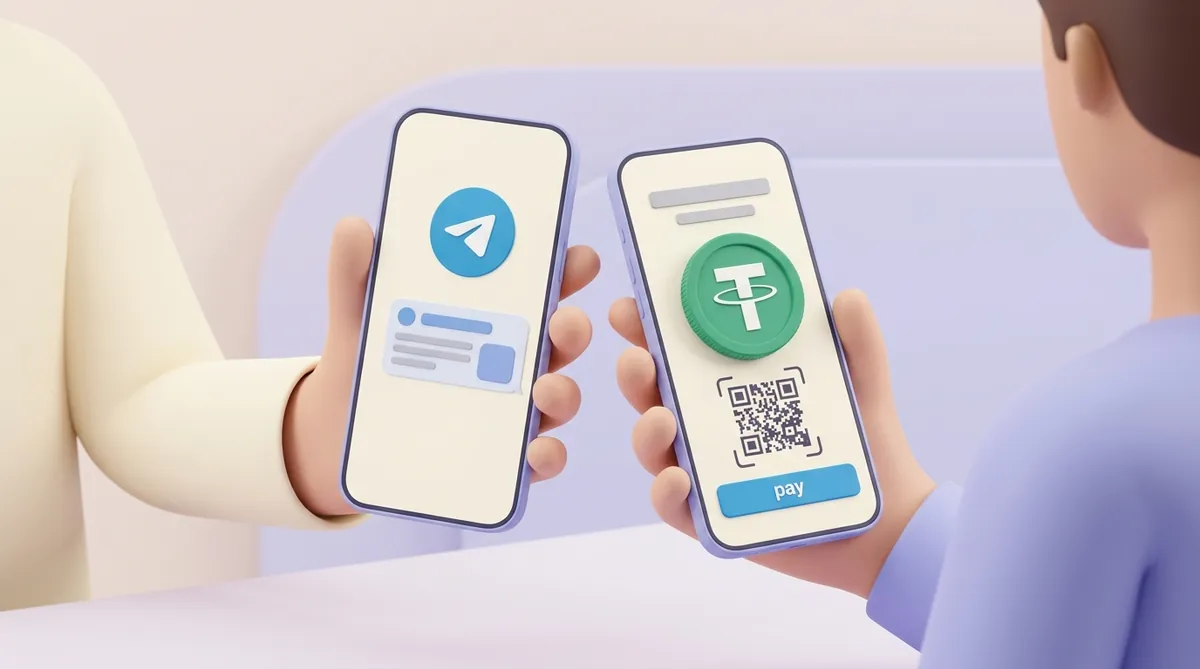
The limit of this route is manual work: every order needs an invoice from you, and at twenty orders a day that becomes a job of its own. Below that point, a bot can wait, and you can accept USDT with payment links and QR invoices, without full integration.
A bot does what you did by hand, in four moves:
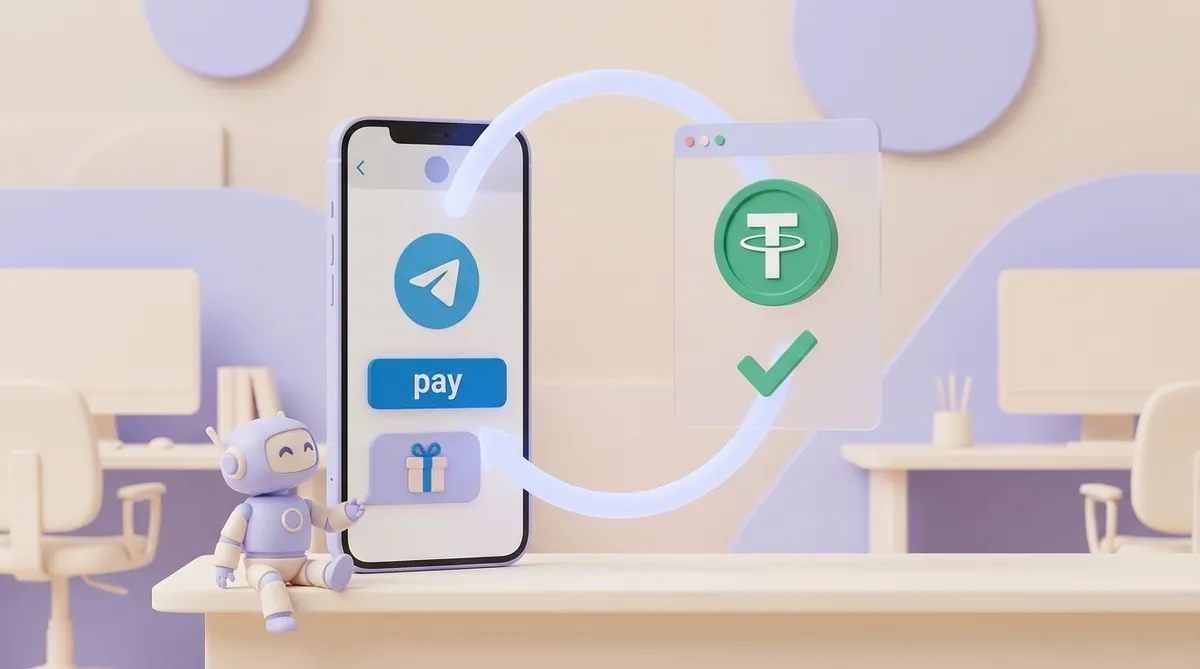
The step to get right is the third one. Before the bot hands anything over, it should check two things:
Here is why the second check matters. A customer who withdraws 100 USDT from an exchange may see the exchange keep its withdrawal fee, so 99 USDT arrives. To the gateway that is an underpayment, and a bot that only checks "was there a payment?" will hand over a full order for it. Both checks are part of the setup when you connect a crypto payment gateway to your Telegram bot.
An address in your profile costs nothing and needs no gateway. It works for a handful of payments from people you know, and it starts to break once strangers pay you:
A gateway takes these four jobs off you, which is what its fee pays for. If your customers pay in USDT on Tron, the alternative to watching the wallet yourself is to accept TRC-20 USDT and TRX payments through a payment gateway.
Telegram adds no protection to a crypto payment. It does not process the payment, and its documentation says it neither maintains nor endorses third-party bots that take payments. A crypto transfer cannot be reversed, so your safety comes from how you confirm that money arrived.
Four tricks to watch for when you sell on Telegram:

The fake-token scheme deserves its own explanation. A fake payment can arrive as an "overpayment" that the sender then asks you to refund in real USDT. Before refunding anything, it helps to know whether flash USDT is real and whether it can be withdrawn.
For the customer, paying on a gateway's page is as safe as the link itself: if the link came from you in a chat they trust, the money goes where you meant it to. The weak spot is the account the link comes from, so tell customers once, in a pinned message, which username you send payment links from.
One risk no screenshot check will catch is where the money came from. A crypto address carries its whole history with it, and an exchange can see that history even when you cannot. A payment out of a hacked account, a scam or a sanctioned address looks like any other in the chat, and it can surface later as a frozen balance when you try to cash out at an exchange. Checking incoming funds against known risky sources before you accept them is called AML screening, and it is one of the ways to secure crypto payments with AML checks, wallet screening and risk controls.
Here is who takes a share when a customer pays you in crypto on Telegram:
The network fee is the one customers notice, and it depends on the network rather than on you. On Tron the fee depends on energy, the network resource that pays for a transfer. A sender with no energy of their own has the network burn TRX for the whole transfer, and that cost a median of about $2.20 when the receiving address already held USDT and about $4.40 when it did not (23 August to 21 September 2026). Senders who stake TRX or rent energy pay less, and exchanges add their own withdrawal fee on top.
The gateway's percentage and the network fee are calculated differently, so before you set your prices it is worth knowing how crypto payment fees work, from network gas to gateway fees.
If you start with links, you may want a bot later, so the gateway should cover both. Before you sign up, check these points:
Beyond Telegram, the same points and a few more decide which crypto payment processor your business should use.
CryptumPay is a crypto payment processor: it takes payment from customers and pays out to the address the merchant specifies. It covers both Telegram routes:
In the checkout window the customer picks the coin and the network, then pays to a one-time deposit address issued for this payment, shown with the exact amount and a QR code. Accepted coins include BTC, ETH, USDT on several networks with Tron among them, TRX, BNB, SOL, Gram, XRP, POL and others.
Once the payment arrives, the terms are these:
Telegram's terms are platform rules; whether you may take crypto at all depends on where your business is. Three common cases:
Other countries, taxes and record-keeping all come into the question of whether a business may legally accept crypto payments.
Crypto on Telegram is taken by a gateway, and Telegram is only the channel. Start with payment links if you sell in conversation, and connect the gateway to a bot once orders outgrow your hands.
Before that, check what you sell: physical goods and services can go through a crypto gateway in a bot, while digital goods inside a bot or Mini App belong to Stars. Whatever the route, the gateway's status, not a screenshot, is the proof of payment.
Yes. A pinned post with a payment link comes from your own account, not from a bot, so the Stars rule for bots does not reach it. If your gateway offers links with an open amount, each reader can decide how much to give. Telegram's built-in way to tip a post, paid reactions, works only in Stars. And if you want tips to come in from more places than the channel, the same kind of payment link lets you accept crypto donations on websites, streams and in communities.
Yes, through Telegram's rewards: a developer receives the equivalent of 0.013 USD for each Star, paid out through Fragment. Stars can take up to 21 days to become available, and those your bot earns stay valid for three years. The other option is to spend them on Telegram Ads, where each Star counts as 0.02 USD.
For physical goods and services, a bot can take cards and other methods through more than 20 payment providers connected to Telegram's payments interface, from customers in over 200 countries. The provider handles the card details; Telegram does not store them. For digital goods and services inside a bot, the only method is Stars.
No. Telegram connects bots to outside payment providers and does not run a crypto checkout of its own. Payment bots inside the wallets that live in Telegram belong to the companies behind those wallets, not to Telegram.
Yes, as long as the coin and the network match the invoice. Wallets inside Telegram can send to outside addresses like any other wallet. If many of your buyers hold Gram, it is worth knowing how the TON network works and what a transfer on it costs.
This article is general information, not legal advice.
Create an account and connect the checkout yourself, or talk to sales and we will plan the integration with you.