


September 10, 2026
Online Course Payment Processing for Students Abroad
Read article
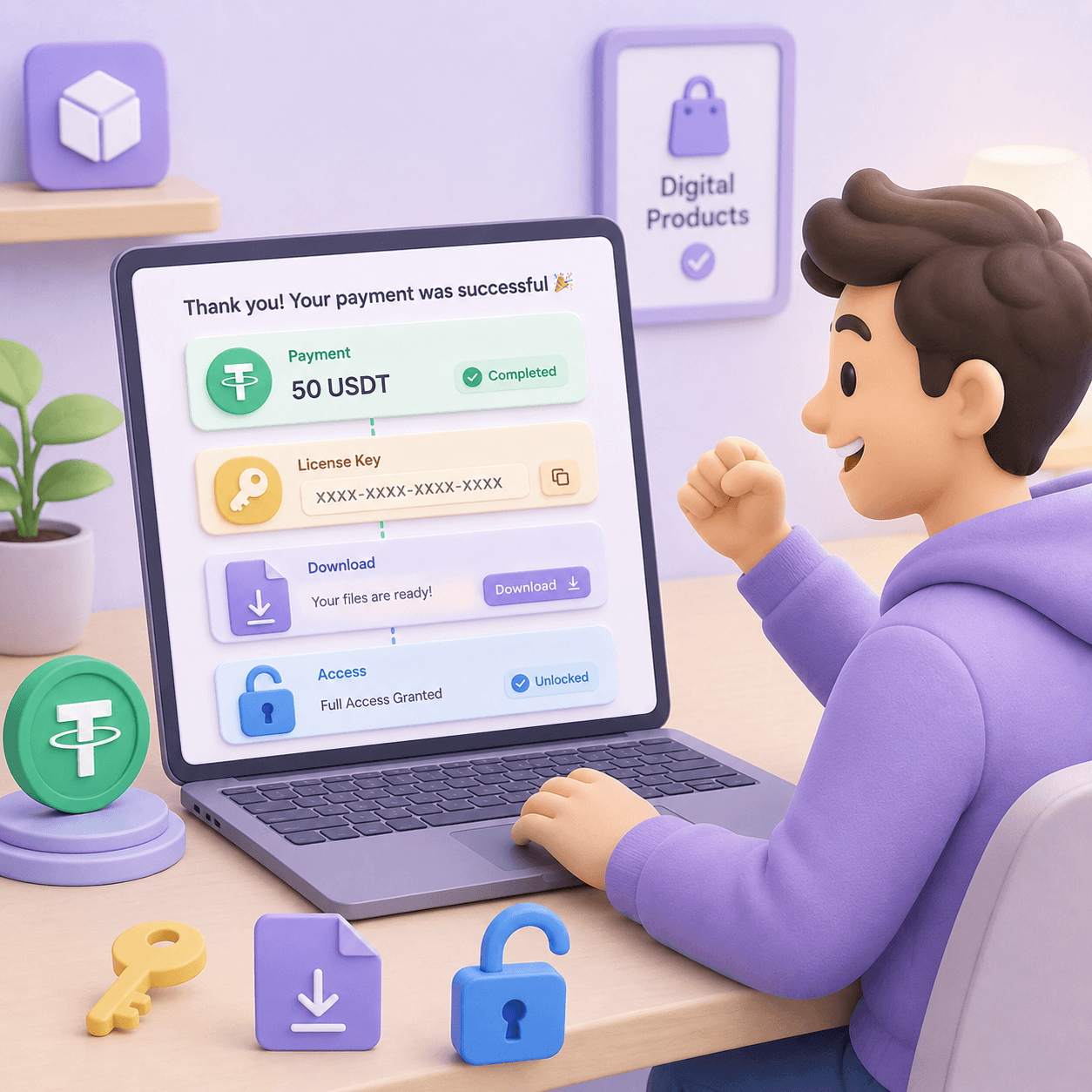
Crypto payments for digital products are not useful just because crypto is popular with some users. They are useful when a customer wants to buy immediately, lives in another country, cannot complete a card payment, or already keeps funds in USDT, BTC, ETH, or another cryptocurrency.
Digital products also create a different kind of payment pressure. After payment, the customer expects the product instantly. A file should download. A license key should appear. A subscription should renew. Access to a course, dashboard, private community, or API should unlock without waiting for support.
That is why the real question is not “How do we add a crypto button?” The better question is: how do we connect a crypto payment to the right user, order, product, status, and delivery rule?
Digital products are easier to connect to crypto payments than physical goods because delivery can be automated. There is no warehouse, courier, customs process, or shipping address. There is a payment event, a product rule, and a fulfillment action.
Crypto payments can be especially useful when a business has:
A software company may sell license keys. An LMS may sell course access. A Telegram bot may unlock a private channel. A SaaS product may renew a subscription. A template marketplace may release a file after payment. An API company may credit usage balance.
In all these cases, crypto does not need to replace cards, local payment methods, or bank transfers. It can work as an additional payment option for customers who prefer paying with crypto or stablecoins.
The same logic appears in crypto payments for online education: the payment itself is only one part of the flow. The real business value appears when the right student gets the right access after confirmation.
“Digital product” is a broad category. A file download, license key, subscription, and private community do not have the same fulfillment rules. If you use one generic payment flow for all of them, support and finance teams will eventually deal with unclear access, duplicate delivery, late payments, and refund disputes.
This is one of the clearest use cases. A customer pays to access a course, dashboard, paid database, member area, private tool, or premium section of a website.
The key requirement is account-level matching. If a customer sends USDT to a shared wallet address, the business may later need to identify who paid, for which plan, on which network, and whether the payment arrived on time. That may work for the first few manual sales. It does not scale.
A stronger flow creates a separate payment request for a specific user and order. After confirmation, the payment status returns to the product, and access opens automatically.
License keys are more complex than simple downloads. After payment, the system must issue a unique key, connect it to a customer, define activation limits, handle renewal, and decide what happens if the payment is refunded.
For software, plugins, themes, desktop tools, API products, and developer utilities, the team should define:
In this scenario, crypto checkout should not be isolated from the license system. Otherwise, finance may see the transaction, while product and support teams manage license records in a separate system with no clean connection between them.
Downloads can look simple: the customer pays, then receives a link. But even here, the details matter.
The download link should be protected, time-limited, or tied to the customer account. If the file can be downloaded forever through an open URL, the business loses control over distribution. If the link fails to send after payment, support gets a payment dispute. If the customer underpays, the system needs to know whether to release the file or hold the order.
For templates, reports, media files, presets, archives, design assets, and software packages, the safer logic is: payment request → confirmation → order status → protected download link → delivery history.
Subscriptions are the most sensitive case. In card payments, a business may rely on automatic recurring charges. In crypto, the model is often different: the user confirms payment manually, prepays a period, tops up an internal balance, or repeats payment through a saved flow.
Before launch, the business should choose the subscription model:
If the product is a private community, paid channel, or member-only group, crypto checkout can be built into the access flow. For example, a bot creates the payment request, the customer pays, and the system grants access after confirmation. This is close to the logic used in crypto payments in Telegram, but memberships also need renewal, expiration, and removal rules.
For SaaS models, it is useful to study recurring crypto payments for SaaS, because subscriptions, top-ups, renewals, and saved payment flows require more than a one-time checkout button.
For a digital product, the payment flow should not end with “funds received.” It should end with “the correct customer received the correct product.”
A practical flow looks like this:
The common mistake is accepting crypto to a general wallet address without tying the payment to an order. That turns every unclear payment into an investigation: who sent it, how much they sent, which network they used, whether they paid on time, and whether access should be opened.
Manual review may be acceptable during the first experiment. But once sales grow, it creates operational debt for support, finance, and developers.
Digital products often need predictable pricing. If a license costs $49, the customer, product team, and finance team all need to understand what “$49” means at the moment of payment.
BTC and ETH may work well for some crypto-native users. But their exchange rates move, which adds questions: what amount should be recorded as revenue, which amount should be refunded, and how should the order show the payment value?
That is why many digital businesses prefer USDT, USDC, or another stablecoin for checkout. A stablecoin makes it easier to connect a dollar-denominated price to the payment amount: a $49 product, a payment request for the equivalent amount in USDT, and fulfillment after confirmation.
But USDT is not one single payment method. It can move across TRON, Ethereum, BSC, Polygon, Solana, and other networks. A customer may think they are paying “USDT,” while your product needs to know the exact network. If the customer chooses the wrong network, the payment may not match the invoice. If they have USDT but no TRX, ETH, BNB, or another native token for gas, the payment may fail before it starts.
This is a major issue for digital products. A user may be ready to buy now, but if checkout asks them to solve a network fee problem, the sale can be lost. The issue is explained in more detail in gasless USDT payments.
You do not need an API to start accepting crypto payments. A payment link works without a website or code, and a checkout widget is one button on a page you already have. An API is worth building when the payment itself has to deliver the product: issue a key, open a course, extend access, with nobody on your team touching the order.
For the customer, the three routes look almost the same. They choose a coin and a network, see an amount and an address, and send the money from their own wallet. The difference sits on your side: how much work is left for you after the money arrives.
Here are the three routes, from the lightest to the most built:
A seller with a working site usually hesitates between the second and third route. The deciding questions are how many products you sell and whether delivery must happen with no person involved; both are worked through in when an HTML widget for crypto payments beats an API and plugins.
If you choose an API, creating an invoice is the easy part to check. What decides how many "I paid, where is my file" tickets you get later:
The last item is the one teams most easily miss, because everything works in a demo. The rest of the questions to ask a provider are collected in what to check in a crypto payment API before integrating it into a website or app.
CryptumPay offers the same three routes:
A seller can start with payment links and add the widget or the API later, if the way they work changes.
When a buyer pays through a payment link or the widget, CryptumPay's checkout brings them to a transfer screen. It says "Send the exact amount to the specified address" and shows:
The buyer needs no account and no app: they pay from the crypto wallet they already use. For a digital product this matters because the address and the amount are copied rather than retyped, and a mistyped digit is one of the ways a paid order ends up in support.
In digital products, every payment issue quickly becomes a product issue. The customer does not receive the file, cannot see the license, remains locked out of the dashboard, or fails to renew a subscription.
Common problems include:
The payment page should explain the essentials clearly. Not a long blockchain tutorial, but practical instructions: which asset to use, which network to select, how long the invoice is valid, when access will open, and what to do if the payment was sent but the product is not available.
When a customer says “I paid,” support should not start from zero. The team should check a defined chain: transaction hash, network, amount, invoice status, confirmations, order ID, and final product action. The same logic is explained in the guide on how to check a crypto payment.
It is also better to reduce failed payments before they reach support. Wrong networks, gas problems, manual amount entry, expired invoices, and unclear checkout status are covered in the guide on how to reduce failed crypto payments.
Refunds for digital products are more complicated than refunds for physical goods. If the customer has already downloaded a file, activated a license, or accessed private content, the business needs clear rules before a dispute happens.
Crypto transactions are not reversible at the network level. That does not mean refunds are impossible. It means a refund is a separate transaction made according to the business’s policy.
Before launch, decide:
Do not hide these rules until something goes wrong. For digital products, the refund policy should be visible before payment, especially if delivery is instant.
Practical cases around underpayments, overpayments, mistaken transfers, and late transactions are covered in crypto payment refunds.
Digital products may look low-risk because there is no physical delivery. But a business that accepts crypto still needs to think about wallet risk, suspicious transactions, sanctions exposure, refunds, limits, and jurisdiction-specific requirements.
This does not mean every template store needs bank-level compliance infrastructure. But basic controls matter:
Risk levels vary. A $9 template store, a $499 software license, a B2B API product, and a high-value subscription platform do not need the same process. AML, KYC, tax, and licensing requirements depend on jurisdiction and business model, so they should be reviewed separately.
CryptumPay includes business-facing tools such as AML checks, two-factor authentication, a dashboard, transaction history, and withdrawals. These features do not replace legal review, but they help keep crypto payments inside a structured business process instead of a wallet address pasted onto a webpage.
Start with the product flow, not the list of coins.
Define what you sell: file, license, gated access, subscription, credits, private community, API balance, or a hybrid model.
Decide where the order is created: website, app, dashboard, Telegram bot, sales manager, or backend API.
Choose the identifier that connects the customer, order, payment, and delivered product.
Select supported assets and networks. If you accept USDT, decide which networks you support and how clearly the user will see them.
Define payment statuses: created, detected, confirming, paid, expired, underpaid, overpaid, late, manual review, fulfilled.
Connect payment confirmation to delivery: download link, license key, account access, subscription renewal, balance top-up, or email notification.
Prepare error flows: wrong network, no gas, underpayment, overpayment, delayed exchange withdrawal, late payment, repeated payment.
Write refund rules before launch.
Add short customer instructions to the checkout page.
Give support a clear process for checking TXID, amount, network, invoice status, and order ID.
Make sure finance can see received amounts, fees, withdrawals, settlement, and product-level payment records.
Yes, if sales are low-volume, delivery is manual, or the product flow is simple. But if access, files, keys, subscriptions, or balances must update automatically, an API is usually the safer option because it connects payment status to product logic.
It depends on your audience. BTC and ETH may work well for crypto-native customers, while USDT and other stablecoins are often easier for products priced in USD. The network choice still matters because it affects fees, speed, and support cases.
Your backend should create a payment request tied to an order and customer. After confirmation, a webhook or status check updates the order, and your product unlocks access, sends the file, issues the license, credits the balance, or renews the subscription.
Support should check the transaction hash, network, received amount, invoice status, expiration time, confirmations, and order ID. The goal is to answer one question: should the product be delivered, held, corrected, or reviewed manually?
Yes, if the business policy allows it. But the original blockchain transaction is not reversed. A refund is a new transaction, and the business should define the currency, fee rules, exchange rate logic, and access consequences before launch.
Crypto payments for digital products work best when they are connected to product logic. Customers are not buying a blockchain transaction. They are buying a file, license, subscription, API credit, course, dashboard, or community access.
That means the business should design the full payment-to-delivery flow: invoice, network, confirmation, access, support, refund, repeat payment, and reporting.
When that flow is clear, crypto becomes more than an experimental checkout option. It becomes a practical payment method for international, digital-first, and crypto-native customers.
Create an account and connect the checkout yourself, or talk to sales and we will plan the integration with you.

.png)