How do crypto scams work, and how can you spot one in time?
Published
05.11.2026
Updated
05.11.2026
Contents
Almost every crypto scam is after one of three things: a transfer you make yourself, access to your wallet, or your money in exchange for something worthless. Crypto suits this well because no bank sits in the middle to cancel a payment, so money that leaves is rarely seen again. Your best protection comes before you send: ask who contacted whom, what is being promised and why it can't wait.
Why scammers like crypto
A card payment can be disputed, and a bank can sometimes stop a transfer. A crypto transfer goes straight from one wallet to another, and once the network confirms it, nobody can reverse it.
The sums are large. In the US, the FBI's Internet Crime Complaint Center (IC3) received more than 180,000 complaints involving crypto in 2025, with reported losses of about $11.4 billion.
Many people don't see it while it is happening. The FBI says about three in four people it contacted through its crypto-fraud warning program did not yet know they were being scammed. So if an offer feels slightly off right now, that feeling is worth an hour of checking before any more money moves.
The common types of crypto scams, sorted by what the scammer wants
New names appear every year, but the mechanics repeat. Once you know what a scheme needs from you, even an unfamiliar one is easier to place.
They get you to send the money yourself
This family needs no hacking, because you press the button. Common versions:
Fake investment platforms. A stranger from a dating app or a "wrong number" text becomes a friend, then shows you a trading site where your balance grows fast. The site belongs to the scammer, and the growing balance is only a number on a page. In the FBI's figures this was the costliest kind: about $7.2 billion in reported US losses in 2025. The version with weeks of friendship first is known as a pig butchering scam.
Impersonators. Someone claims to be the police, the tax office, your bank or your exchange's security team. They say your money is at risk or a fine is overdue, and the fix is always the same: move your coins to a "safe" address or feed cash into a crypto ATM, a kiosk that turns banknotes into coins. US complaints to the FBI in 2025 that involved one of these machines reported about $389 million in losses. Those cases can include other kinds of transfers too, so not all of that money went through a kiosk.
Giveaways. A video of a famous founder, sometimes faked with AI, promises to double whatever you send to an address. Nothing comes back: someone who sends 0.1 BTC is simply 0.1 BTC poorer.
Paid-task jobs. A recruiter pays you small sums to rate products or like videos. Then your "earnings" are locked until you top up the account in crypto, and every top-up is followed by a request for a bigger one.
Lookalike addresses. This one needs no conversation. A scammer sends you a tiny transfer from an address that starts and ends like one you use, hoping you will copy it from your history next time. The trick is known as address poisoning.
They get into your wallet
The second family asks you to send nothing. It goes after the two things that control your coins, and once it has them the money leaves without your help:
Your seed phrase. These are the 12 or 24 words that restore a wallet on any device, so whoever has them has your coins. They get stolen by fake support agents, "wallet sync" pages and lookalike wallet apps. Anyone who asks for them is a scammer, whatever badge they show.
Your signature. A website asks you to connect your wallet and confirm something, such as a free token claim. On screen it looks like any other confirmation. What you sign can be a permission that lets someone else's program spend your tokens, and it keeps working long after you close the page.
Neither trick breaks the wallet's code, so a drained wallet doesn't by itself mean the app was at fault. To work out what happened to yours, start with the ways a crypto wallet can get hacked.
They sell you something worthless
In the third family the seller walks away with real money, and you are left holding something that only looks like an asset:
Rug pulls. A team launches a new token with a polished site and big promises, collects the buyers' money, then pulls it out and disappears. The token stays in your wallet, but nobody is left to buy it, and a token nobody will buy is worth nothing, whatever the chart on the site says.
Pump and dump. Promoters quietly buy a cheap token, hype it in chats and on social media, then sell to the people rushing in. The price falls back, and the late arrivals carry the loss.
Fake coins. Someone offers USDT, a coin pegged to the dollar, at a discount: say, $500 for 1,000 "USDT". Real dollar-pegged coins don't sell at half price, and what lands in the buyer's wallet can't be spent like the real thing. The best-known version is sold as flash USDT, which is fake and can't be withdrawn.
The oldest scheme in this family deserves more than a line.
How a crypto Ponzi scheme works
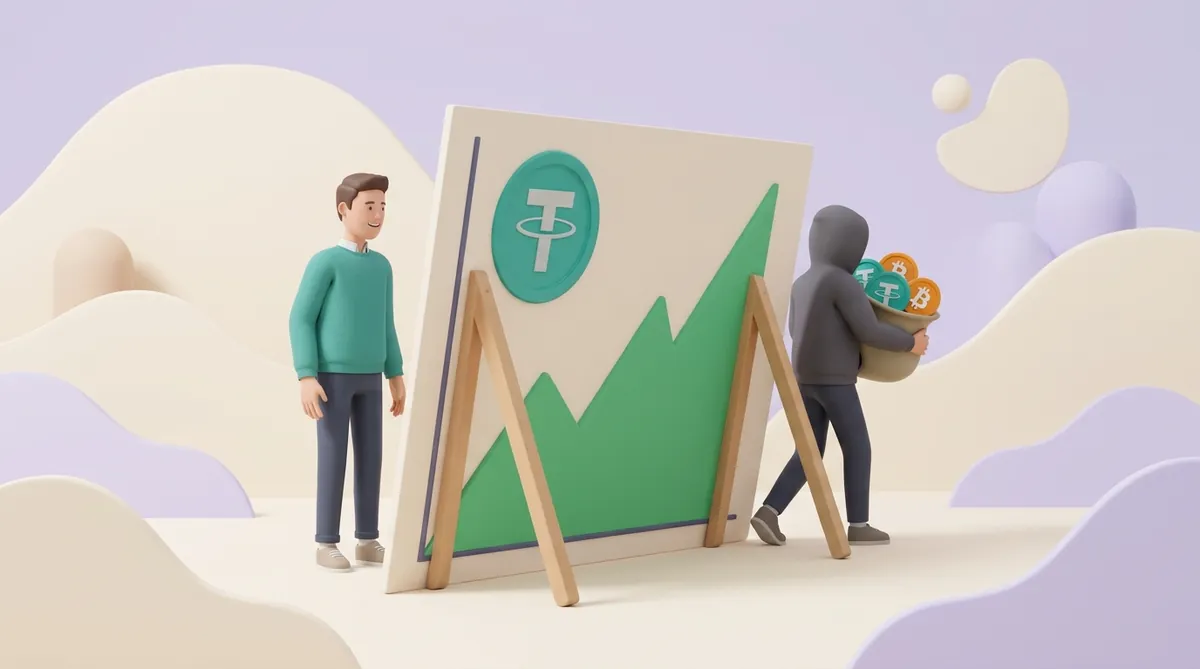
A Ponzi scheme pays old investors with new investors' money. There is no real business behind it: the "trading bot" or "staking pool" is a story, and the payouts are other people's deposits.
Say Anna puts $1,000 into a platform that promises 1% a day. She sees $10 appear daily, withdraws $50 to test it, and the money arrives. So she adds $5,000 and brings in two friends, and their deposits pay her "profits" while the platform keeps the rest.
That is why a working withdrawal proves little. Early payouts are what make the scheme convincing, and they cost the organisers only a fraction of what they bring in.
The scheme needs ever more newcomers. When deposits slow down, withdrawals get delayed for "maintenance" or a new "fee", then stop, and the people who joined last lose the most.
BitConnect is a well-documented case. In September 2021 the US Securities and Exchange Commission (SEC) alleged that it took about $2 billion from retail investors by promising high returns from a trading bot. According to the SEC, the money was never traded and went to wallets controlled by the people behind the project. Its lead US promoter pleaded guilty to criminal charges.
A pyramid scheme is a close relative: the money comes mainly from recruiting, and you are told so openly. A crypto scheme can mix both, paying you a bonus for every friend you bring in.
How to spot a scammer before you send anything
Scammers change their stories, but they lean on the same pressures. Any one of these signs is a reason to stop and check:
They found you first. An unexpected message offers an investment, a job or a warning about your account. People with a real money-making system have little reason to cold-message strangers about it.
The profit is guaranteed. "A steady 2% a day, no risk" is a promise nobody can keep on a market that moves every hour. The US Federal Trade Commission (FTC) says in its consumer guidance that only scammers guarantee profits or big returns.
You are told to hurry or keep quiet. "The offer ends tonight" and "don't tell your bank" both exist to stop you checking. A person-to-person sale has its own version: the buyer waves a payment screenshot and presses you to release your coins before the money has landed. That is one of the traps to know before you buy or sell crypto P2P.
A bill has to be paid in crypto. A fine, a tax, bail or a "verification fee" payable only in coins is a warning sign. The FTC's guidance for US consumers says no legitimate business or government will demand that you pay with crypto.
You have to pay to get your own money out. "Pay the 20% tax and your withdrawal unlocks" is the moment the scheme collects a second time. If you pay, expect another fee after it.
Someone wants your seed phrase. "Just to verify your wallet" is one excuse you may hear. Support staff don't need to see it, and neither does a friend helping you trade.
How to spot a fake crypto website
A fake site can copy a real one pixel by pixel, so judge it by the things that are harder to copy:
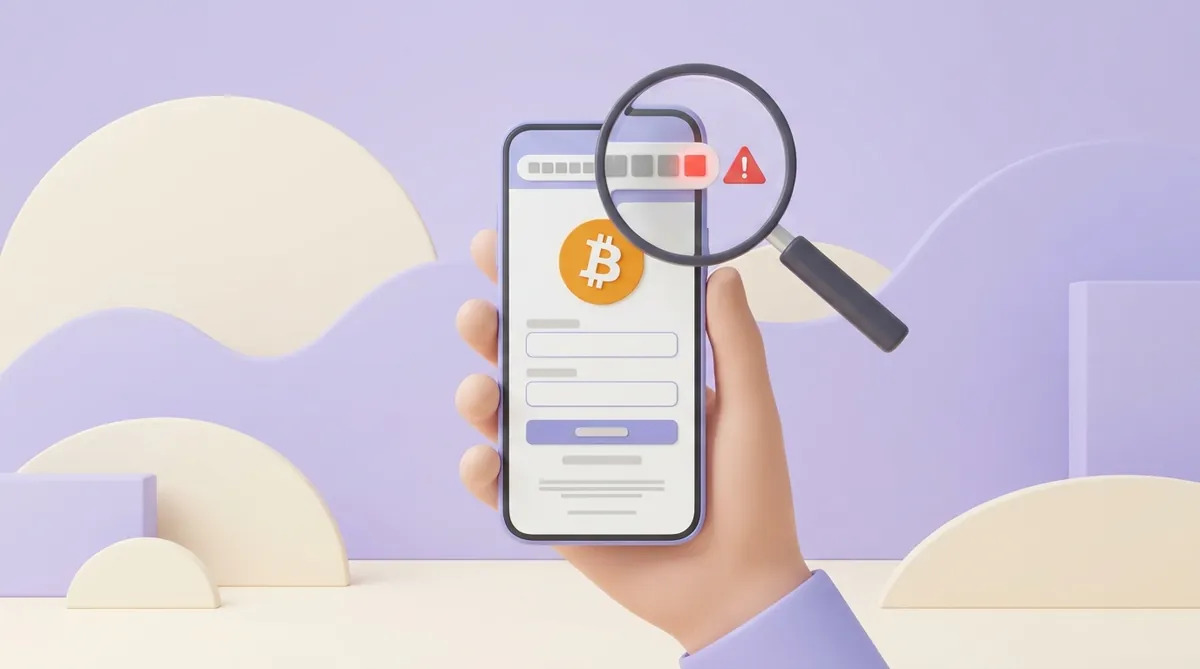
The address. Fake sites swap a letter or add a word to a known name. Reach exchanges and wallets through a bookmark or the official app, and not through an ad or a link in a chat.
The age of the domain. ICANN Lookup (lookup.icann.org), a free public tool, usually shows when a domain was created. A platform that boasts ten years of history on a domain registered last month has answered your question.
The regulator's lists. The UK's Financial Conduct Authority publishes a Warning List, and the US Commodity Futures Trading Commission (CFTC) publishes the RED List of unregistered foreign firms. A name missing from a list proves nothing, as both regulators point out themselves.
The deposit address. Before a large transfer, you can look up the address you were given. A fresh address can come up clean, so a good result is no guarantee, but it helps to know what a wallet risk score tells you.
These checks catch careless fakes, and a well-prepared one can pass all of them. A clean result doesn't prove a site is honest, so keep any first deposit to a sum you could afford to lose.
What to do if you've already sent money
The first hours matter most, because coins that are still moving may yet reach a place where someone can stop them. Work through these in order:
Stop paying. Any new "fee", "tax" or "recovery deposit" goes to the same people, however official the request looks. That includes a message saying one last payment will release everything.
Contact the exchange you sent from. Give it the transaction ID and the scammer's address, and ask it to flag them. If the money started in a bank or on a card, ask the bank to stop any transactions still pending.
Protect what's left. If you shared your seed phrase, move the remaining coins to a new wallet with a new phrase. If you signed something on a website, check and revoke your token approvals.
Save the evidence. Keep the chats, the website address, the wallet addresses and the transaction IDs. Screenshot what you can before the site or the account disappears.
Report the scam. Use the agency for your country, listed below, and keep any reference number it gives you.
How to report crypto scams in your country
A report rarely brings money back on its own. It creates a record that a bank or exchange may ask for, and it lets investigators connect your case to others.
Type these addresses yourself, because scammers pose as the agencies too. The routes below are correct as of November 2026:
United States. File with the FBI's IC3 at ic3.gov and with the FTC at reportfraud.ftc.gov. If someone pitched you an investment, you can also report to the SEC at sec.gov/tcr and the CFTC at cftc.gov/complaint.
England, Wales and Northern Ireland. Use Report Fraud at reportfraud.police.uk or call 0300 123 2040. It replaced Action Fraud on 4 December 2025. The Financial Conduct Authority also asks you to report scams to it after you have contacted Report Fraud.
Scotland. Call Police Scotland on 101.
Canada. Contact your local police first, then the Canadian Anti-Fraud Centre at reportcyberandfraud.canada.ca or 1-888-495-8501.
Australia. Report to the police through ReportCyber at cyber.gov.au, and tell Scamwatch at scamwatch.gov.au so others can be warned.
EU countries. Go to your local or national police. Europol supports national investigations and says it does not contact citizens directly or accept payments, so a demand for money "from Europol" is itself a scam.
Anywhere else. Start with your local police and your national financial regulator.
Can you get your money back after a crypto scam?
Often you can't, and it is better to plan around that. The FTC warns US consumers that crypto sent to a scammer typically doesn't come back, and Australia's Moneysmart guide gives a similar warning. Your chances improve in three situations:
The coins reached an exchange. A centralized exchange holds customer accounts and can freeze one, for example at the request of the police. This is why speed matters.
The coins are a stablecoin with an issuer. Tether, the company behind USDT, can freeze coins at a specific address and has done so in scam cases. Bitcoin has no such central party.
The authorities have already seized the funds. In June 2025 the US Justice Department filed to forfeit more than $225.3 million in USDT tied to investment scams, with over 400 suspected victims. It said the seizure is meant to let the money eventually return to its owners, and "eventually" is the honest word for how long this takes.
You can follow your own money, since every transfer is public, by learning how to read a transaction in a blockchain explorer. Seeing where the coins went doesn't stop them, though. Only someone with authority over the exchange account or the token can do that.
Be careful with anyone offering to recover it
People who have lost money get approached a second time, by "recovery" specialists. In an August 2025 alert the FBI warned US victims about fake law firms, with red flags like these:
Real-looking paperwork. The documents carry the insignia or letterhead of a genuine law firm.
A government list. They say your name is on a list of victims and the money can come back through "legal channels".
Payment in crypto or gift cards. Some also tell you to pay a third-party company.
The same alert says no law firm is an officially authorized partner of US government agencies, and the US government doesn't charge for law enforcement services. An earlier FBI alert counted more than $9.9 million in reported US losses to this scheme between February 2023 and February 2024.
We don't recommend paying anyone up front on a promise of recovery. For a large loss, a real lawyer or tracing firm can help, at a cost. A tracing report doesn't move coins by itself, and it is worth checking a lawyer's licence with the licensing body yourself.
The short version
Crypto scams look different on the surface, but each one needs your transfer, your wallet access or your money for something empty. Before any payment, ask who contacted whom, whether a profit is being guaranteed and why you are being rushed. If the money has already gone, stop paying, tell the exchange, report it, and be wary of anyone selling a recovery.
FAQ
Is crypto itself a scam?
No. Bitcoin, Ethereum and stablecoins are working networks that move real value, and scammers use them much as fraudsters use bank transfers and gift cards. A coin being real says nothing about the person selling it to you. The price of a real coin can also fall hard without anyone having cheated you, and that is a market risk rather than a scam.
Can a Bitcoin scammer actually be tracked?
The coins can, because every Bitcoin transfer stays on a public ledger for good. The person is harder, because an address carries no name, and scammers split funds across many addresses to blur the trail. The most direct route to a name opens when the coins reach a service that holds ID documents, which is why investigators turn to exchanges and the records from KYC, the identity check they run on customers.
Should I report a scam if I lost very little, or nothing at all?
Yes, because agencies can link small reports to the same addresses and people. The Canadian Anti-Fraud Centre, for one, takes reports whether or not you are a victim, and you can report to it anonymously. Europol notes that shame keeps many victims silent, which hides how widespread online fraud is.
This article is general information, not legal advice. For your own case, speak to a lawyer or the authorities in your country.
Start accepting crypto payments
Create an account and connect the checkout yourself, or talk to sales and we will plan the integration with you.