October 18, 2026
Crypto AML compliance: what a business that accepts crypto actually has to do
Read article
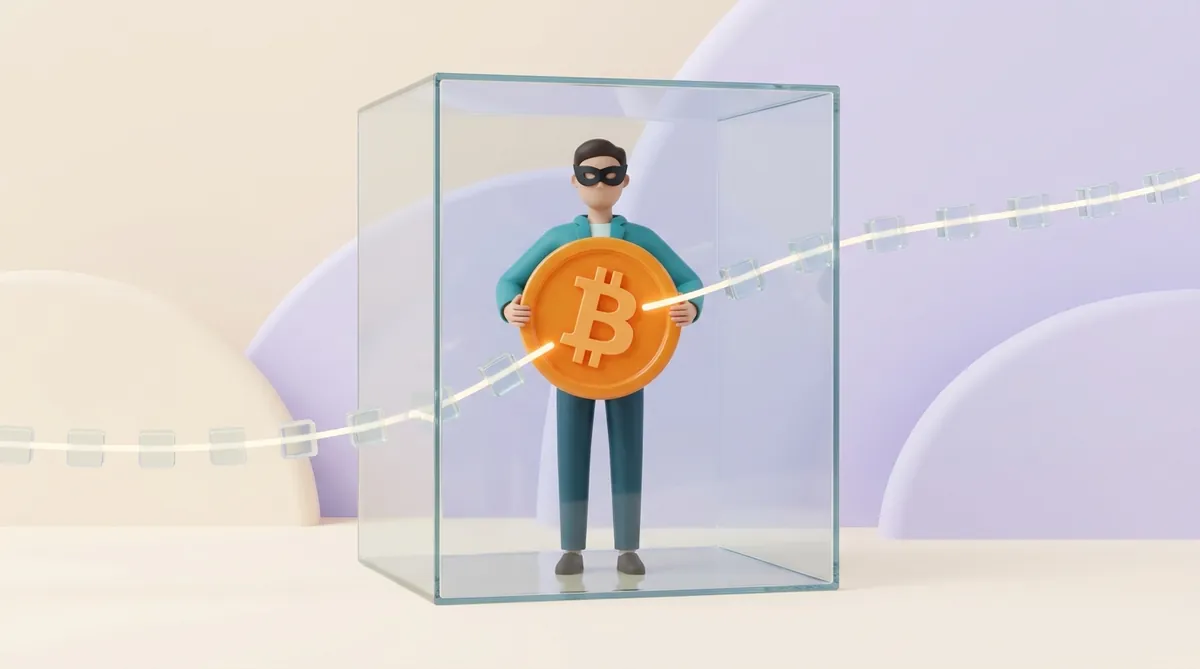
Mostly no: Bitcoin, Ethereum and USDT are not anonymous but pseudonymous, meaning every transfer stays public for good and only your name is missing from it. Once something that knows your name, such as an exchange account, links one of your addresses to you, your whole history becomes readable. Privacy coins hide far more, which is exactly why exchanges and regulators are pushing them out.
Pseudonymous. A pseudonym is a pen name: the books are public, only the author's real name is hidden. In Bitcoin, the pen name is your address, a string of letters and numbers that stands in for an account.
Everything else is on display. The blockchain is a shared record of every transfer, kept in copies on computers all over the world, and anyone can read it. You can open any transfer yourself and see what it reveals, step by step, with this guide on how to read a crypto transaction in a blockchain explorer.
Here is what that looks like. Say Maria pays 0.002 BTC for a VPN subscription. The record shows the sending address, the receiving address, the amount, the time and which earlier transfers the coins came from. It does not show "Maria".
It also never goes away. Ten years from now, that payment will still be there for anyone to read, along with everything Maria sent from the same address before and after.
That permanence is the real difference between the two words:
Bitcoin's creator saw this from the start. The 2008 white paper that introduced Bitcoin noted that a public record of transfers means privacy rests only on keeping addresses separate from identities, and admitted that some linking between addresses is unavoidable. Ethereum and most other coins work the same way: addresses instead of names, transfers in the open.

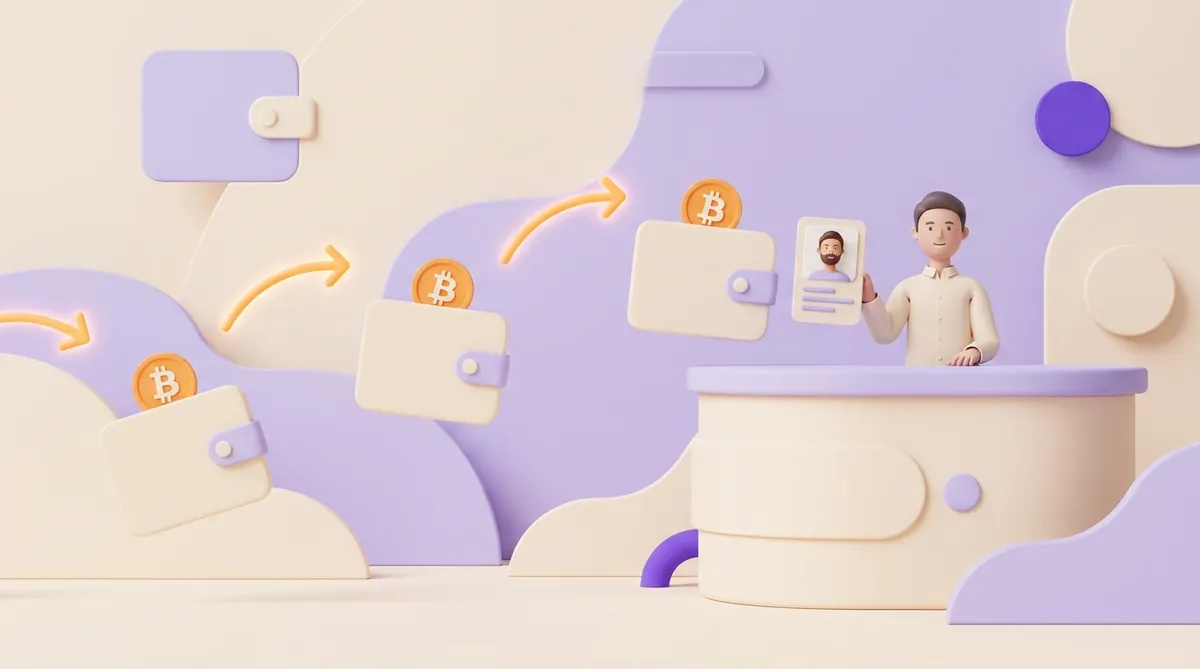
Yes, and usually not through clever maths but through ordinary records at the edges, where crypto meets the rest of your life. A name gets attached to an address in a handful of typical ways:
In the EU, a second paper trail follows the money between companies. Since 30 December 2024, under Regulation (EU) 2023/1113, crypto service providers have had to pass the sender's and the recipient's details along with the transfers they handle. This is known as the travel rule.
Investigators use all of this in practice. In June 2021, the US Department of Justice announced it had seized 63.7 bitcoins out of roughly 75 that Colonial Pipeline had paid to ransomware attackers a month earlier, after following the payment across the public ledger.
Tracing has a limit, though: seeing where stolen coins went is not the same as getting them back. That gap is where fake "recovery agents" step in, promising to trace and return lost crypto for an upfront fee, and it is one of the crypto scams worth learning to spot in time.
It depends on which kind of wallet you mean, because the word covers two very different things:
A self-custody wallet stays nameless only until one of its addresses touches something that knows you. The first time it receives coins withdrawn from your exchange account, the exchange's records connect the two, and from then on anyone with access to those records can follow what the wallet does next. A fresh address does not start a fresh history either: if it is funded from your old one, the ledger shows the link.
Each wallet can hold many addresses, and each address is just a public label anyone can look up. If that distinction is new, start with what a crypto wallet address is and how to find yours.
Sending crypto also reveals more than people expect. When you pay someone, they see your address, and from it they can see its balance and every transfer it ever made. Anyone who pays you learns the same about your receiving address.
Say you pay a freelancer 200 USDT from an address that holds 15,000 USDT. The freelancer can look the address up in a block explorer and see the 15,000, plus everyone else you paid from it. For most people, this is the more everyday privacy question: not whether a government can identify them, but what the people they pay can learn about them.
Sellers face the same thing from the other side of the counter. A shop that takes crypto shows its receiving address to every customer, and a shop that wants a payment service rather than a bare wallet soon asks whether it will have to hand over documents. That is its own question, answered in whether you can accept crypto payments through a gateway without KYC.
Yes, as easily as Bitcoin, and in one respect more so. USDT is a stablecoin, a token designed to stay worth one US dollar, and it lives on public blockchains such as TRON and Ethereum. Every USDT transfer sits in the open, exactly like a bitcoin transfer.
The extra layer is the issuer. Tether, the company behind USDT, can freeze the USDT held at a specific address, and it has done so at the request of law enforcement. Bitcoin has no company behind it that could do the same.
Then there is screening. Before crediting a deposit, exchanges and payment services can run the sending address through a check of where its money came from. The risk score goes up when the coins trace back to:
A deposit with a bad history can be held until its owner explains where the money came from.
That check looks at more than the address you sent from: it follows the coins back through earlier hops. The scoring itself, and what pushes an address up or down, is covered in how a crypto risk score works and what an AML wallet check looks at.
The IRS does not watch your wallet in real time, but it does not need to. Most of the picture reaches it through paperwork, and the ledger can fill in the rest:
So moving coins to a private wallet does not take them off the tax map. When a crypto tax is actually due, and how much it comes to, is a separate topic, covered in when you pay crypto taxes in 2026 and how much.
Some coins are built so that the ledger shows far less. These are privacy coins; Monero is the best known, and Zcash offers a similar private mode.
In plain terms, Monero changes three things about what the ledger shows:
An outsider can see that a transfer happened, but not who sent how much to whom.
Their privacy covers the ledger, not the edges. Buying a privacy coin on an exchange with your ID leaves the same record as buying bitcoin, and the shop that ships your order still knows where you live.
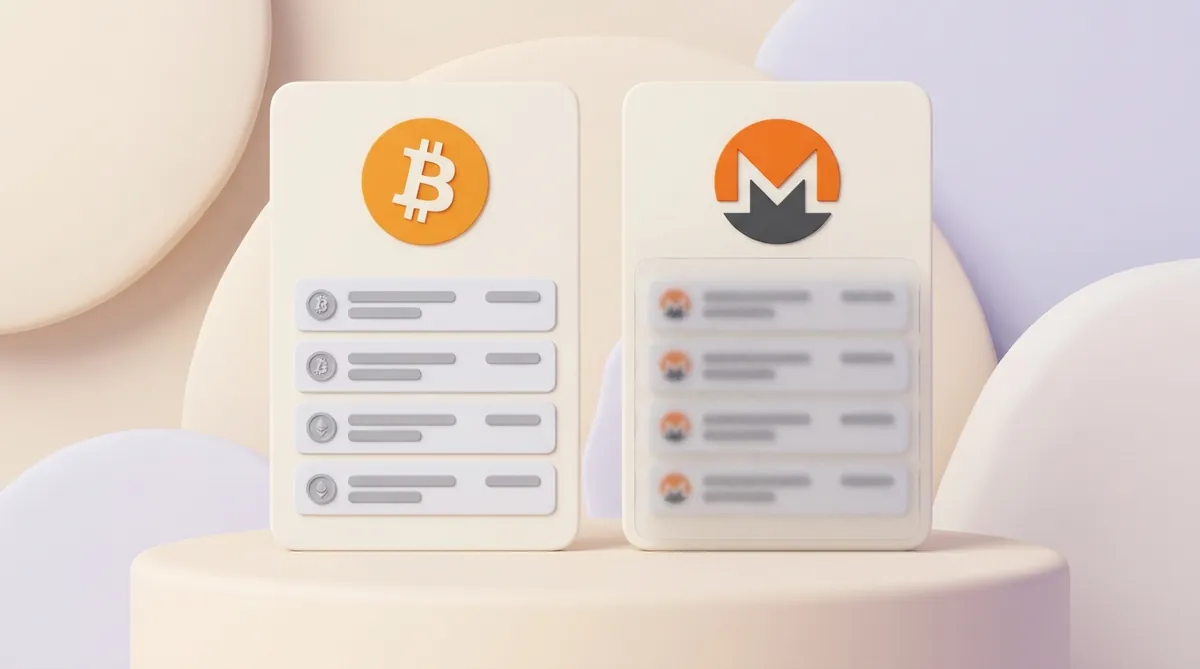
That design is why regulated platforms keep backing away from privacy coins:
Crypto gives you a pen name, not an invisibility cloak. The ledger is public and permanent, so the question is never whether your transfers can be read, only whether someone can connect them to you, and an exchange account, a delivery address or a tax form is usually enough. Privacy coins hide what happens on the ledger, and that is why fewer and fewer regulated platforms will touch them.
On a regulated exchange, yes: in the US and the EU, as of November 2026, exchanges must check who their customers are before they can trade. Setting up a self-custody wallet asks for no ID, but the coins in it still have to come from somewhere. That is why most people's on-chain history starts at an account with their name on it.
Privacy coins such as Monero are designed to hide the most: the sender, the recipient and the amount. Bitcoin, Ethereum and USDT sit at the other end, with everything public except names. No coin hides the moments where you meet an exchange, a shop or a tax form, and those moments can identify you whatever coin you use.
In the US and the EU, as of November 2026, no law bans individuals from holding them. The EU rule that starts on 10 July 2027 is aimed at banks and crypto service providers, so its practical effect is that fewer platforms will let you buy, sell or store such coins. Rules differ elsewhere, and Dubai, for one, prohibits all regulated virtual asset activity with them.
This article is general information, not legal or tax advice.
Create an account and connect the checkout yourself, or talk to sales and we will plan the integration with you.