

October 17, 2026
What are crypto network fees, and why do they change so much?
Read article
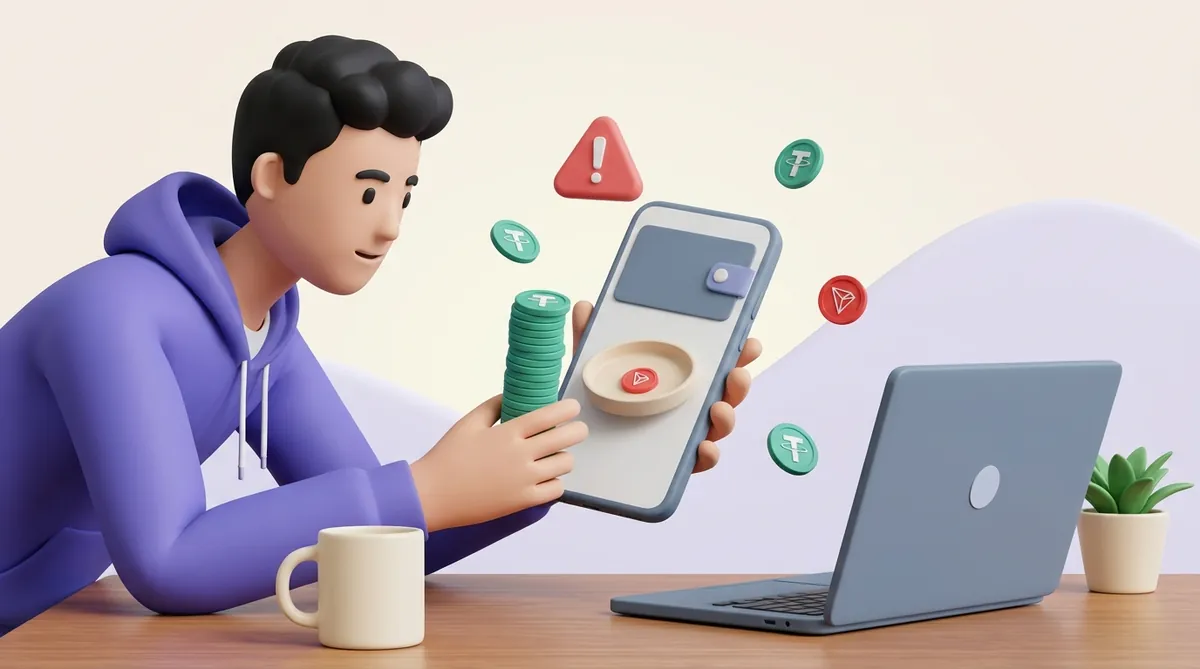
Your wallet shows USDT and refuses to send it: "not enough TRX for the network fee", or "insufficient resources", or "not enough TRON to cover the fee". The money is right there on the screen and you cannot move it.
Nothing is broken and nothing is frozen. The TRON network charges for transfers only in its own coin, TRX, and your wallet has none of it. USDT cannot pay for its own delivery.
So every fix has the same shape: a little TRX has to land in the wallet you are staring at — the one holding the USDT, not the address you are trying to pay. A normal transfer needs about 7 TRX, roughly two dollars; a transfer to an address that has never held USDT needs about 15 TRX, roughly five. Put 20 TRX in and you have covered either case with change left over.
And if you have no TRX anywhere and no card to hand, the fastest move is to ask whoever sent you the USDT to add 20 TRX to that same address. Below: why USDT needs a second coin, why the free daily limit you heard about does not cover it, five ways to get moving today, and what to do when USDT really is all you have.
USDT on TRON is not a coin sitting in your wallet the way TRX is. It is a line in a program — a smart contract, a piece of code living on the network — that keeps a list of everyone's balances. When you send USDT, you are asking that program to lower one number and raise another.
The network does that work, and it charges for it in TRX. Put simply: USDT is the letter, TRX is the stamp. No stamp, no delivery, however much is in the envelope.
The size of the transfer makes no difference. Anna sending 20 USDT to a friend and Anna sending 2,000 to an exchange are asking for the same job, so the two cost the same. This is normal for crypto in general: the fee follows the work, not the sum. We go through that logic in more detail in what a network fee is actually made of.
Two numbers cover almost every case:
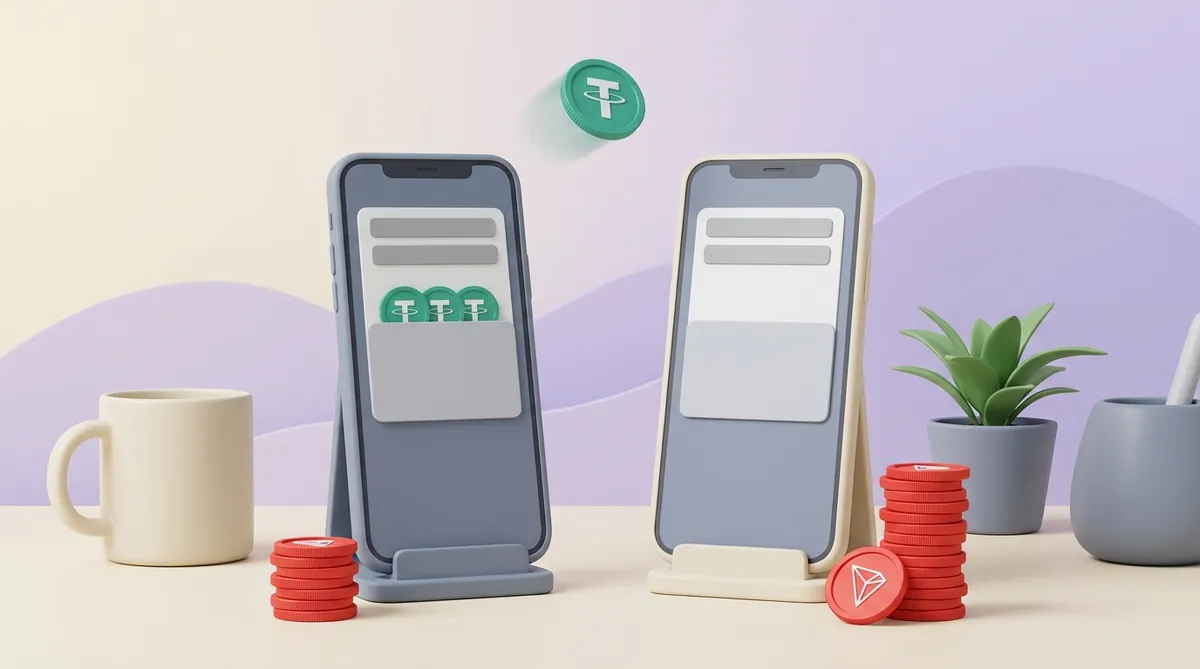
Which of the two is yours? Usually you cannot tell. All you have is a string of letters someone pasted into a chat, and nothing in it says whether that address has ever seen USDT. This is exactly why the practical answer is 20 TRX: it covers the expensive case, and nothing is wasted, because the network takes only what your transfer actually costs and leaves the rest sitting in the wallet for next time.
You might also want to know what the two cases cost in dollars this month, and whether another network would be cheaper for the same transfer. We measure that every month from real transfers: the median price on Tron to a recipient who already holds USDT and to one who doesn't, next to the other popular networks: measured TRC20 fees compared with other networks.
Your wallet's word for this is "resources", and TRON gives every account two of them. They pay for two different halves of the job, and only one half is free.
Bandwidth pays for the size of your transfer — how many bytes it takes up. Every account gets 600 units of bandwidth free every day, enough for a transfer or two. This is the free limit people remember hearing about.
Energy pays for the contract's work — the changing of the numbers in that balance list. There is no free energy for anyone, ever. You can stock up on it in advance by locking TRX in the network, which we come to below. If you have not, your wallet pays the blunt way: the moment you press send, the network takes the TRX the transfer needs and destroys it. That is what "burning" means here — the coins go to nobody, they simply leave circulation.
So a USDT transfer fits comfortably inside your free bandwidth and still needs energy, and energy costs money. That is the whole trap.
It also explains the thing people say next: "but I sent something for free yesterday." That was TRX. Moving TRX touches no contract, so it needs no energy at all, and the free bandwidth covers the rest.
One thing before the list, because everything on it depends on it: whenever TRX or energy is involved below, it goes to your wallet — the one holding the USDT. The address you are trying to pay needs nothing from you. TRX sent there is gone: it belongs to them now, and your transfer is still stuck.

First, the thing that looks obvious and does not work: swapping a few USDT for TRX inside the wallet. A swap is a contract call as well, so it needs energy too, and the wallet refuses for exactly the same reason.
Three routes do work.
Ask a human. Whoever sent you the USDT, or any friend with a TRON wallet, sends 20 TRX to your address. That is about seven dollars of their money and a minute of their time, and you can pay them back in USDT once you are unstuck. This is not begging, it is the normal way people unstick each other.
Rent energy and pay for it from outside the wallet. Some energy services take payment by card or from an exchange account. You give them your address, they lend energy to it, your transfer goes through — and no TRX ever has to appear in the stuck wallet.
Check whether your wallet can charge the fee in USDT. Where that feature is built on energy rental, it runs from your ordinary address and handles the whole errand: the wallet registers the account if it is new, moves a little TRX onto it, buys the energy your transfer needs, and bills you in USDT. Worth looking for in the settings before you go hunting for help elsewhere.
The middle route attracts scams, so here is the shape of a legitimate service. It asks for one thing: your wallet address. It takes no payment out of that wallet. It never asks for your seed phrase — the list of words that restores your wallet — and it never asks you to connect the wallet to a site. Anything offering "free TRX" or "flash USDT" is there to take the USDT you still have.
If you find an article saying a plain USDT transfer costs around 14 TRX, it is not lying to you, it is simply out of date. On 29 August 2025 the network halved the price of energy, and every fee on TRON dropped with it overnight. Anything written before that day quotes roughly double what you will pay now.
Keep 20–30 TRX sitting in the wallet. That is seven to ten dollars, and it is the entire cure. Top it up when it runs low, not when a transfer fails.
When you fund a brand-new wallet, send the TRX first and the USDT second. A new TRON address has to be registered on the network before it can do anything, and that registration costs the sender 1 TRX on top of the transfer — small, and paid once. In that order, the person on the other end gets a wallet that can move money instead of one that only displays it.
One paragraph for a different reader: if you take USDT as payment for goods rather than from friends, this stops being your problem and becomes your customers'. Someone who pays with no TRX leaves you a payment that never arrives and a conversation to have about it, which is one of the reasons shops accept TRON payments through a payment service rather than a bare wallet. Terms differ across those services — some set a minimum withdrawal, some hold funds for a period, some add a fee of their own — so ask in writing before you sign up. At CryptumPay, withdrawal is manual from the dashboard, at any moment, with no minimum, to any address you name.
USDT on TRON cannot pay for its own delivery. The network wants TRX, it wants it from the wallet doing the sending, and the free daily limit everyone remembers covers the cheap half of the job rather than the half that costs money.
So get about 20 TRX into that wallet — from an exchange, from another wallet of yours, from whoever sent you the money, or by renting energy and paying for it from somewhere else. Then leave a little TRX in there permanently, and this stops being a thing that happens to you.
Can I see exactly what a transfer will cost before I press send? Yes, on the confirmation screen. Before the final button, your wallet asks the network what this particular transfer would consume and shows you the estimated fee and the total you are about to pay. What you cannot do is work the price out in advance from the recipient's address — a string of letters tells you nothing about whether it has ever held USDT. So keep about 20 TRX in the wallet, then read the number the wallet puts in front of you. Afterwards the real figure is public: open the transfer on tronscan.org, an explorer that shows everything happening on the network, and look at the fee it lists in TRX. The Energy field beside it is the same thing in the network's own units, at 0.0001 TRX per unit. Our walkthrough of how to read your own transaction in an explorer covers where to click.
Does the person receiving my USDT need TRX too? No. Receiving costs nothing on TRON; the sender pays. They will need TRX only when they want to send that USDT onward, which is worth mentioning if you are paying someone new to crypto.
My wallet says "insufficient resources" and never mentions TRX. Is that the same problem? Almost certainly, yes. Wallets word it differently — "gas fee", "network fee", "insufficient resources", "not enough TRON" — but underneath it is one thing: not enough TRX in the wallet to pay for the contract's work.
Create an account and connect the checkout yourself, or talk to sales and we will plan the integration with you.