

August 7, 2026
Is BEP-20 the Same as BSC? Yes — For Your Transfer
Read article

Sending USDT to someone who already holds it costs a fraction of a cent on Solana, Polygon, TON and BNB Smart Chain, about 16 cents on Ethereum, and $2.17 on Tron when you have no energy of your own. A recipient who has never held USDT costs more on every network, most noticeably on Solana, where the price rises to $0.15–$0.20. These are medians from our 30-day measurement of real transfers, 23 August to 21 September 2026. The numbers are true as of 22 September 2026, and the page is updated every month.
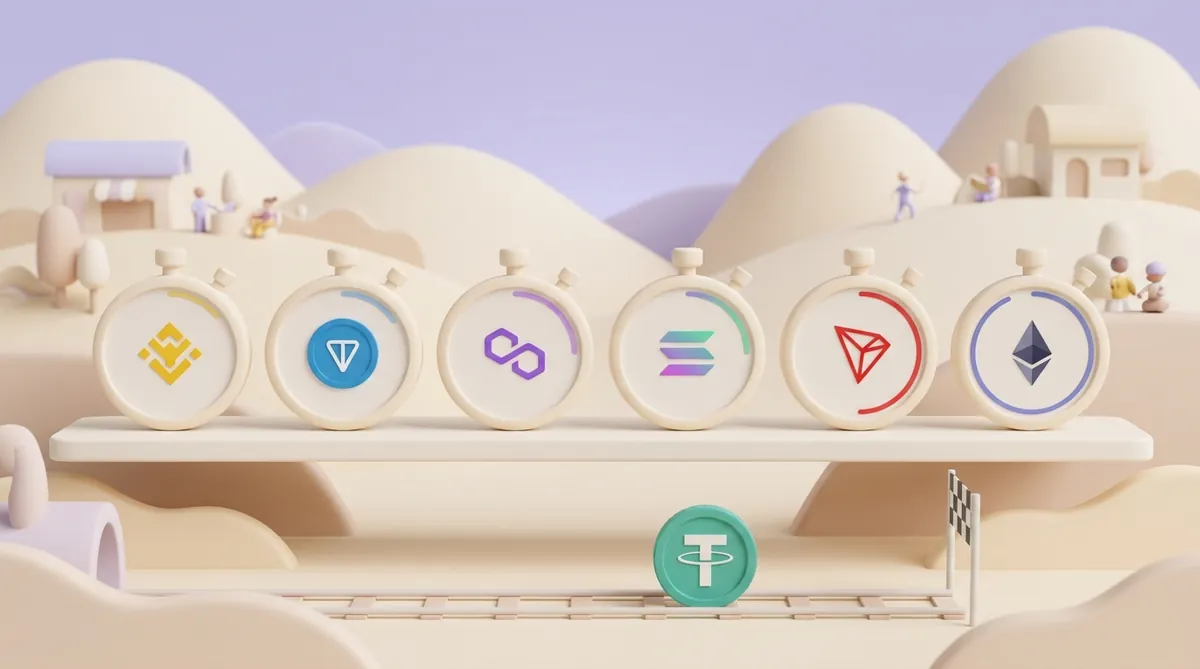
Time differs even more than price. On BNB Smart Chain, TON and Polygon the block with your transfer becomes final within a few seconds, on Solana in about 10 seconds, on Tron in about a minute, and on Ethereum in about a quarter of an hour.
The fee here means what the network itself charged. A withdrawal fee that an exchange or a wallet adds on top is its own price and is not part of these numbers.
Here is the median cost of one direct USDT transfer, in US dollars, from our measurement of 23 August to 21 September 2026 (network data from public nodes, coin prices from CoinGecko). The first number is for a recipient who already held USDT, the second for a recipient who had none:

So the cheapest USDT network depends on who you send to. If the recipient already holds USDT, Solana is cheapest at $0.0010 a transfer. If the recipient has never held USDT, Polygon and TON are cheapest at $0.0032, and Solana climbs to $0.15–$0.20.
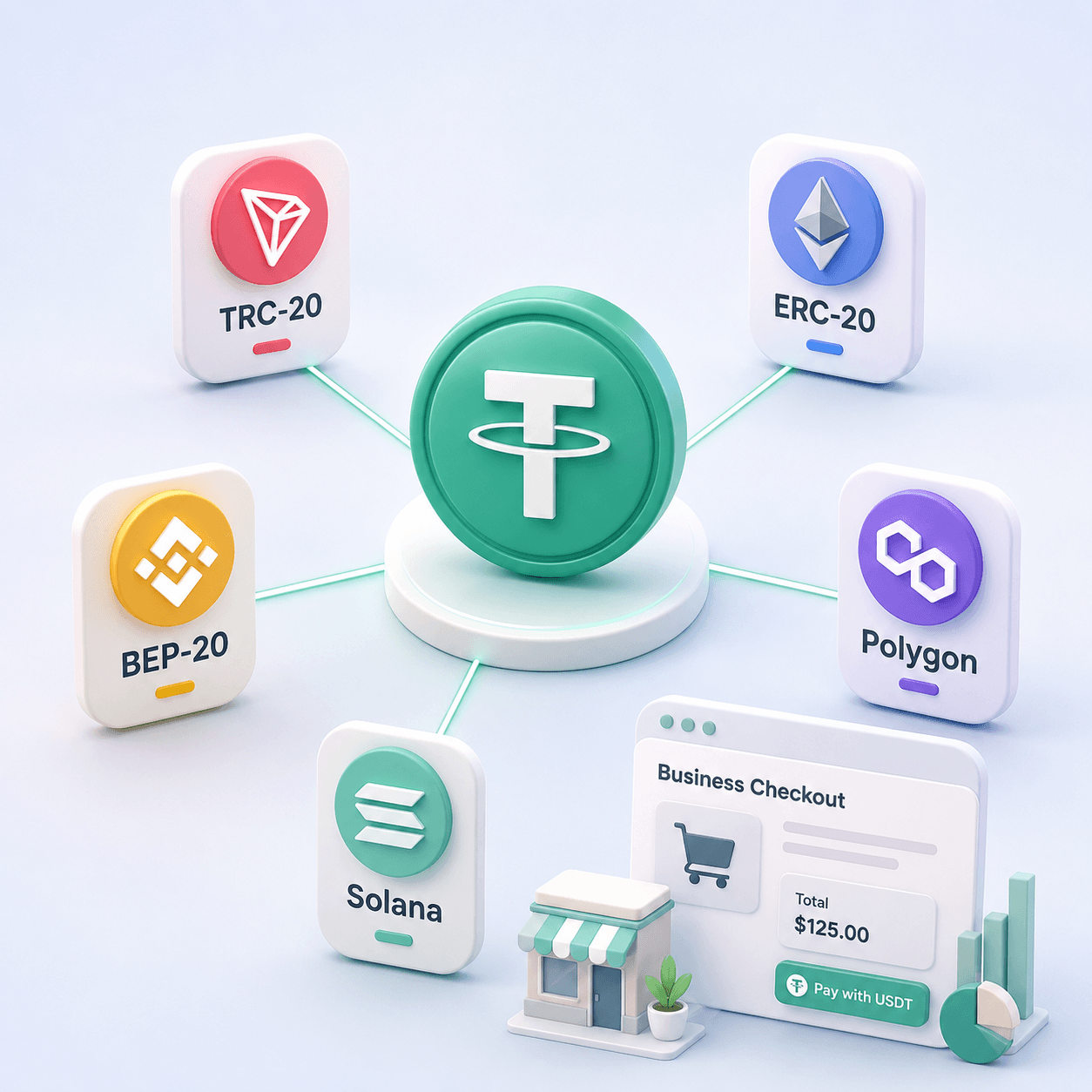
Between the four cheap networks the difference is a fraction of a cent, and nobody will feel it. What decides more is whether the recipient accepts USDT on that network at all, because a transfer on a network they don't support never reaches them. So the choice starts with the recipient, not with the price: which USDT network suits a sender and which suits a business.
The median for a recipient who already held USDT was calculated for each day of the window. Here is how far it moved from the calmest day to the busiest, 23 August to 21 September 2026:
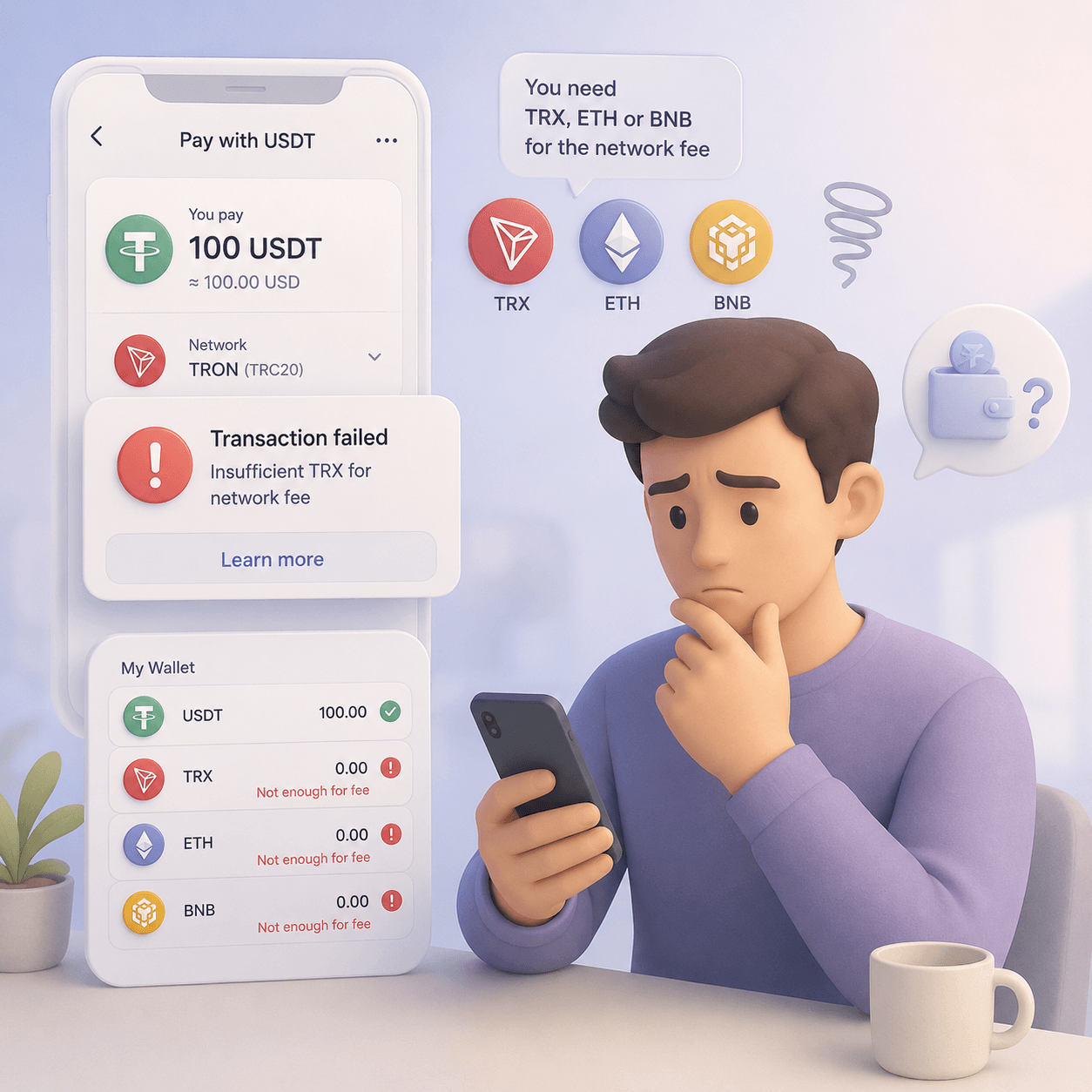
Each network charges in its own coin, whatever token you are sending. A wallet that sends USDT needs a little of that coin as well:
That is why the dollar figures above move with the price of these coins, not only with how busy the network is.
An ordinary wallet that holds USDT and none of the network's coin cannot send it. There are two exceptions:
For an ordinary wallet, the reason is spelled out in why a USDT payment fails without TRX, ETH or BNB.
USDT on each network is a program that keeps a list of balances. Sending USDT asks that program to lower one number and raise another.
If the recipient is already on the list, the program changes an existing entry. If the recipient has never held USDT, the program has to write a new entry, and storing new data costs the network more than changing old data. That is why a transfer to a new recipient costs more on every network, though not by the same amount:
Two networks do it their own way:
Two numbers describe the wait:
Here is what we measured: the block interval is the average over 23 August to 21 September 2026, and finality is the median of 10 to 12 checks against public nodes up to 22 September 2026.
These are the network's own times. Two waits on top of them are not measured here:
If the money doesn't show up, the transfer's hash (TXID) tells you whether it made it into a block and on which network, and you can follow the steps in how to check a crypto payment by TXID, network and amount.
Tron does not charge in coins directly. A USDT transfer uses up two resources:
If your address has energy, the transfer spends it. If it has none, the network burns TRX instead, at 100 sun per unit of energy, where 1 TRX is 1,000,000 sun.
Here is what 3,571 transfers read from Tron's public API (TronGrid) showed:
So Tron is expensive not because it is busy at a given moment but because it charges a fixed surcharge on the program everyone uses. That is also why its price barely moved during the month.
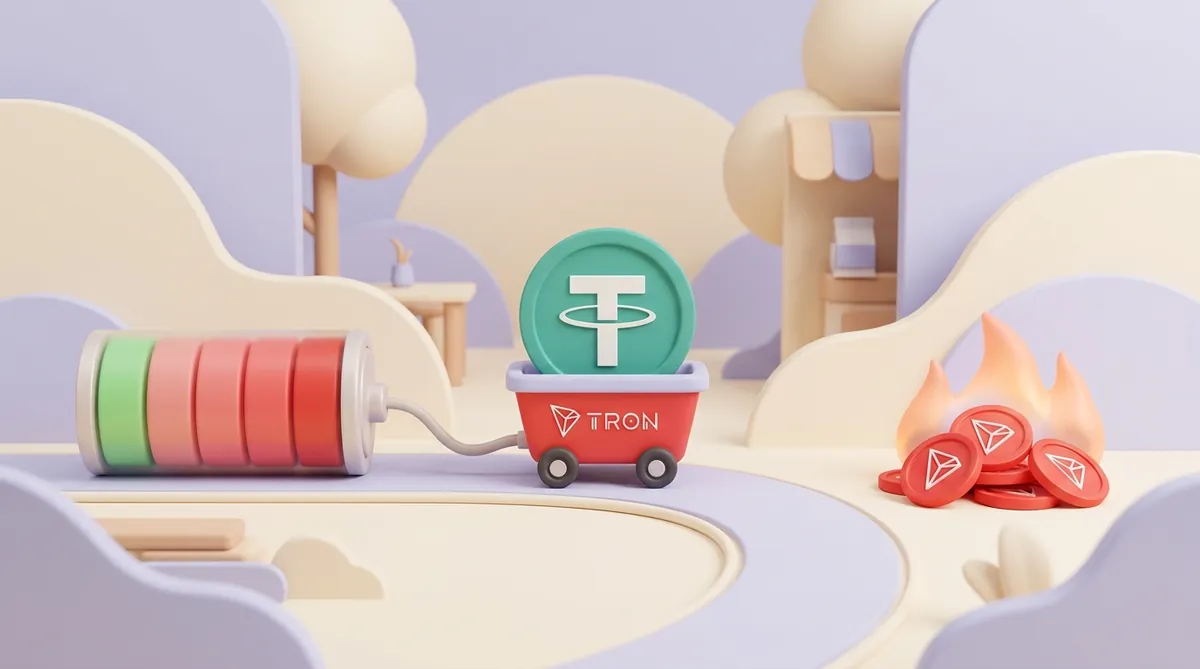
In practice few people pay the full burn. Here is how the transfers in our sample paid for energy:
What the rental cost is not visible on the chain, so we can't put a number on it.
And 46.7% of transfers burned no TRX at all, neither for energy nor for bandwidth.
If you have no energy, the wallet will want enough TRX for the burn before it sends anything; the amounts and the ways around it are in how much TRX a USDT transfer needs and what to do when you are short.
On Ethereum the price of a transfer has two parts:
Here is what 3,600 transfers read from a public Ethereum node (PublicNode) showed:
In other words, most of the ERC20 fee in these weeks was the tip that wallets add by default to get a transfer in quickly. Some wallets let you set a lower tip; the cost of doing that is a longer wait if the network gets busy. About 36.5% of the transfers went to recipients who had never held USDT.
BNB Smart Chain works like Ethereum, with gas paid in BNB, but its gas price is far lower. Here is what 3,594 transfers read from public BNB Smart Chain nodes (PublicNode and BNB Chain's own) showed:
A zero price means someone else paid. BNB Chain lets a wallet hand a transfer to a sponsor, called a paymaster, which covers the cost for the user. About 35.0% of the transfers went to new recipients.
Polygon also works like Ethereum, with gas paid in POL. Here is what 3,600 transfers read from a public Polygon node (PublicNode) showed:
One detail for anyone looking the token up: as of 22 September 2026 the USDT contract on Polygon gives its symbol as USDT0, so wallets and explorers that read the name from the contract show it that way. About 22.1% of the transfers went to new recipients.
USDT on TON moves as a chain of messages between small wallets, one per holder. The sender attaches a little GRAM to pay for that chain; the network takes its fees, and the rest comes back. More on how the network is built is in how the TON network works and what sending money on it costs.
Here is what 540 transfers read from TON's public APIs (Toncenter and TonAPI) showed:
Solana charges a base fee of 5,000 lamports (billionths of a SOL) per signature, and the sender can add a priority fee on top. Here is what 683 transfers read from public Solana endpoints (Solana's own and Tatum's) showed:
The network lowered that deposit twice within the month. Here is what it was in the sampled transfers, with the payer's median cost for a new account:
These three figures rest on only 23 transfers, so they show the direction of the change rather than a precise price.
On the chain, someone always pays. What changes is who, and when. There are three ways a sender ends up paying nothing at the moment of sending:
Paying a store adds another fee to think about: the one the store's payment service charges, besides the network's.
In the CryptumPay checkout window the payer picks the coin and then the network, and USDT is accepted on several networks. If the merchant has passed the fee on to the customer, the CryptumPay window shows it as a separate line before payment, so the payer sees the full amount before sending. On Tron the service pays for its own leg of the payment, servicing the one-time deposit address, with rented energy, so its transfer fee there is lower than the same transfer would cost by burning TRX; the network fee for sending from the payer's own wallet is still paid by that wallet. On the merchant's side, CryptumPay converts incoming payments to USDT as soon as they arrive; more on this in what crypto payment processing costs a business.
We read real transfers straight from each network, not from price lists. Every 4 hours for 30 full days, 23 August to 21 September 2026, we took the block closest to that moment and the blocks after it, and recorded the USDT transfers in them. That makes 180 moments per network, and every network had data at all 180.
Only plain transfers of USDT from one address to another count. Three kinds of transactions are left out, because their cost says nothing about sending USDT:
At each moment we took up to 20 transfers; on Solana we read 2 to 5 blocks, and on TON up to 3 transfers. The samples came out like this:
The cost of each transfer is what the network charged, in its own coin. We turned it into dollars at the coin's price in the hour of the transfer, using CoinGecko's hourly prices. For reference, here are the median coin prices over the window:
Every cost in the article is a median: half the transfers cost less, half cost more. We use the median because a few unusually expensive transfers would pull an average up and paint a picture nobody actually pays.
The block interval is the average over the window, taken from the first and last block numbers and the time between them. Finality was checked 10 to 12 times per network up to 22 September 2026, by asking a node how far its final block lags behind its newest one. On Polygon 2 of 12 checks were thrown out, because the public endpoint answered from different servers and gave a lag below zero.
Every transfer is recorded with its hash, so each number here traces back to specific transactions on the chain. The measurement is repeated every month, and this page is updated with it.
To a recipient who already holds USDT, a transfer costs well under a cent on Solana, Polygon, TON and BNB Smart Chain, about 16 cents on Ethereum, and $2.17 on Tron if you burn TRX, as of 22 September 2026. A recipient who has never held USDT raises the price everywhere, from about a quarter more on Ethereum to about double on Polygon, TON and Tron, and to $0.15–$0.20 on Solana. The fastest networks finish a transfer in seconds, Tron in about a minute, Ethereum in about a quarter of an hour. On Tron most of the price is a surcharge on the USDT program, and on Ethereum most of it is the tip your wallet chooses.
The network itself doesn't set a number: the service receiving the money decides how many blocks to wait for. On Tron a block is considered final, or "solidified", once it sits about 19 blocks behind the newest one; in our checks up to 22 September 2026 that was 18 to 20 blocks, about 55 seconds. An exchange may ask for more before it credits you.
Yes, on both counts we measured. Tron makes a block every 3 seconds and finalizes it in about 55 seconds, while Ethereum makes one every 12 seconds and finalizes in about 16 minutes. On price it is the other way round: in the same month an ERC20 transfer cost a median $0.16 against $2.17 for a TRC20 transfer that burns TRX.
Energy is the resource Tron spends on running programs, and a USDT transfer is a call to one. You get it by staking TRX: staked TRX gives your address a daily supply of energy that refills over 24 hours. Someone who has staked can also lend energy to another address, and rental services sell exactly that for a fee in TRX. In our sample 90.7% of transfers used staked or rented energy, but the rental price itself is not visible on the chain.
From your own wallet, usually not: an ERC20 transfer pays for gas in ETH, and with no ETH the wallet won't send. Two routes get around it:
Create an account and connect the checkout yourself, or talk to sales and we will plan the integration with you.