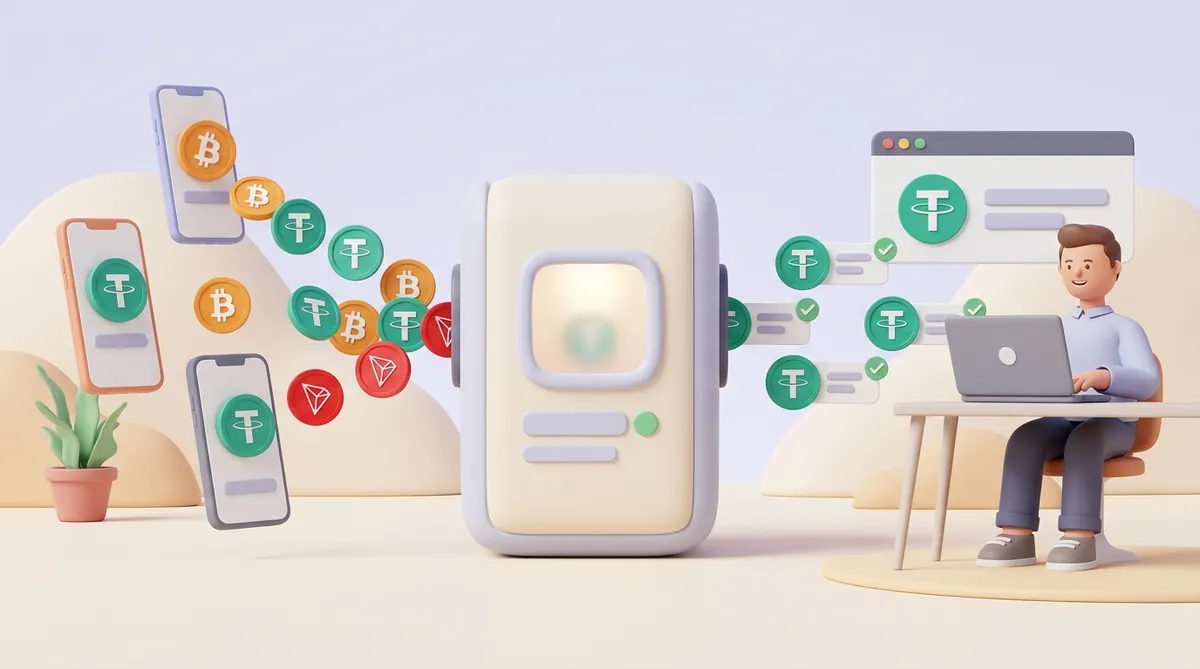
October 5, 2026
What is a crypto payment gateway, and how does crypto payment processing work for a business?
Read article

Wise does not accept USDT: a Wise account holds only ordinary currencies, has no crypto address, and turns away money that comes from Binance. Payoneer does take USDT from eligible business customers, into a separate stablecoin wallet, while Revolut Business takes crypto only in some countries, and Revolut has dropped USDT in the EEA and Switzerland. If a client wants to pay you in USDT, you receive it somewhere built for crypto first and move ordinary money to your account afterwards.
USDT is a stablecoin: a crypto token meant to stay worth one US dollar, sent over blockchain networks such as TRON or Ethereum. To receive it, you need an address on one of those networks. Wise gives you account details for dollars, euros, pounds and other currencies, but no crypto address, so a USDT transfer has nowhere to land.
Wise's rules go further than the missing address. As of November 2026, its help pages draw these lines:
The same pages say there may be exceptions, and in each the money reaches Wise as ordinary currency:
A designer who builds a website for a crypto exchange and invoices it in euros can be paid into Wise; the same designer can't hand that exchange a Wise account to receive USDT.
If the search results showed you "WISE to USDT" converters, those price a crypto token called WISE. It has nothing to do with Wise, the money transfer company.
The plan looks simple: the client pays USDT to your Binance account, you sell it there and withdraw dollars or euros to Wise. Wise's rules close both ways out of Binance:
Breaking these rules has a price. Wise says it may cancel or return payments that fall outside the risk it accepts, and it may close the account.
What still works is selling USDT on a platform that is regulated and supervised in the EU or the UK, then withdrawing ordinary money from there to Wise. Even then Wise keeps the final word on risk, so a small first withdrawal is a cheap test. The step from tokens to money a bank will take has its own costs and checks, explained in how crypto payments become usable money through an off-ramp.
Of the three, Payoneer is the one that says yes. Its stablecoin page lists USDC and USDT, received on networks including Tron, Ethereum, Solana, Base and Polygon. The service is for eligible business customers: eligibility depends on account type, location and local regulation, and Payoneer is rolling it out in phases.
Receiving USDT on Payoneer takes three steps:
That last point matters more than it looks. The stablecoin wallet is provided and operated by Bridge, a stablecoin company owned by Stripe, and you manage it from inside your Payoneer account. Payoneer says the wallet does not replace your Payoneer balances or bank accounts.
Stablecoins also don't move straight into your Payoneer USD balance. Payoneer's FAQ says to withdraw from the stablecoin wallet to a bank account and, if you need the money in Payoneer, add it from that bank. Withdrawal routes are live only in some markets so far, with more being added.
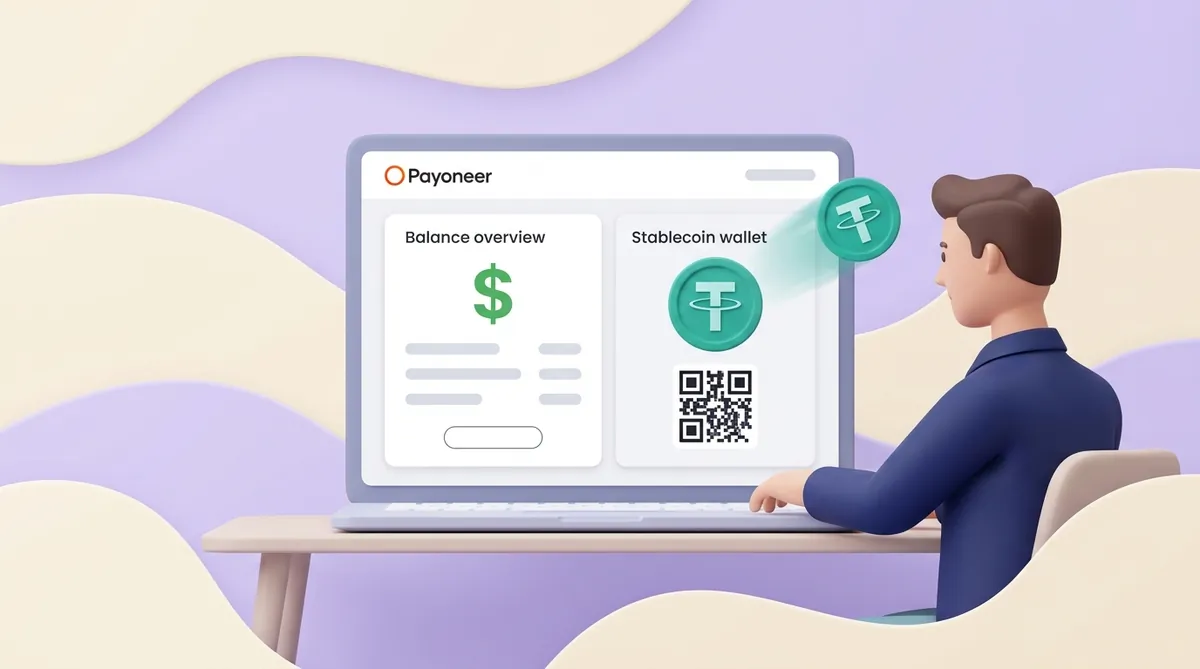
Fees and exchange rates are shown by Bridge before you confirm each transaction; Payoneer's pages don't publish fixed numbers. If the Stablecoin tab is already in your account, this is the shortest path from a client's USDT to your money.
If the tab isn't there, the service hasn't reached your market or account type yet, and Payoneer is not your route for now. Freelancers in that position still have several ways to take crypto from clients, compared in how to get paid in crypto as a freelancer.
Revolut answers differently from country to country: its crypto services follow local rules, and the help centre for each region says its own thing. As of November 2026, there are three situations:
So a design studio in Lisbon whose client offers 2,000 USDT should not plan on taking it into Revolut. A business elsewhere should open the Receive crypto screen before giving a client any details: Revolut warns that a coin it doesn't support, or one sent on a network it doesn't support, can be lost.
An occasional client payment in crypto is one thing. If crypto is a regular part of your income, an account built to hold it next to ordinary money may suit you better, and the options are laid out in which crypto business account a company needs and how to open one.
The working route has two halves. First the USDT arrives somewhere built for crypto; then you turn it into ordinary money on a platform your bank account will accept money from.
For the first half there are two ways:
If you take payments to your own wallet, a few habits save most of the trouble:
If you go the payment-service way, here is how it works at CryptumPay for freelancers and specialists:
The second half is the same whichever way you received the USDT. You send it to a platform regulated and supervised in the EU or the UK, sell it there for dollars or euros, and withdraw to your bank account or to Wise.
Every hop on that road costs something:
Count those costs before you set your prices: for a freelancer who bills small amounts, a few hops a month add up. It often pays to collect several payments and cash them out together. Networks differ a lot here, and the current numbers are gathered in how much a USDT transfer costs and how long it takes on each network.
The three accounts give three different answers:
Whichever account you have, the dependable route is to receive USDT in a wallet or through a payment service, then sell it on a regulated platform and move ordinary money to your bank.
The main risks come from mistakes and from where the money came from, not from the token itself. A crypto transfer can't be reversed, so a wrong address or network usually means the money is gone. Tether can freeze USDT on addresses linked to crime, and a platform may hold a deposit it traces to a risky source, so take payments from clients you know and keep the invoice trail. Also remember that USDT's link to the dollar rests on Tether, a private company, not on a bank deposit guarantee.
It depends on your country. Where Revolut supports crypto deposits, the app's Receive crypto section shows an address for each supported coin and network; in some regions you can only receive crypto from other Revolut users. Crypto you hold in the app can be sold for ordinary money in your account, and in the EEA and Switzerland USDT is no longer on the list.
Yes, if the dollars come from the client's bank account or from a crypto platform regulated in the EU or the UK. For Wise that is an ordinary payment for your work. If the client sends the money straight out of Binance, Wise will not accept it.
Payoneer's pages don't publish a fixed fee for receiving stablecoins. Bridge, which operates the stablecoin wallet, shows the fees, exchange rate and estimated amount before you confirm a transaction. The client separately pays the network fee on their side when they send the USDT.
This article is general information, not legal or tax advice.
Create an account and connect the checkout yourself, or talk to sales and we will plan the integration with you.