

September 1, 2026
How Hosting Providers Accept Crypto Payments: Costs, Statuses, and Refund Rules
Read article

Two hundred webmasters cleared the $50 minimum this month. Finance pushes the batch out through PayPal or Payoneer. A visible slice of every small payout goes to fees. Meanwhile two advertisers abroad keep offering to top up their balance in USDT, and a growing share of your media buyers keep asking to be paid in it.
Here is that batch priced. Two hundred payouts of $50 is $10,000 moved. PayPal costs about $200. Payoneer costs up to $900. The network fee for the same 200 transfers in USDT is $54 on Arbitrum One, or $36 on Optimism. That is 3.7 and 5.6 times less than PayPal — on the network component alone, before whatever your crypto provider charges to send a payout. Send the batch over Ethereum's main chain instead and the network fee by itself is $1,096, five times more than PayPal charges you today. The saving is not in crypto. It is in which network the transfer rides on.
Coming in: an advertiser funds an account and spends it on campaigns. Going out: webmasters, publishers and media buyers earn against that spend and get paid. Different counterparties, different failure modes, different reasons to touch crypto at all.
Almost everyone starts with payouts, because payouts look like the exciting part. But the money enters through deposits, and that is where the quiet damage lives. A few dollars of avoidable fee per payout is a line in a report; a deposit side built on a published wallet address is a person on your finance team opening a block explorer every morning. Who paid, for what, and why is the amount $12 short.

One rule carries this entire section: the payment is bound to the account before the money moves.
The broken version is a static address published in the dashboard or handed out by an account manager. Every incoming transfer then arrives as an anonymous number that somebody matches by hand — against a Telegram message, a screenshot, a timestamp. It works at five advertisers a month. At fifty it becomes a job.
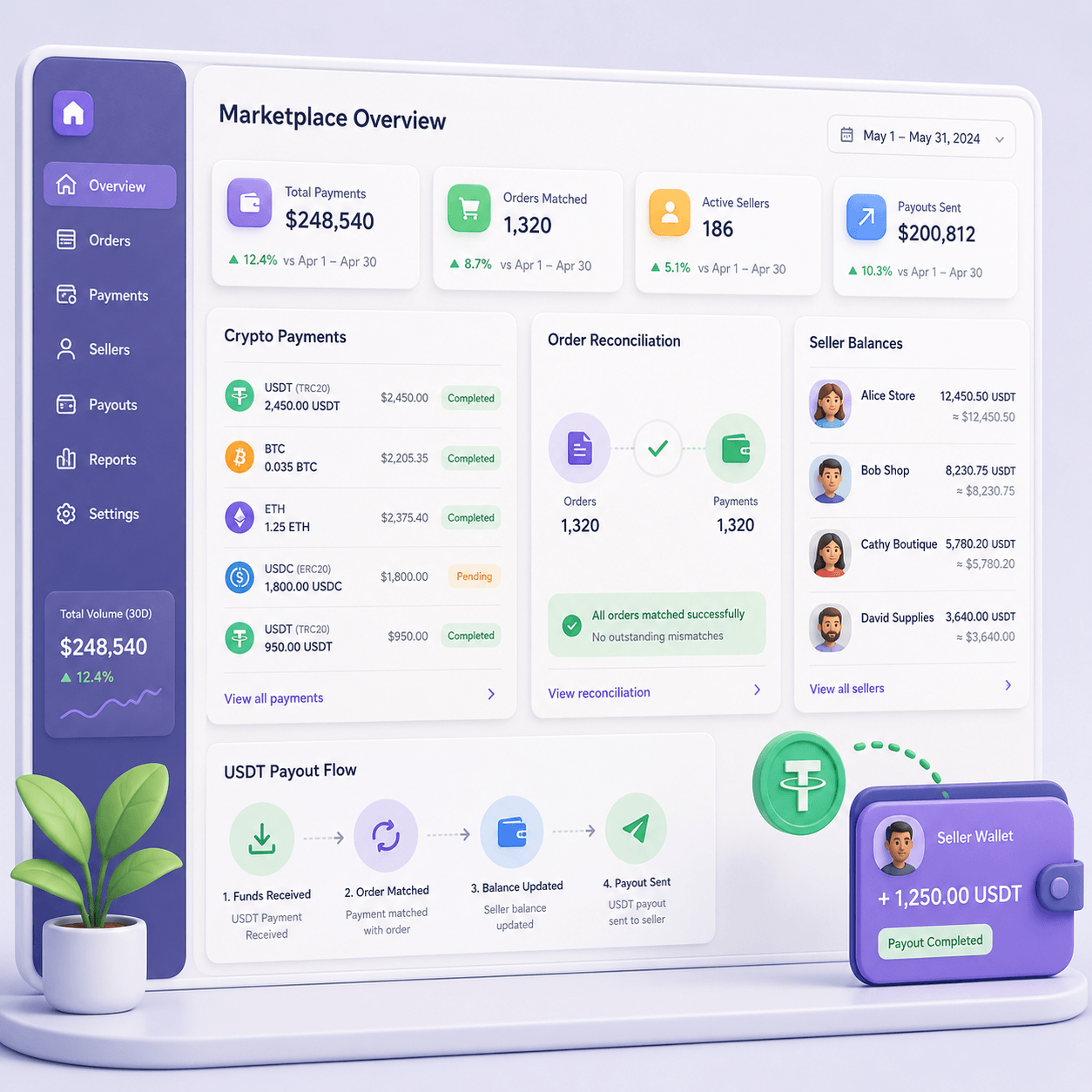
The working shape is an invoice per top-up. Before the advertiser sends anything, the system creates a payment carrying the advertiser ID, a fixed amount and an expiry. When the transfer lands against that invoice, crediting is automatic: the system already knows whose balance to move.
This is where CryptumPay slots into the money-in side. An invoice carries your identifier. The payment runs created → pending → crediting → finished, with a webhook on every change. What arrives is converted into USDT automatically, and underpayment and overpayment are handled without a human. CryptumPay charges 1% per successful payment, from 0.5% at high volume, and the fee can be passed to the payer. The crypto payment API checklist covers what to nail down first.
When does a crypto deposit actually earn its place? When your advertisers are abroad and cards or wires are slow, expensive or declined outright. If every advertiser you have already pays by a fast domestic transfer that clears the same day, crypto adds an FX layer and a legal layer and buys you nothing. Do not build it because it looks modern.
Five things break on deposits, and each has a control that prevents it:
Write the formula down once and every rail can be priced on the same terms:
cost of a batch = (number of payouts × fee per transfer) + (provider's percentage × volume moved).
At a small ticket the first term dominates, because a fee charged per transfer does not care that the transfer is small. Here is the batch — 200 partners at $50 each, $10,000 of affiliate payouts — with published tariffs as of August 2026.
The last four lines are one term of the formula, not both. They say nothing about what a provider charges you to push the payout out. That number is rarely published, and it is the single most important one you will ask a provider for.
You already know what it has to beat: there is about $150 of daylight between PayPal's $200 and Arbitrum's $54. A payout fee that eats all of it makes the switch pointless; one that eats a third of it still leaves you paying roughly half of what you pay today.
Then the $0.25 line. If your partners are US-domestic and finance already pays them through the Payouts API, $50 all-in is what USDT has to beat — so your provider's payout fee would have to be close to nothing for the switch to pay. Treat that corner as one where cost is not the argument. What is left is everything else: partners abroad who cannot hold a PayPal account, weekends and bank holidays, or partners who simply refuse to be paid any other way.
Network fees move daily — check the live numbers on l2fees.info before you commit to a corridor. Note the spread: $5.48 against $0.18 is a factor of thirty on the same asset, which is why choosing the USDT network is the decision that sets your payout cost. What a network fee is made of unpacks the components.
The rail that moves your own money off the platform can be the same one that pays partners. CryptumPay's withdrawal call takes the currency, the network and the destination address, so it sends to whichever wallet you name — your own or a partner's. One call is one transfer, which means the loop over your payout list stays your code. There is no minimum on a withdrawal, and the API key needs an IP allowlist before any of it runs.
The rule works on any network, including the one you cannot price in advance:
Set the threshold so the network fee stays under about 1% of a payout.
At $0.27 on Arbitrum that gives you a $27 minimum. At $5.48 on Ethereum L1 it gives you $548 — which is the arithmetic telling you not to pay $50 tickets on that chain. For TRON, measure one transfer from your own wallet and multiply by a hundred.
A fee charged per transfer falls when there are fewer transfers, whatever the amounts. Lift the minimum from $50 to $100 and Arbitrum goes from $54 to $27 — no negotiation, no new provider, no code.
It moves your card rail too, with one catch. PayPal domestic is a percentage with a cap, and at these tickets the cap binds. So it behaves like a flat $1.00 per payout: halve the payouts and the bill halves too, $200 to $100. PayPal international behaves differently. Two per cent of $100 is $2, well under the $20.00 ceiling — a true percentage, and the threshold does nothing to it.
The counterweight: the threshold is a term partners shop on. Adsterra advertises a $5 minimum for publishers paid via Paxum. Every dollar you add is a dollar of fee saved and a line in your offer that a competitor beats.
At the top of the range crypto stops being merely competitive. A $5.48 fee on a $5,000 payout is 0.11% — and that is on Ethereum L1, the chain you were just told to avoid at $50. Send the same $5,000 internationally through PayPal and the 2% hits the $20.00 ceiling: $20 against $5.48, nearly four times more.

A crypto transfer, once confirmed, is final. There is no recall, no chargeback, no acquirer to appeal to.
For a CPA platform that single fact reorders the operation. The hold period and the traffic-quality review look like bureaucracy. They are the only clawback this business will ever have. Whatever you did not check before the transfer is unrecoverable after it.
How long should the hold be? Set it off the window in which your advertiser can still reject or adjust conversions, because that window decides when the money is actually yours. Pay before it closes and you have handed out money you may still owe back. Read your advertiser contracts, find the longest approval window among them, let the hold cover it.
The same irreversibility names your real fraud vector, and it is not the one people expect. Nobody is going to break into the network's wallet. What happens is quieter. A partner's account is compromised, the payout wallet is swapped, and the change lands shortly before a large payout is due. The transfer goes out, correctly authorised, to the wrong person.

Two controls handle almost all of it, and both are yours to build. Freeze payouts after any change to wallet details. Long enough that a swapped address cannot be cashed before a human looks at it — in practice, at least one full payout cycle. And require a second factor on financial settings, because login alone leaves the money side open. On your own account with the provider, CryptumPay applies 2FA at both points, on login and on withdrawal, and holds suspicious funds before they reach the balance.
Beyond that, screening a wallet before you send takes seconds, and it is the one check that still works after an address has changed.
A corridor that saves $150 a month and cannot legally operate is not a saving.
In the European Union, MiCA — the Markets in Crypto-Assets Regulation — has applied in full since 30.12.2024. The transitional window that let providers keep operating under national regimes closed on 01.07.2026. Since that date, only an authorised CASP — a crypto-asset service provider holding a MiCA licence — may provide the service.
You are not the one providing the crypto-asset service; the provider you plug in is. So there is one question. Are you an authorised CASP, in which member state, and can I see the entry in the register? ESMA publishes the interim MiCA register of authorised providers on its markets in crypto-assets page. Checking takes a minute. A provider that answers vaguely has answered.
Ask it even if your company sits outside the EU — it is the cheapest single filter you have on a provider. Your own obligations are a separate, local question, and the above is the EU position as of August 2026: general information, and no substitute for advice from a lawyer in your jurisdiction. If your outbound side is closer to a contractor roster than an affiliate programme, the mechanics of paying contractors in stablecoins overlap heavily.
Run your own batch through the formula before you run it through a provider: number of payouts times the fee per transfer, plus the provider's percentage on the volume.
At $50 tickets the network component on a cheap chain sits far below PayPal's all-in $200 — $54 on Arbitrum, $36 on Optimism, 3.7 and 5.6 times less — while Ethereum L1 loses outright at $1,096. Whether that lead survives once your provider's payout fee lands on top of it is the one number you have to go and get. And if your partners are US-domestic, the Payouts API at $50 the batch is an all-in figure that already contains what those crypto lines leave out. Set the minimum so the network fee stays under 1% of a payout. On the money-in side, the invoice bound to an advertiser ID is the whole game: without it you have not added a payment method, you have added a reconciliation job. And because none of it can be undone, the hold and the wallet-change freeze are not friction. They are the only money you will ever get back.
Create an account and connect the checkout yourself, or talk to sales and we will plan the integration with you.