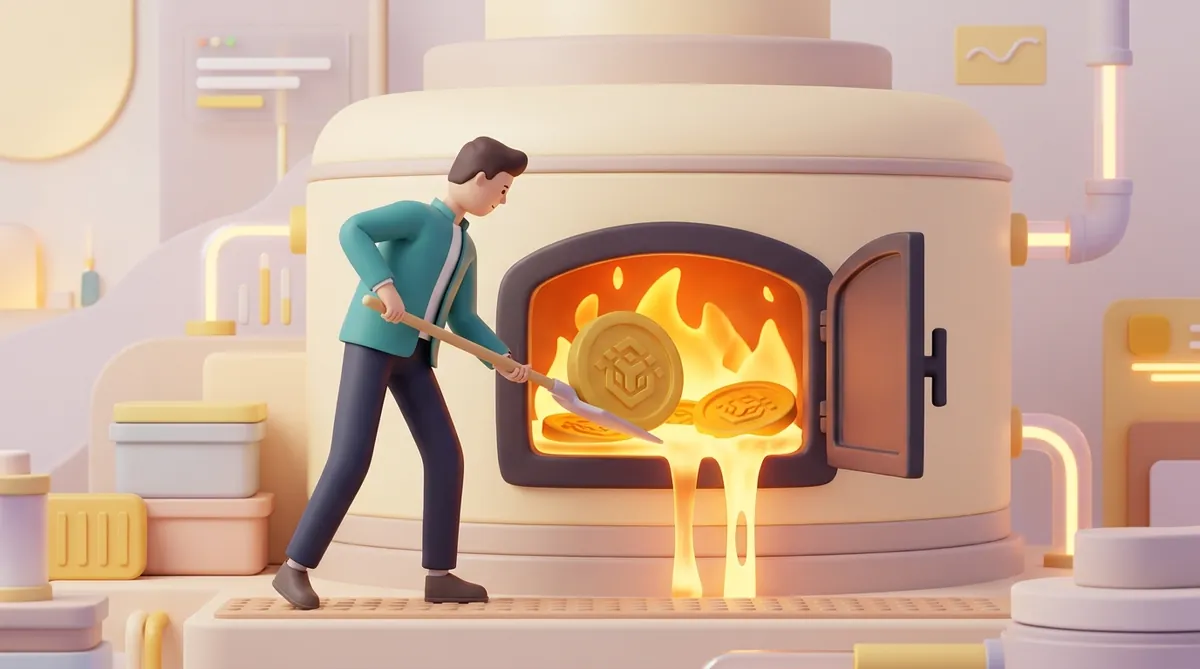
A token burn means some crypto is destroyed on purpose: it is deleted from the ledger or sent somewhere no one can ever spend it. Projects do this to cut supply or to hand earnings back to holders, and some networks burn part of every fee automatically. A burn does not make a token worth more by itself: that depends on where the burned tokens came from and what else is happening to the supply.
How a token burn actually works
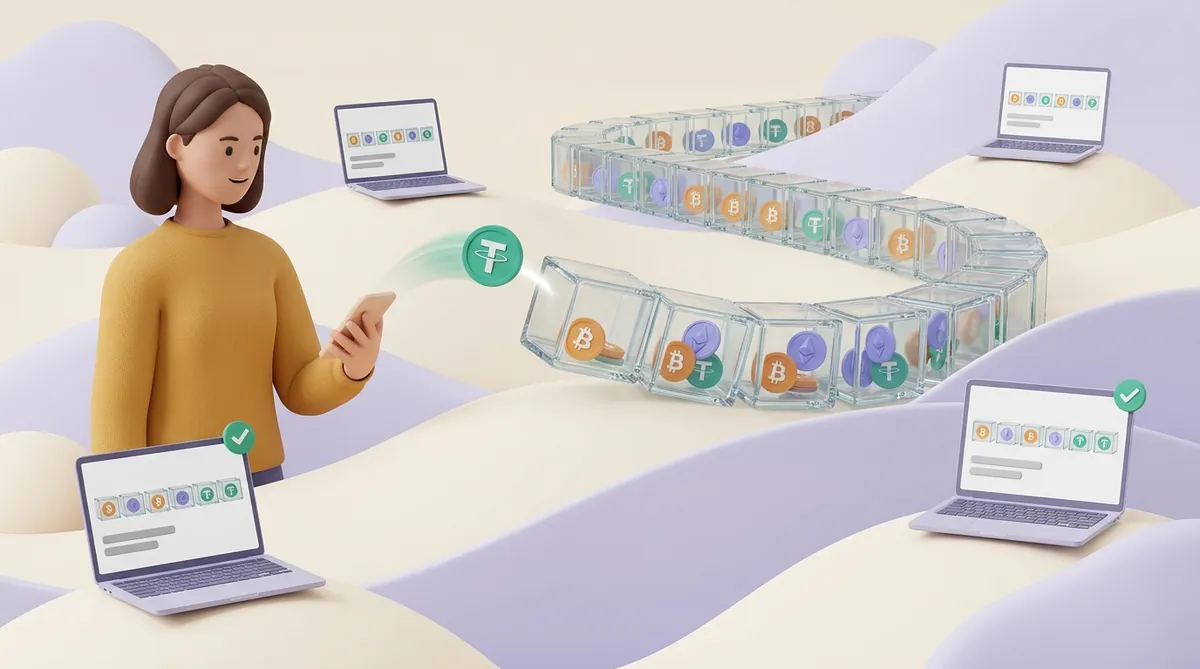
Nothing catches fire. A blockchain is a shared ledger of who holds what, and a burn is an entry in that ledger that makes some tokens permanently unspendable.
It happens in one of three ways:
The token's own program deletes them. A token on a network like Ethereum is a list of balances kept by a smart contract, a program that runs on the blockchain. Its burn command lowers one balance and the total by the same amount. If a token has 1,000,000 units and you burn 100 of yours, the list now adds up to 999,900.
Someone sends them to a burn address. This is a wallet address nobody controls. Spending from an address takes its private key, the secret code that signs transfers, and no one is known to have the key for a burn address or could work it out by guessing. The tokens stay visible there forever and can never move. One catch: the transfer doesn't change the token's own count, so the program still reports the full total, and data sites have to subtract what sits at the burn address.
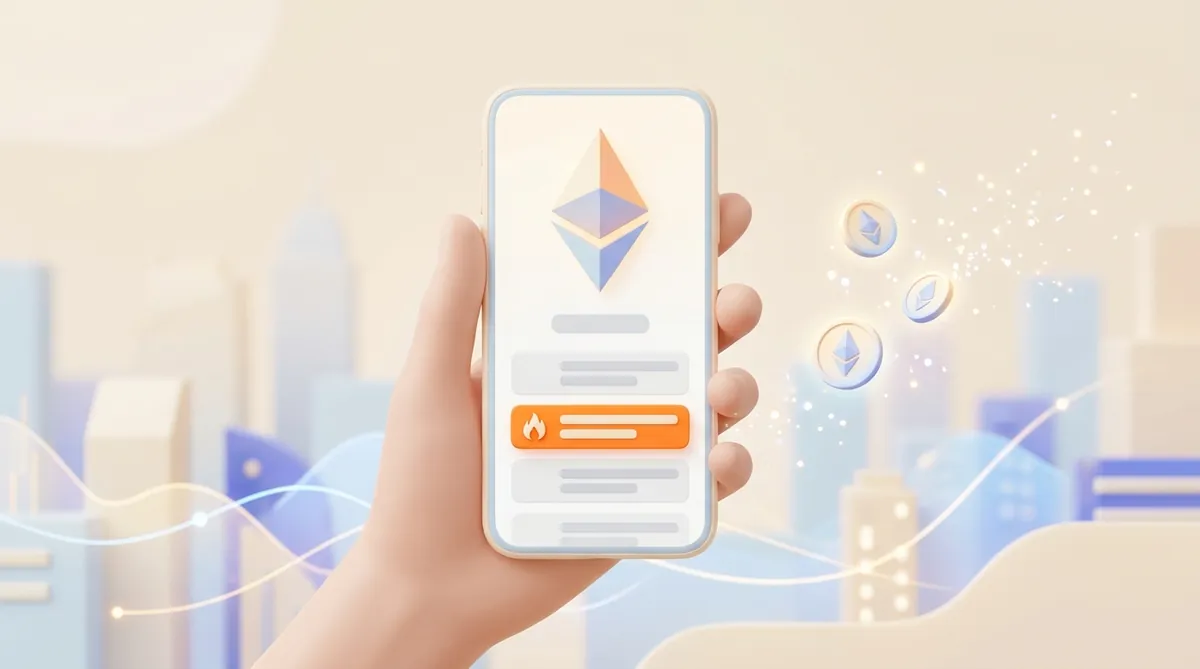
The network destroys a fee. Ethereum splits every transaction fee into a base fee and a tip. The validator, the computer that adds the transaction to the chain, keeps the tip. The base fee goes to nobody: that ETH is taken from the sender and credited nowhere. The base fee rises and falls with how busy the network is, and it is priced in a tiny unit, so it helps to know what gwei is and how it becomes your Ethereum fee.
Why do projects burn tokens?
Burns don't all have the same purpose, and the purpose tells you a lot about what a burn is worth. There are five common reasons:
To pass earnings on to holders. The project spends its revenue to buy its own token on the open market, then burns what it bought. It works a bit like a company buying back its shares, and it costs the project real money.
To shrink supply on a schedule. The rules set a target, and burns continue until it is reached. BNB works this way, with a goal of 100 million coins.
To keep validators from gaming the fee. If Ethereum's validators received the base fee, they would have a reason to push it up. Burning it removes that reason, and the destroyed ETH also offsets some of the new ETH the network creates.
To keep a stablecoin matched to its reserves. A stablecoin is a token pegged to a currency like the dollar. When someone hands 1,000 USDC back to its issuer, Circle, and gets $1,000, those 1,000 USDC are burned. This burn is bookkeeping and has nothing to do with scarcity.
To clear out tokens the project never used. Unsold tokens from a launch or a surplus in the treasury get destroyed, which shows the team can no longer sell them later.
Not by itself. The arithmetic looks promising: if 1,000,000 tokens trade at $1 and 100,000 are burned, the remaining 900,000 would be worth about $1.11 each, as long as the total value stayed at $1 million. Nothing forces it to stay there, because a token's price is only what the next buyer pays.
Whether a burn matters comes down to four things:
Where the burned tokens came from. Tokens bought on the market cost the project real money and came out of what was for sale. Tokens from a locked team reserve were not for sale that day. Burning them lowers fully diluted value (FDV), which counts every token that will ever exist, and leaves market cap, which counts only tokens already in circulation, where it was. If those two numbers are new to you, here is how market cap differs from FDV. A team can make this kind of burn without spending any money.
How big the burn is next to the supply. Round numbers in announcements sound huge. A billion tokens out of a quadrillion is 0.0001% of the supply. Check the percentage before the headline number.
Whether people want the token anyway. A burn doesn't create demand. With no buyers, a smaller supply of something nobody wants is still unwanted. A burn scheduled months ahead also isn't news to anyone trading the token.
Whether new tokens are arriving faster. Issuance is the creation of new coins, usually to pay the people who run the network, and a burn only counts once you subtract it. Ethereum has burned about 4.6 million ETH since 2021, yet from January to early October 2026 its fee burn offset only about 2% of the new ETH created, and supply still grew. The burn rises and falls with activity on the network, while validators keep earning new ETH for securing it. If you are wondering why a network creates new coins at all, that comes down to how the Ethereum network works.
A burn is one input among several. We don't recommend treating the announcement on its own as a reason to buy, because it tells you nothing about demand.
Which crypto projects are burning coins right now?
Plenty are, and the method differs from one to the next. Here are well-known examples as of November 2026, in no particular order:
Ethereum (ETH). Every transaction's base fee is burned automatically, so the amount depends on how much people use the network and how high the fee is. Supply today is about 122 million ETH.
BNB. A quarterly Auto-Burn, calculated from BNB's price and the number of blocks produced, sends coins to a burn address. The latest one destroyed about 1.65 million BNB and left about 131.5 million against the 100 million goal. A share of the gas fees in every block is burned as well.
XRP. The cost of every transaction on the XRP Ledger is destroyed and paid to nobody. The usual minimum is 0.00001 XRP, so each burn is tiny.
TRX (TRON). If an account doesn't have enough bandwidth and energy, the resources a transaction consumes on TRON, the network burns TRX to cover the gap. That's why a USDT transfer from a wallet with no TRX can fail, and it pays to check how much TRX a USDT transfer needs. The burn there isn't a supply policy. It is simply how the fee gets paid.
UNI (Uniswap). Uniswap is a service for swapping tokens. Its token holders voted at the end of 2025 to burn 100 million UNI from the treasury and to route part of the trading fees into further burns. The first is a one-off, and the second depends on how much people trade.
USDC. Circle burns USDC when holders redeem it for dollars, and also when its transfer service moves USDC between networks: the tokens are burned on one network and created on the other. In that second case the total stays the same, so a large USDC burn in the news may mean nothing at all for supply.
Bitcoin is the notable exception: it has no built-in burn, and transaction fees go to the miners who add each block to the chain.
This list mixes coins and tokens. ETH, BNB, XRP and TRX are the native coins of their own networks, while UNI and USDC are tokens that live on other networks, and that is the main difference between a coin and a token.
How to check a token burn with a tracker
Every burn leaves a public record, so you don't have to take an announcement on faith. These tools show the numbers:
Etherscan and ultrasound.money for ETH. Etherscan shows the total burned next to the supply, and ultrasound.money tracks the burn rate against supply growth.
BNBBurn for BNB. This dashboard shows gas-fee burns and the quarterly Auto-Burn, with links to BscScan, the block explorer for BNB Chain.
Tokenomist's Burn Screener for many projects at once. It compares recent burns and shows whether each was programmatic or manual. The 7-day figure is free, and the other columns need a paid plan.
Those tools only cover the tokens they follow. To check a specific burn claim yourself, take three steps:
Open the burn transaction in a block explorer. A block explorer is a website that shows every transaction on a network. Paste in the transaction hash, the ID from the announcement, and if the page looks cryptic, here is how to read a crypto transaction in a blockchain explorer. The page shows the sender, the receiver and the amount.
Look at where the tokens went. The burned tokens should land at a burn address, such as the all-zeros address or the one ending in dEaD, or the transaction should call the token's burn command. A wallet belonging to the team is not a burn, whatever the announcement calls it.
Compare the supply before and after. Look at the token's circulating supply and at what share of it the burn took. A burn of 1% of the supply is a very different event from a burn of 0.001%, and if the tokens came from a locked reserve, the circulating number will not move.
What a token burn comes down to
A token burn is a permanent cut to the tokens anyone can spend. What it is worth depends on one question: did it cost someone real money and take tokens out of the market? An announced burn with no transaction you can look up is only a claim, and an empty promise of that kind is a good reason to learn how crypto scams work and how to spot one in time.
Common questions about token burns
Is a token burn good news for people who hold the token?
It can be, when the burn is paid for with real revenue and reduces the supply actually trading. It is close to neutral when the tokens were locked away and never due for sale. A heavy burn can also cut the other way, because fewer tokens available to trade can make the price jumpier.
What is the burn address on Ethereum?
There is no single official one. The best known are the zero address, 0x0000000000000000000000000000000000000000, and 0x000000000000000000000000000000000000dEaD, which Etherscan tags as a burn address. Many token programs refuse a plain transfer to the zero address and only allow it through their burn command. Ethereum's own fee burn uses neither, because the base fee never goes to an address at all.
What happens if I send crypto to a burn address by mistake?
It is gone. Nobody holds the key to that address, so no wallet, exchange or developer can send it back. Matching only the first and last characters won't protect you from the wrong address, because scammers create look-alikes that share them, so compare the whole address before you confirm. For a large amount, send a small test first and have the recipient confirm it arrived, which costs one extra network fee.
Does a token burn take tokens out of my wallet?
Normally no. A project burns tokens from its own holdings, and a network burns a fee you were paying anyway. The exception is a token with a built-in transfer tax: a slice of each transfer is destroyed, so the person receiving gets less than you sent.
This article is for information only and is not investment, legal or tax advice.
Start accepting crypto payments
Create an account and connect the checkout yourself, or talk to sales and we will plan the integration with you.