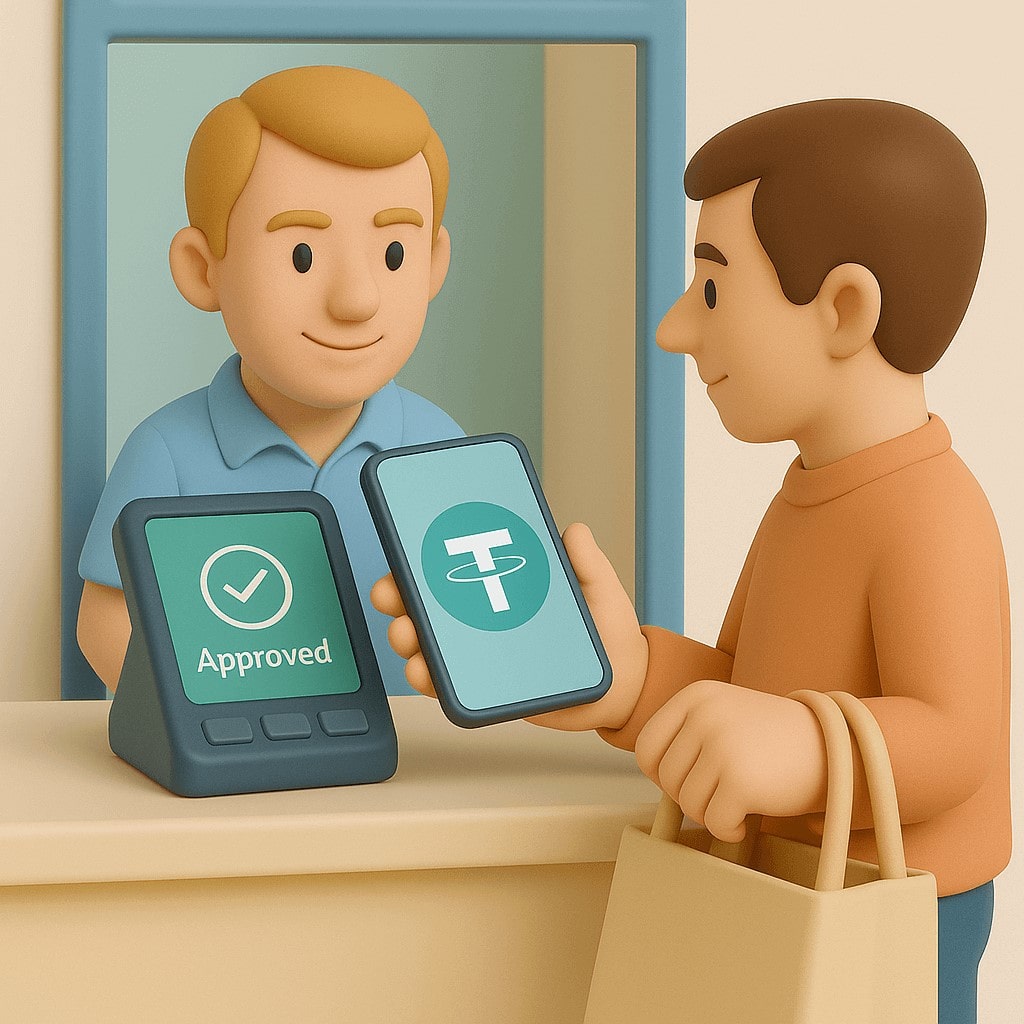
en

What is USDT, and how do I start accepting Tether payments in my business?

Published
16.11.2024
Updated
28.10.2026
USDT guide, picture
Contents

    USDT is a digital dollar. A private company called Tether issues it on several blockchains and stands ready to exchange one USDT for one US dollar. For your business, that means a customer anywhere in the world can pay you in minutes, and the payment is worth the same tomorrow as it is today.

    To start accepting USDT, you make three decisions before the first customer pays:

    • Where the money lands. Either straight in your own wallet, or with a payment processor that takes the payment for you.
    • Which networks you accept. USDT lives on several blockchains, and the customer has to send it on one you watch.
    • How each payment finds its order. With many customers paying, you need a way to tell who paid for what.

    They are worth getting right up front, because a USDT payment cannot be reversed. If it goes to the wrong place, there is no bank to call.

    One note on names before we start. Customers often say "Tether" when they mean the coin. In this article, USDT is the coin, and Tether is the company behind it.

    What USDT is and who stands behind it

    USDT is a token: a balance recorded on a blockchain, the shared ledger that a network of computers keeps in sync. Tether launched it in 2014, and today it is the most widely used stablecoin, meaning a coin built to hold a steady price.

    Tether creates and destroys USDT on demand. A large verified client sends Tether dollars, and Tether issues the same number of USDT. The client sends USDT back, and Tether destroys it and returns the dollars.

    That direct door is open only to verified large clients. A business like yours turns USDT into dollars the ordinary way: by selling it on an exchange or through a broker.

    People pay in USDT for three reasons that matter to a merchant:

    • It holds its price. A customer who pays 100 USDT for an order has paid about 100 dollars, not a coin that may be worth 90 by evening. That is the main difference from bitcoin, and the reason businesses that fear price swings accept crypto through stablecoins to protect their revenue.
    • It crosses borders without a bank in the middle. A client abroad sends USDT from their wallet or exchange account, and it arrives in minutes, on weekends too.
    • Customers already have it. Freelancers, crypto users and buyers in countries with hard-to-reach dollar accounts often keep their savings in USDT and would rather pay with it than with a card.

    If your USDT will mostly come from subscribers abroad, the wider question is how a subscription business gets paid across borders, and that has its own guide to international payments for SaaS.

    Why one USDT is worth one dollar

    The price holds because of that exchange door. If USDT drops to 99 cents on an exchange, a large client can buy it cheap and redeem it with Tether for a full dollar. Enough people doing that pulls the price back up.

    The door only works if Tether actually has the dollars. So the company keeps reserves, mostly in short-term US government debt, and publishes a report on them every quarter, checked by an accounting firm. That quarterly report is an attestation: a snapshot of the reserves on one date.

    A fuller check came in August 2026, when Tether published its first full audit. KPMG examined the company's 2025 financial statements and gave an unqualified opinion, the cleanest verdict an auditor issues.
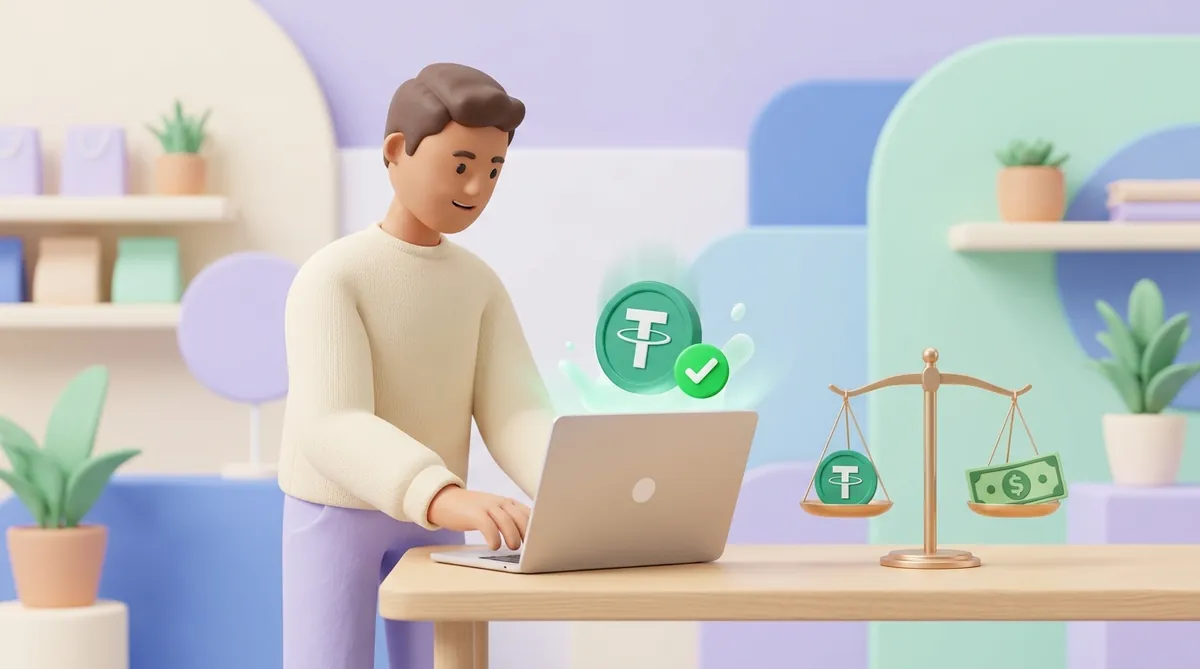
    A shop owner at a laptop as an emerald Tether USDT coin arrives with a green checkmark; on the desk a small scale balances one USDT coin against a dollar bill

    Is Tether safe for a business to hold?

    For taking payments and keeping working balances, USDT has done its job for years. It still carries risks that a bank balance does not, and each of them has a practical answer:

    • The price can slip for a while. In May 2022, during a crypto market crash, USDT briefly traded around 95 cents before returning to a dollar. Money you only hold for a few days is barely exposed; money you park for months is exposed more.
    • Everything rests on one private company. There is no deposit insurance behind USDT. If trust in Tether's reserves broke, the price would fall and you would stand in line with everyone else.
    • Tether can freeze USDT at any address. It does this in cases tied to crime, hacks and sanctions. A merchant who takes an innocent payment from a tainted wallet can get caught in the fallout.

    Because of the last two points, many businesses keep only working capital in USDT and convert the rest on a schedule. If the single issuer is what worries you, it is worth seeing how USDT compares with USDC for business payments.

    Can you accept USDT in the EU?

    In the EU, yes. As of September 2026, the MiCA regulation (Regulation (EU) 2023/1114, fully applicable since 30 December 2024) contains no provision that makes holding or receiving USDT illegal. MiCA regulates the services around crypto, not the act of being paid.

    Three points from it matter to an EU merchant as of September 2026:

    • Stablecoins can be offered and listed only if their issuer is authorised. Under art. 48(1) MiCA, as it stands in September 2026, an e-money token, which is what the regulation calls a stablecoin tied to one currency, may be offered to the public or admitted to trading in the EU only by an authorised issuer.
    • EU platforms dropped USDT in early 2025. USDT's issuer had no MiCA authorisation, so in Q1 2025 regulated EU trading platforms delisted USDT pairs or restricted them. Selling USDT for euros inside the EU became harder, not illegal.
    • A processor that holds and moves your crypto needs a licence. A company that takes USDT into its own wallet, converts it and pays it out provides crypto-asset services under art. 3(1)(16) MiCA, and under art. 59(1) it may do so in the EU only with authorisation. Before you sign with a processor in the EU, ask which authorisation it holds.

    Outside the EU, rules differ by country, and it is worth checking your own before you invoice in USDT.

    The mistakes you cannot undo

    A USDT transfer is final. Nobody can cancel it, and Tether steps in only in cases of crime, not in customer errors. These are the places where money gets lost for good:

    • Wrong network. USDT exists as separate tokens on several networks, such as TRON and Ethereum. A customer who sends it on a network your address does not watch may land the money somewhere you cannot reach.
    • Fake USDT. Anyone can create a token and call it USDT. What counts is the token's contract address, the program behind it, and a good wallet or processor checks that for you; a balance that "arrived" in a fake token is worth nothing.
    • Copying an address from history. Scammers send tiny transfers from addresses that look almost like yours or your supplier's, hoping you will copy the wrong one next time. Always copy an address from its source, never from past transactions.
    • Losing the keys to your own wallet. A self-custody wallet is restored only from its recovery phrase, the list of words it shows at setup. Lose the phrase and the device, and the USDT in it is gone.
    • Taking money from a tainted wallet. A payment from an address tied to fraud can get your balance frozen by Tether or blocked by an exchange. Processors reduce this risk by screening wallets for AML risk before the money reaches you.

    Do you need a payment gateway, or can customers pay straight to your wallet?

    There are two routes, and every method of accepting USDT sits on one of them. Either customers pay straight to your own wallet, or the payment goes through crypto payment processing, a service that sits between the customer and your balance.

    Route one: customers pay straight to your wallet

    You publish or send your wallet address, the customer transfers USDT, and you check the blockchain to see that the money arrived. There is no processor fee. Everything else is on you:

    • Matching payments to orders. If ten customers pay to one address, you see ten transfers and have to work out who paid for what.
    • Wrong amounts. Exchanges take a withdrawal fee, so a customer who sends 100 USDT from an exchange may deliver 99. You decide by hand whether that order counts as paid.
    • Fees for moving your own money. To send USDT onward, your wallet needs the network's own coin: TRX on TRON, ETH on Ethereum. A wallet holding 5,000 USDT and no TRX cannot send a cent.
    • Keeping the keys safe. The recovery phrase is the whole bank; it belongs on paper or a hardware device, not in a screenshot.

    This route suits a business with a few large invoices a month from partners it knows. If you take it, start by picking a crypto wallet that fits your situation.

    Route two: a payment processor

    A processor, also called a payment gateway, gives each payment its own exact amount and address, watches the blockchain, and tells you or your website when the order is paid. It also handles the awkward cases that the own-wallet route leaves to you.

    Inside processing there are several ways to take a payment, and they are ways of the same service, not alternatives to it:

    • A payment link. You create it in the processor's console and send it to the customer in a chat or an invoice. No website code is needed.
    • A button on your site. With an open amount, the customer types the sum, which suits donations and account top-ups. With a fixed amount, your server creates a payment for each order, so the customer pays exactly the order total.
    • An API. Your developers create payments from your own system and receive a notification when each one is paid. This is the route for online shops with their own backend, SaaS products and apps; for the last case, see how crypto payments are built into a mobile app.

    Some customers will also want to pay in bitcoin or another coin, and most processors can take those too. If you plan to go beyond USDT, it helps to know which coins are worth accepting and how to set them up.

    CryptumPay, for example, offers all three ways: payment links from its console, a checkout widget button and an API. With CryptumPay the customer picks the coin and the network in the payment window, and whatever coin they pay in is converted to USDT on arrival, so the merchant's balance is always in USDT. The fee is 1% per successful payment, going down to 0.5% at higher volumes, and it can be passed on to the customer. CryptumPay has no CMS plugins, and a website is needed for the project review.

    A hand holding a phone checkout with the Tether USDT coin and the red TRON network logo selected, a QR code and a pay button below

    Which network should your customers pay in?

    Most USDT moves on two networks:

    • TRON, where the token is called TRC20. It is the common choice for everyday payments, because almost every exchange and wallet supports it. A transfer is cheap only when the sender has energy, a network resource you get by staking or renting TRX; without it, as of September 2026, one USDT transfer burns TRX worth a few dollars.
    • Ethereum, where the token is called ERC20. It is just as widely supported. As of September 2026 the network is mostly quiet and a USDT transfer usually costs cents, but its fees rise when the network is busy.

    A practical rule: accept the networks your customers' wallets and exchanges already use, and name the network on every invoice. How the formats differ in practice, including BEP20 on BNB Chain, is laid out in the business guide to USDT token standards.

    Since TRON carries so many of these payments, it is worth knowing what a USDT TRC20 transfer actually costs and how TRX fees work.

    What does accepting USDT cost?

    The cost of accepting USDT is made of four parts, and which ones you pay depends on the route:

    • The processor's fee. Processors charge a percentage of each successful payment, often lower at higher volumes, and some let you pass it on to the customer. At CryptumPay it is the 1% to 0.5% described above.
    • Network fees. The customer pays the fee for sending you USDT. You pay it again whenever you move USDT out of your own wallet.
    • Conversion. Turning USDT into dollars or euros on an exchange costs a trading fee and a withdrawal fee, and in the EU the choice of venues is narrower since 2025.
    • Your time. On the own-wallet route, matching payments and chasing underpayments is unpaid work that grows with every order.

    To weigh these against what you pay today, it helps to know what drives online payment fees and how businesses cut them.

    The full picture of connecting a gateway, from sign-up to first payout, is in the crypto payments guide for businesses.

    Taking your first USDT payment, step by step

    Whichever route you choose, the first payment is where the mistakes you cannot undo are easiest to avoid:

    1. Choose the route. Pay-to-wallet for a handful of known partners, a processor for a website, a shop or a steady flow of customers.
    2. Decide which networks you accept. Write the network next to the amount on every invoice, for example "100 USDT, TRON (TRC20) only".
    3. Set up where the money lands. For your own wallet, write the recovery phrase on paper and keep a little TRX or ETH for fees; for a processor, register and pass its project review.
    4. Send yourself a test payment of a few dollars. Check that it arrives on the network you expect and that you can move it onward before a customer sends a real sum.
    5. Set a rule for underpayments. Decide in advance whether a payment that arrives a dollar short counts as paid, and tell customers so.
    6. Decide how long you hold USDT. Set a threshold or a schedule for converting it, so your exposure to one issuer stays as small as you want it to be.
    A small business owner sends a test USDT payment from a phone; a Tether coin flies to a laptop showing a green checkmark

    What it comes down to

    USDT is a dollar-pegged token issued by one private company, Tether, and backed by reserves that the company reports on every quarter. It is good at crossing borders fast and holding its price, and it carries the risks of a single issuer, including freezes.

    To accept it, you pick a route that matches how many customers pay you, and you run a small test payment before the first real one. Every mistake you cannot undo happens before the money moves, which is why it is cheaper to prevent than to discover.

    Questions merchants ask about USDT

    Can Tether freeze funds sent to my address?

    Yes. Tether can freeze USDT at any address on the networks where it issues the token, and it does so at the request of law enforcement or for addresses tied to hacks and sanctions. An ordinary merchant is rarely the target; the risk comes from receiving a payment from a wallet that is. Screening incoming payments and not holding large balances for long both reduce the exposure.

    In the United States, freezing is becoming a legal requirement rather than an issuer's policy. Under the GENIUS Act, which applies from 18 January 2027, an approved issuer must be able to freeze coins on a lawful order and must comply. US platforms may offer a foreign issuer's coin only if that issuer can do the same, and Tether is based outside the United States. For a merchant taking USDT, the open question is what the GENIUS Act means for USDT and the businesses that accept it.

    Is there a USDT payment gateway plugin for WordPress?

    Some processors offer plugins for WordPress and WooCommerce, and others do not, so ask before you choose. Without a plugin, a WordPress site can still take USDT through a payment button or a payment link. CryptumPay, for instance, has no CMS plugins and works through links, a widget button and its API.

    Is there an open-source USDT payment gateway?

    Yes, there are open-source gateways you can install on your own server. They save the processor's fee, but you run the server, keep the keys, install updates and handle every stuck payment yourself. That trade-off usually pays off for teams with their own developers and a large, steady volume.

    Is Tether backed by US Treasuries?

    Mostly. Tether's quarterly reports show that the bulk of its reserves sits in short-term US Treasury bills and in repurchase agreements backed by them. Smaller parts are held in gold, bitcoin and secured loans, which are riskier than government debt.

    Does a USDT payment gateway come with an API?

    Most processors offer one. Through an API your system creates a payment for each order, receives a status message when the payment is confirmed, underpaid or expired, and marks the order accordingly. If you have no developers, payment links and a button cover the same need without code.

    This article is general information, not legal or tax advice.

    Start accepting crypto payments

    Create an account and connect the checkout yourself, or talk to sales and we will plan the integration with you.