en

White-Label Crypto Payment Gateway for PSPs: When to Build, Buy, or Use a Hybrid Model

Published
31.05.2026
Updated
31.05.2026
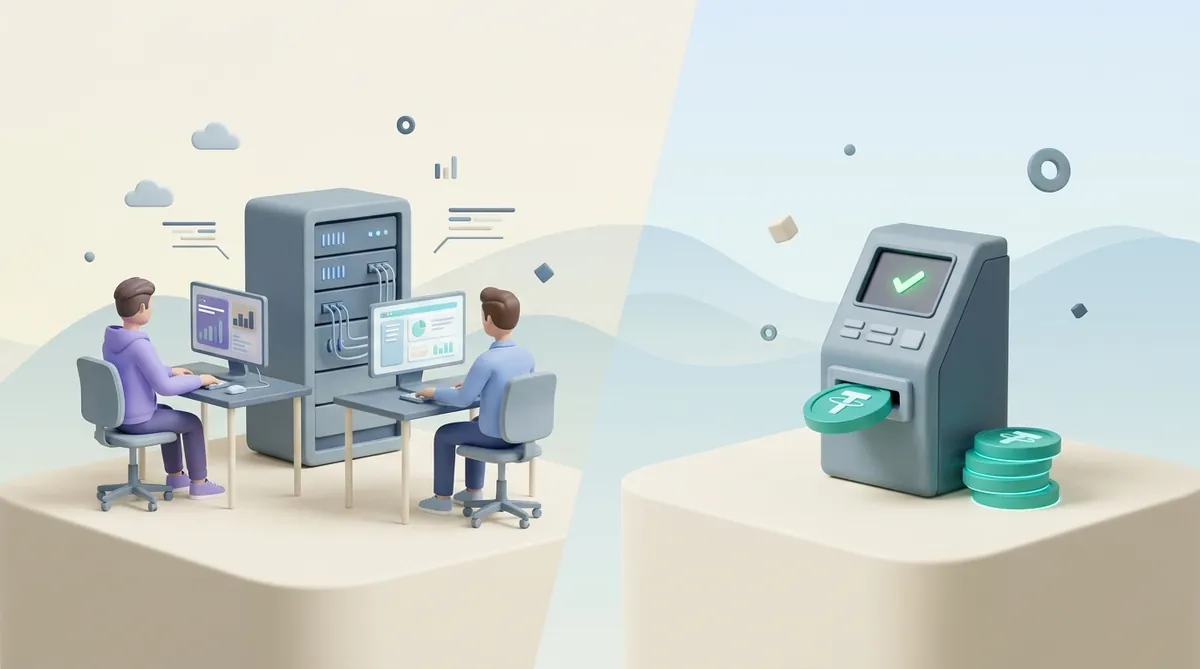
Fintech team comparing custom crypto payment infrastructure with a white-label crypto payment gateway for PSPs

A PSP, or payment service provider, helps businesses accept payments through cards, bank transfers, local payment methods, wallets, and increasingly crypto or stablecoins. For a PSP, adding crypto payments is not the same as adding one more checkout button. It becomes part of the payment product sold to merchants.

Merchants may ask for USDT payments, international checkout options, faster balance top-ups, fewer failed payments, or a way to serve customers who already hold crypto. The PSP has to decide how to support that demand without turning a new payment method into a long infrastructure project.

That decision usually comes down to one question: should the PSP build its own crypto payment infrastructure, or launch with a white-label crypto payment gateway?

There is no universal answer. Building gives more control, but it requires deep technical, security, operational, and compliance work. A white-label solution can speed up launch, but it must be evaluated carefully: brand control, API depth, status logic, settlement, AML checks, reporting, support, and exit options all matter.

This guide breaks down the build vs buy decision for PSPs and fintech platforms.

What a white-label crypto payment gateway means for a PSP

A white-label crypto payment gateway lets a PSP offer crypto payments under its own brand while the underlying infrastructure is provided by a specialist payment provider.

To the merchant, the payment experience can look like part of the PSP’s product: branded payment screens, merchant-facing reporting, payment statuses, support flows, and integration into the existing platform. Behind the scenes, the provider may handle wallet infrastructure, invoice creation, blockchain monitoring, payment confirmation, network support, AML checks, conversion, withdrawals, and API events.

For a PSP, white label is not just a logo on a checkout page. The more important question is what can be controlled, configured, and embedded into the PSP’s own payment stack.

A strong white-label crypto payment gateway should help with:

  • branded crypto checkout or embedded payment flow;
  • invoice or payment request creation;
  • supported cryptocurrencies and networks;
  • USDT payments across different networks;
  • blockchain transaction detection;
  • payment statuses and webhooks;
  • underpayment, overpayment, expired invoice, and late payment logic;
  • AML and risk checks;
  • merchant reporting;
  • wallet and withdrawal workflows;
  • settlement or conversion options;
  • API integration into the PSP’s product.

For a merchant, the main question is “Can I accept crypto?” For a PSP, the question is broader: “Can we offer crypto payments as our own product without losing control of the merchant experience?”

Why PSPs are looking at crypto and stablecoin payments

Crypto payments used to be treated as an experiment. A merchant would add Bitcoin or USDT, test demand, and see what happened. For PSPs, the conversation has become more strategic.

Stablecoins, especially USDT and USDC, are now part of how many digital businesses think about international payments. Merchants serving global customers may want faster settlement, additional payment coverage, fewer card-related restrictions, or a payment method that works for users outside traditional banking rails.

The demand is especially visible in segments such as:

  • SaaS and subscription platforms;
  • marketplaces;
  • iGaming and gaming platforms;
  • VPN and privacy tools;
  • hosting, VPS, and GPU cloud providers;
  • Telegram commerce;
  • digital products and online education;
  • cross-border B2B services;
  • fintech products serving global merchants.

For PSPs, this creates a product opportunity. Crypto payments can become a new payment method, a merchant acquisition tool, a retention feature, or a settlement option. But it also creates a responsibility: once crypto payments are part of the PSP’s offering, merchants will expect the same level of reliability, reporting, and support they expect from other payment methods.

What you need to build if you do it yourself

Building a crypto payment gateway may look simple at the prototype stage. Create a wallet address, show a QR code, wait for a transaction, update the order. That can work for a demo.

A production PSP product is different. It needs to handle edge cases, merchant onboarding, payment statuses, network differences, security controls, withdrawals, reconciliation, and support tickets.

Currency and network support

Supporting crypto payments means supporting more than asset names. BTC, ETH, TRX, BNB, SOL, XRP, MATIC, and USDT all come with different networks, confirmation rules, fee behavior, address formats, and operational risks.

USDT is the clearest example. A customer may think they are paying “USDT,” but USDT can move through TRON, Ethereum, BNB Smart Chain, Polygon, Solana, or another supported network. For a PSP system, these are different payment paths.

If the network logic is unclear, merchants and support teams will see familiar problems:

  • the customer sent USDT on the wrong network;
  • the customer does not have TRX, ETH, BNB, or another native coin for gas;
  • the payment arrived late;
  • the transaction amount does not match the invoice;
  • the payment was detected, but the order status did not update;
  • the merchant cannot reconcile the transaction with the customer account.

If your product mainly accepts USDT, network handling is not a detail. It affects payment success, support workload, and merchant trust. The operational side is covered in more detail in the guide to gasless USDT payments.

Invoice and order logic

A PSP cannot treat crypto payments as isolated wallet transfers. Each payment has to connect to a merchant, customer, order, invoice, subscription, balance top-up, payout, or internal account.

That means your system needs to store and process:

  • merchant ID;
  • customer ID;
  • order ID or invoice ID;
  • expected amount;
  • received amount;
  • pricing currency;
  • payment currency;
  • blockchain network;
  • payment address;
  • invoice expiration time;
  • transaction hash;
  • payment status;
  • fee data;
  • settlement or conversion data.

This matters because support and finance teams should not search for payments by screenshots, wallet addresses, or approximate timestamps. That may work at low volume. It does not scale when a PSP serves many merchants.

Payment statuses and webhooks

Crypto payments are not simply paid or unpaid. A transaction may be detected, waiting for confirmations, confirmed, underpaid, overpaid, expired, late, flagged for review, or unresolved.

A PSP building its own gateway has to decide how each status affects the merchant’s system. Should an order be marked paid after the first confirmation or only after final confirmation? Should a SaaS balance be credited immediately or after a pending state? Should a marketplace allow seller withdrawal right away? What happens when the customer pays after the invoice expires?

The API and webhook model has to be robust. It should support idempotency, retries, signatures, event IDs, and clear status transitions. For technical planning, the crypto payment API checklist is the natural internal reference.

Wallets, keys, and fund movement

Once a PSP handles crypto payments directly, wallet infrastructure becomes a serious operational layer.

The team needs to decide how addresses are generated, where keys are stored, who can access funds, how withdrawals are approved, which limits apply, what happens during incidents, and how every action is logged.

Even if the PSP does not hold funds for long, the platform still needs to know where money is at each stage:

  • awaiting payment;
  • detected on-chain;
  • confirmed;
  • converted;
  • available for withdrawal;
  • withdrawn;
  • blocked for review;
  • unresolved.

This is not just engineering. It involves security, operations, finance, risk, and support.

AML and risk controls

Crypto payments also require risk controls. Depending on the jurisdiction and business model, a PSP may need to consider source-of-funds risk, sanctions exposure, suspicious wallet activity, high-risk transaction patterns, customer due diligence, and merchant-level rules.

A provider can help with infrastructure and screening, but the PSP still needs to understand its role in the payment chain. Who performs AML checks? Who decides whether to block a payment? What data is shown to the merchant? What is logged for future review? What happens when a transaction is flagged?

This is especially important for PSPs serving higher-risk sectors or cross-border merchants. A broad starting point is the guide to secure crypto payments, AML, and KYC.

Reporting and reconciliation

Merchants do not only need to receive crypto. They need to close orders, review fees, export payment records, match transactions to customers, and understand withdrawals.

For a PSP, reporting becomes a product layer. Merchant dashboards, exports, filters, balance views, roles, audit trails, fee breakdowns, and settlement records all matter.

If this layer is weak, crypto payments remain a manual process. That may work for a few merchants, but it creates operational friction as volume grows. CFO and operations teams will care about this from day one, especially if settlement happens in USDT. The finance side is covered in the guide to stablecoin payment operations for CFOs.

What a white-label provider can solve

A white-label crypto payment gateway can reduce the time and complexity required to launch. Instead of building blockchain infrastructure from scratch, the PSP can integrate a provider that already supports networks, payment statuses, risk checks, settlement flows, merchant tools, and checkout logic.

This is useful when crypto payments are an important new product line, but not the PSP’s core technology thesis.

A white-label provider may help with:

  • faster market launch;
  • crypto and stablecoin support;
  • branded payment flows;
  • API or widget integration;
  • blockchain transaction monitoring;
  • payment status updates;
  • webhooks;
  • AML screening;
  • merchant reporting;
  • settlement or conversion;
  • withdrawal workflows;
  • support for common payment errors.

The main advantage is focus. The PSP can spend more time on merchant acquisition, pricing, onboarding, support, product packaging, and market positioning instead of building and maintaining every blockchain layer internally.

But white label does not remove responsibility. The PSP still owns the merchant relationship. If a payment fails, a withdrawal is delayed, or a report is unclear, the merchant will usually blame the PSP, not the hidden infrastructure provider.

That is why the vendor decision must go deeper than “Can we add our logo?”

When building your own infrastructure makes sense

Building your own crypto payment gateway can be the right decision if crypto payments are central to the company’s long-term strategy.

This may be true when the PSP wants to become a specialized crypto or stablecoin infrastructure company, control wallet architecture, design custom risk rules, manage liquidity directly, own settlement logic, or create payment products that cannot be supported by existing providers.

Building is more likely to make sense when the company has:

  • a strong blockchain engineering team;
  • wallet and key management expertise;
  • security and incident response processes;
  • AML and compliance resources;
  • enough transaction volume to justify the investment;
  • a clear need for custom payment logic;
  • a long-term infrastructure roadmap;
  • tolerance for a slower launch;
  • a plan to support multiple networks over time.

The risk is underestimating the real scope. A production crypto payment gateway is not a one-time engineering project. Networks change, fees move, wallet behavior shifts, merchant needs evolve, and support cases reveal edge cases that were not obvious during testing.

If the team only budgets for version one, the internal build may become more expensive than expected.

When a white-label crypto payment gateway makes more sense

A white-label solution is often the better path when the PSP wants to add crypto payments under its own brand, validate merchant demand, and launch without turning the project into a year-long infrastructure build.

It is usually a strong fit when:

  • crypto payments are an extension of the PSP’s current product suite;
  • merchant demand needs to be tested quickly;
  • the PSP does not have a dedicated blockchain infrastructure team;
  • USDT and major networks are more important than custom on-chain logic;
  • the merchant experience must be branded;
  • API, widget, or hosted payment flow options are needed;
  • AML checks and reporting should be available without building them from scratch;
  • the team wants fewer manual payment investigations;
  • speed to market matters.

For an early rollout, the PSP may not need the most complex integration from day one. A hosted flow, widget, or API can be chosen based on merchant needs. The guide to HTML widgets for crypto payments explains when a lighter integration can be enough and when API-level control becomes necessary.

The hybrid model: launch with white label, keep strategic control

The build vs buy decision is not always permanent. Many PSPs can start with a white-label provider and still design their architecture in a way that preserves long-term control.

In a hybrid model, the PSP keeps ownership of:

  • merchant relationships;
  • pricing and contracts;
  • merchant onboarding;
  • merchant IDs and customer IDs;
  • order and invoice logic;
  • internal reporting;
  • support processes;
  • product rules;
  • historical payment data;
  • the option to add another provider later.

The provider handles the crypto payment layer: networks, transaction detection, payment confirmation, AML checks, checkout, and parts of settlement or withdrawal.

This model helps the PSP launch faster while learning from real merchant activity. Which networks are used most? Which sectors adopt USDT fastest? Where do customers fail to pay? What does support need to explain? Which reports do merchants request?

Those answers are hard to predict before launch. A hybrid model gives the PSP data before it commits to building everything internally.

The key is to avoid treating the provider as a black box. The PSP should store its own identifiers, event history, status mapping, and reconciliation records. That way, future migration or multi-provider routing remains possible.

How to compare build, buy, and hybrid options

The decision should be made across several dimensions.

Launch speed

If the PSP needs to test demand quickly, white label usually wins. The team can launch with selected merchants, collect feedback, and refine the offer.

Building internally may be justified if the company can afford a slower launch and needs deep product control from the start.

Product control

Building gives maximum control over networks, fees, statuses, dashboards, risk rules, merchant configuration, settlement logic, and product roadmap.

White label gives control within the provider’s capabilities. That may be enough, but the PSP must check how flexible those capabilities are.

Important questions include:

  • Can the PSP control the payment page branding?
  • Can different merchants have different network settings?
  • Can the provider’s brand be hidden?
  • Can the PSP receive full payment status data?
  • Can payments be linked to internal order and invoice IDs?
  • Can reports be exported?
  • Can the PSP build its own merchant dashboard on top of the provider API?

Economics

White label reduces upfront cost but adds provider fees. Building requires more upfront investment, but may improve margins at scale.

The full cost calculation should include:

  • engineering;
  • security;
  • wallet infrastructure;
  • network monitoring;
  • AML tools;
  • compliance work;
  • support;
  • reporting;
  • maintenance;
  • incident response;
  • future migration costs.

If transaction volume is still uncertain, white label can reduce the risk of overbuilding before demand is proven.

Compliance and risk

Crypto payment requirements depend on jurisdiction, product model, customer type, custody model, and the PSP’s role in the transaction flow. A white-label provider may help with infrastructure and checks, but it does not remove the need for legal and compliance review.

This is especially important in Europe, where stablecoin and crypto-asset service rules have become a major part of provider due diligence. The business context is covered in the guide to stablecoin payments in Europe after MiCA.

Operations

The real test is not the first successful payment. It is everything that happens after volume grows: wrong network payments, missing gas, underpayments, expired invoices, late payments, repeated webhooks, support tickets, suspicious transactions, withdrawal questions, and month-end reconciliation.

If the PSP builds internally, these scenarios must be designed from the start. If it buys, the provider must prove how they handle them. The guide to failed crypto payments is a useful reference for the most common operational issues.

Questions to ask a white-label crypto payment provider

Before signing, a PSP should evaluate the provider across product, API, operations, risk, and exit options.

Branding and merchant experience

Can the payment flow fully match the PSP’s brand? Which elements can be changed: logo, colors, domain, copy, payment instructions, network list, currencies, and redirects?

Can the provider be invisible to the merchant and end customer? Can the PSP create different configurations for different merchants?

Can the payment flow be embedded into the PSP’s platform, merchant dashboard, website, app, or checkout experience?

API and data

Which payment statuses are available? Are webhooks supported? Are webhook events signed? Can events be safely retried? Is idempotency supported?

Can the PSP receive:

  • provider payment ID;
  • merchant ID;
  • customer ID;
  • order ID;
  • invoice ID;
  • expected amount;
  • received amount;
  • payment currency;
  • pricing currency;
  • blockchain network;
  • transaction hash;
  • fee data;
  • timestamps;
  • status history;
  • error reason or review reason?

These fields are not minor technical details. They determine whether the PSP can reconcile payments, support merchants, and automate product logic.

Networks, USDT, and gas

Which assets and networks are supported? Can the PSP limit networks by merchant? How does the checkout explain network choice? What happens if a customer has USDT but no TRX, ETH, BNB, or another native token for gas?

How are underpayments, overpayments, expired invoices, and late payments handled? Can these rules be configured?

For PSPs, this is one of the most important areas to test before launch. A weak network flow creates support tickets, failed payments, and frustrated merchants.

AML, security, and roles

What AML checks are included? What happens when a transaction is flagged? Can rules differ by merchant or transaction size? What data is visible to the PSP? What data is visible to the merchant?

Does the provider support 2FA, role-based access, withdrawal approvals, activity logs, and account security controls?

The PSP should also understand the contract model: who provides which service, who handles which check, and what responsibility remains with the PSP.

Settlement, withdrawals, and reporting

How are merchant balances displayed? Can incoming payments be converted to USDT? Can withdrawals be automated? What withdrawal controls exist? Can merchants export reports? Are fees clearly shown? Is reconciliation possible without manually checking blockchain explorers?

If the PSP serves many merchants, reporting is not an add-on. It is part of the payment product.

Support and reliability

What support channel is available for the PSP? How are incidents reported? What happens if a network is congested? Does the provider help investigate disputed payments? Are there escalation rules?

A provider that can support one merchant may not be ready to support a PSP that serves many merchants. The PSP needs partner-level support, not only end-merchant support.

How to avoid vendor lock-in

White label does not automatically mean lock-in. Lock-in happens when the PSP gives the provider too much control over data, customer logic, and merchant operations.

To reduce the risk, the PSP should keep its own source of truth for:

  • merchant records;
  • customer IDs;
  • order and invoice IDs;
  • pricing and fee logic;
  • status mapping;
  • event logs;
  • payment history;
  • support notes;
  • merchant reporting;
  • reconciliation exports.

The PSP should also check data export options, API documentation, contract terms, and migration processes before going live.

A simple rule helps: buy the infrastructure layer, but keep the business logic. That way, the PSP can start faster without closing the door to future internal infrastructure, a second provider, or a more advanced routing model.

Where CryptumPay fits

CryptumPay can be considered by PSPs and fintech teams that want to add crypto payments to websites, apps, or digital platforms while keeping the payment experience aligned with their own brand. The product supports White Label, API, HTML widget, AML checks, 2FA, merchant account controls, withdrawals, and automatic conversion to USDT.

For a PSP, the value is in the combination of features rather than any single checkbox. The payment flow can support major cryptocurrencies and networks, reduce customer confusion around network fees, connect payment status to product logic, and give merchants a more structured way to accept crypto.

CryptumPay is not a substitute for the PSP’s own legal, compliance, and risk review. It should be evaluated as an infrastructure layer that can shorten launch time and reduce technical complexity while the PSP keeps control over merchants, pricing, support, and product strategy.

A practical first step is to map the PSP’s merchant scenarios: which businesses will use crypto payments, which assets they need, how much branding control is required, what data must stay inside the PSP platform, and which workflows should be automated from day one.

Build, buy, or hybrid: the practical decision

Build if crypto payment infrastructure is the core of your business and you need deep control over wallets, networks, settlement, liquidity, risk rules, and product roadmap.

Buy if crypto payments are an important addition to your PSP product suite, but speed, reliability, and merchant rollout matter more than owning every infrastructure layer.

Use a hybrid model if you want to launch quickly, validate demand, and keep your strategic data and merchant logic inside your own platform.

For many PSPs, the hybrid model is the safest starting point. It avoids a long internal build before demand is proven, but it also avoids treating the provider as a black box.

The best decision is not simply the cheapest one. It is the decision that matches where your PSP creates value. If your advantage is merchant relationships, local markets, payment packaging, support, and distribution, a white-label crypto payment gateway can help you move faster. If your advantage is proprietary crypto infrastructure itself, then building may be worth the cost.

FAQ

What is a PSP?

A PSP, or payment service provider, helps businesses accept payments through different methods such as cards, bank transfers, local payment methods, wallets, and crypto payments. PSPs usually provide technical integration, payment status handling, reporting, and merchant support.

What is a white-label crypto payment gateway?

A white-label crypto payment gateway is a payment solution that lets a PSP or fintech offer crypto payments under its own brand while the underlying infrastructure is handled by a provider.

Is white label only about branding?

No. Branding is only one part. For PSPs, the important parts are API access, payment statuses, network support, merchant reporting, AML checks, settlement, withdrawals, support, and data control.

Can a PSP start with white label and build later?

Yes. Many PSPs can start with a white-label provider, keep their own merchant data and product logic, and later build internal components or add a second provider if volume and strategy justify it.

What should PSPs check first when choosing a provider?

Start with the payment status model, API and webhook quality, branding control, USDT network handling, AML checks, reporting, withdrawal logic, support process, and data export options.

Start accepting payments in cryptocurrencies now

Let's discuss your task in detail and plan the integration
Telegram_icon
form_success_icon
Thank you! We will contact you shortly.

Or write to us via Telegram.
Oops! Something went wrong.
By clicking the button, you agree to provide us with your email for communication purposes